Comparison
Madagascar Sandgrouse vs Black-bellied Sandgrouse
Madagascar Sandgrouse (Pterocles personatus) and Black-bellied Sandgrouse (Pterocles orientalis) both belong to the genus Pterocles (sandgrouse) and part ways below it.
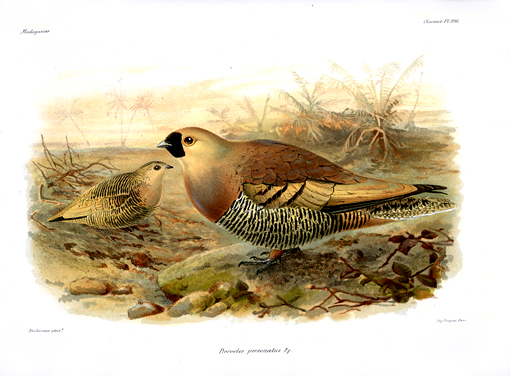
Madagascar Sandgrouse
Pterocles personatus
John Gerrard Keulemans (8 June 1842 - 29 March 1912), Public domain, via Wikimedia Commons


Side by side
| Madagascar Sandgrouse | Black-bellied Sandgrouse | |
|---|---|---|
| Scientific name | Pterocles personatus Gould, 1843 | Pterocles orientalis (Linnaeus, 1758) |
| English name | Madagascar Sandgrouse | Black-bellied Sandgrouse |
| Group | Birds | Birds |
| Class | Aves Bird | Aves Bird |
| Order | Pterocliformes Sandgrouse | Pterocliformes Sandgrouse |
| Family | Pteroclidae Sandgrouse | Pteroclidae Sandgrouse |
| Genus | Pterocles Sandgrouse | Pterocles Sandgrouse |
| Named in | 1843 | 1758 |
| Red List category | Least Concern | Least Concern |
| Countries on record | 1 country | 27 countries |
| GBIF occurrence records | 1,211 records | 39,642 records |
Rows where the two agree are shown in grey.
Where each is found
Only Madagascar Sandgrouse (1)
Only Black-bellied Sandgrouse (27)
- Afghanistan
- Algeria
- Armenia
- Azerbaijan
- China
- Cyprus
- Georgia
- India
- Iran
- Iraq
- Israel
- Jordan
- Kazakhstan
- Kyrgyzstan
- Mongolia
- Morocco
- Pakistan
- Palestinian Territory
- Portugal
- Russia
- Spain
- Syria
- Tajikistan
- Tunisia
- Turkey
- Turkmenistan
- Uzbekistan
From Catalogue of Life checklists and GBIF occurrence records. A country missing from a list means no record is held, which is not proof of absence.
Checked facts
| Madagascar Sandgrouse | Black-bellied Sandgrouse | |
|---|---|---|
| Appearance |
|
|
| Size | No checked fact yet |
|
| Habitat |
|
|
| Diet |
| No checked fact yet |
| Behaviour |
|
|
| Reproduction |
|
|
| Distribution |
|
|
| Conservation |
| No checked fact yet |
| Other |
| No checked fact yet |
In brief
Madagascar Sandgrouse
The Madagascar Sandgrouse is a plump, short-legged bird with a short tail. It is endemic to Madagascar and occurs in the drier southern and western regions of the island. Full profile
Black-bellied Sandgrouse
The nominate subspecies breeds in the Iberian Peninsula, Northwest Africa, the Canary Islands, Turkey, Iran, Cyprus and Palestine, while the eastern subspecies occurs in Kazakhstan, western China and northern Pakistan. The species has a striking black belly, white underwings and a pale breast that contrast with its black wingtips. Full profile
Compare something else
Page built on 28 November 2026 from the data on the two species pages, where every source is listed.
Cite this page
ScientificNames.org. (2026). Madagascar Sandgrouse vs Black-bellied Sandgrouse. Retrieved November 28, 2026, from https://scientificnames.org/compare/madagascar-sandgrouse-vs-black-bellied-sandgrouse
“Madagascar Sandgrouse vs Black-bellied Sandgrouse.” ScientificNames.org, 2026, scientificnames.org/compare/madagascar-sandgrouse-vs-black-bellied-sandgrouse. Accessed 28 Nov. 2026.
ScientificNames.org. “Madagascar Sandgrouse vs Black-bellied Sandgrouse.” Accessed November 28, 2026. https://scientificnames.org/compare/madagascar-sandgrouse-vs-black-bellied-sandgrouse.
@misc{scientificnames_madagascar_sandgrouse_vs_black_bellied_sandgrouse,
  author = {{ScientificNames.org}},
  title = {Madagascar Sandgrouse vs Black-bellied Sandgrouse},
  year = {2026},
  url = {https://scientificnames.org/compare/madagascar-sandgrouse-vs-black-bellied-sandgrouse},
  note = {Accessed 2026-11-28}
}