Comparison
Pumpkin Toadlet vs Brazilian Flea Toad
Pumpkin Toadlet (Brachycephalus ephippium) and Brazilian Flea Toad (Brachycephalus pulex) both belong to the genus Brachycephalus (saddleback toad) and part ways below it.
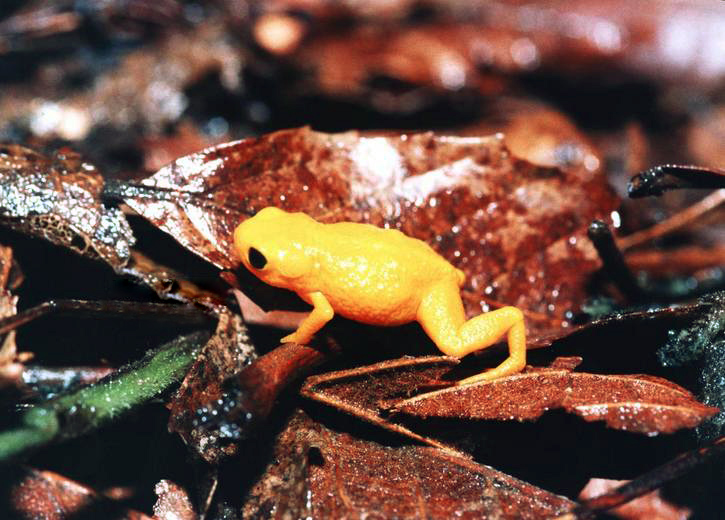
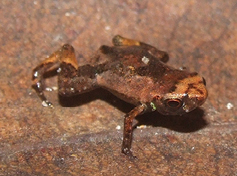


Side by side
| Pumpkin Toadlet | Brazilian Flea Toad | |
|---|---|---|
| Scientific name | Brachycephalus ephippium (Spix, 1824) | Brachycephalus pulex Napoli, Caramaschi, Cruz & Dias, 2011 |
| English name | Pumpkin Toadlet | Brazilian Flea Toad |
| Group | Amphibians | Amphibians |
| Class | Amphibia Amphibians | Amphibia Amphibians |
| Order | Anura Frogs | Anura Frogs |
| Family | Brachycephalidae Shield Toads | Brachycephalidae Shield Toads |
| Genus | Brachycephalus Saddleback Toad | Brachycephalus Saddleback Toad |
| Named in | 1824 | 2011 |
| Red List category | Least Concern | Not recorded |
| Countries on record | 2 countries | Not recorded |
| GBIF occurrence records | 1,007 records | Not recorded |
Rows where the two agree are shown in grey.
Where each is found
Only Pumpkin Toadlet (2)
From Catalogue of Life checklists and GBIF occurrence records. A country missing from a list means no record is held, which is not proof of absence.
Checked facts
| Pumpkin Toadlet | Brazilian Flea Toad | |
|---|---|---|
| Appearance |
|
|
| Size |
|
|
| Habitat |
|
|
| Diet |
| No checked fact yet |
| Behaviour |
|
|
| Reproduction |
| No checked fact yet |
| Distribution |
|
|
| Conservation |
|
|
| Similar species |
| No checked fact yet |
| Other |
| No checked fact yet |
In brief
Pumpkin Toadlet
Brachycephalus ephippium inhabits leaf litter in primary and secondary montane forests of southeastern Brazil. Adults have bright yellow-orange coloration, rounded black eyes and skin with tiny wart-like bumps along the back. Full profile
Brazilian Flea Toad
Brachycephalus pulex has only been recorded from its type locality in the Serra Bonita mountain range in the municipalities of Camacan and Pau Brasil, Bahia, Brazil. It has a slender body, a long narrow head and snout, and is capable of long-distance jumping. Full profile
Compare something else
Page built on 28 November 2026 from the data on the two species pages, where every source is listed.
Cite this page
ScientificNames.org. (2026). Pumpkin Toadlet vs Brazilian Flea Toad. Retrieved November 28, 2026, from https://scientificnames.org/compare/pumpkin-toadlet-vs-brazilian-flea-toad
“Pumpkin Toadlet vs Brazilian Flea Toad.” ScientificNames.org, 2026, scientificnames.org/compare/pumpkin-toadlet-vs-brazilian-flea-toad. Accessed 28 Nov. 2026.
ScientificNames.org. “Pumpkin Toadlet vs Brazilian Flea Toad.” Accessed November 28, 2026. https://scientificnames.org/compare/pumpkin-toadlet-vs-brazilian-flea-toad.
@misc{scientificnames_pumpkin_toadlet_vs_brazilian_flea_toad,
  author = {{ScientificNames.org}},
  title = {Pumpkin Toadlet vs Brazilian Flea Toad},
  year = {2026},
  url = {https://scientificnames.org/compare/pumpkin-toadlet-vs-brazilian-flea-toad},
  note = {Accessed 2026-11-28}
}