Species · Amphibians
Brazilian Flea Toad Brachycephalus pulex
The scientific name of the Brazilian Flea Toad is Brachycephalus pulex. It is a species of amphibian in the family Brachycephalidae (shield toads), order Anura. The name dates from 2011.
- Scientific name
- Brachycephalus pulex Napoli, Caramaschi, Cruz & Dias, 2011
- Common name
- Brazilian Flea Toad
- Genus
- Brachycephalus
- Family
- Brachycephalidae (Shield Toads)
- Order
- Anura
- Class
- Amphibia
- Name status
- accepted in the Catalogue of Life
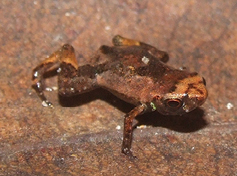
Overview
Brachycephalus pulex has only been recorded from its type locality in the Serra Bonita mountain range in the municipalities of Camacan and Pau Brasil, Bahia, Brazil. It has a slender body, a long narrow head and snout, and is capable of long-distance jumping.
Written 26 November 2026 from the sources listed below. Each statement was checked against the passage it cites; statements that could not be supported were removed.
Appearance
Mature males have an average length of 7.10 millimetres. Females average 8.15 millimetres and are consistently slightly larger than males.[1][2]
An adult specimen was recorded with a snout–vent length of 6.45 millimetres.[3]
Habitat
The Brazilian Flea Toad inhabits mountainous evergreen subtropical to tropical moist montane forests in the Atlantic Forest biome. It occurs at elevations between 220 and 930 metres above sea level.[4][5]
Behaviour
The Brazilian Flea Toad is capable of long-distance jumping. One observed individual feigned death after jumping several times and landing on a leaf.[6][7]
Conservation
The Brazilian Flea Toad has low abundance and declining populations.[8]
Urban expansion, agriculture, and livestock grazing are identified as leading causes of habitat loss affecting the species.[9]
Classification of the Brazilian Flea Toad
| Kingdom | Animalia |
|---|---|
| Phylum | Chordata |
| Subphylum | Vertebrata |
| Infraphylum | Gnathostomata |
| Parvphylum | Osteichthyes |
| Megaclass | Tetrapoda |
| Class | Amphibia (Amphibians) |
| Order | Anura (Frogs) |
| Superfamily | Brachycephaloidea |
| Family | Brachycephalidae (Shield Toads) |
| Genus | Brachycephalus (Saddleback Toad) |
| Species | Brachycephalus pulex Napoli, Caramaschi, Cruz & Dias, 2011 |
Origin of the name. Etymology. The specific name (pulex), a noun in apposition, refers to the flea, Pulex irritans, and is allusive to the small size and to the striking capacity for large leaps presented by the new species. Geographic distribution and Natural History. Brachycephalus pulex is only known from the type locality, a forest remnant located in a mountain range regionally named Serra Bonita, with elevations ranging from 200 to 950 m above sea level, which leads to altitudinal changes in the vegetation, from evergreen forest with elements of moist lowland semi-deciduous forest, to moist submontane forest near the summits. The Serra Bonita mountain range lies in the municipalities of Camacan and Pau Brasil, in the State of Bahia, Brazil, and is one of the last remnants of moist submontane forest in the region. It covers an area of approximately 7,500 hectares, 130 km from the city of Ilheus on the Atlantic coast and 526 km from the State capital of Salvador. Approximately 50 % of the land cover is primary forest, and the remaining is a mosaic of forests in advanced stages of recuperation mixed with ' cabruca' (cocoa trees planted under natural forest canopy) and small areas of pasture. In the Serra Bonita there are several springs that provide fresh water for the inhabitants of Camacan and Pau Brasil. Brachycephalus pulex was captured within the Serra Bonita Reserve Complex (SBR), a Private Natural Heritage Reserve (RPPN), which comprises ca. 1,800 hectares of a " consortium " of privately owned properties (Instituto Uiracu 2009). This is the first record of a Brachycephalus for the State of Bahia and the northernmost record for the coastal Atlantic Forest (but see below). FIGURE 3. Living adult specimen of Brachycephalus pulex sp. nov., paratopotype, MZUESC 8604, from the Serra Bonita mountain, Municipality of Camacan, State of Bahia, Brazil; SVL 8.4 mm (Photos by Iuri R. Dias, 27 July 2010). The new species was captured in a primary forest remnant provided with streams near the top of the mountain (800 - 930 m a. s. l.), within an area of dense leaf litter and several epiphytic bromeliads. At the time of specimens capture (December 2009 to July 2010), the minimum mean air temperature was 16.9 ºC (12 - 20 ºC), the maximum 23.9 ºC (20 - 28 ºC), and the average monthly precipitation was 188.6 mm (22.5 - 315 mm). The specimens were captured beneath the leaf litter, except by one individual that was on a tree trunk 30 cm above the ground. One specimen when disturbed during the survey of anurans jumped away many times quickly and stopped over a dry leaf, remaining immovable (deaf feigning) even after we raise the leaf. This behavior was also observed for both juvenile paratypes. No vocalization was heard, although the advertisement call of the closely allied B. hermogenesi has been recorded and described by Verdade et al. (2008), and also for B. ephippium (Pombal et al. 1994).
Common names
English
- Brazilian Flea Toad
- Flea Toad
- Serra Bonita Flea Toad
Related species
-
 Pumpkin ToadletBrachycephalus ephippium
-
 Brachycephalus dacnis
-
 Brazilian Gold FrogBrachycephalus didactylus
-
 Pumpkin ToadletBrachycephalus pitanga
- Morro Anhangava Flea ToadBrachycephalus pernix
-
 Pico Caratuva Flea ToadBrachycephalus brunneus
-
 Vargem Alta Flea ToadBrachycephalus alipioi
-
 Pedra Da Tartaruga Flea ToadBrachycephalus auroguttatus
Compare
Questions and answers
What is the scientific name of the Brazilian Flea Toad?
The scientific name of the Brazilian Flea Toad is Brachycephalus pulex. Written with its author, the full name is Brachycephalus pulex Napoli, Caramaschi, Cruz & Dias, 2011.
Which family does the Brazilian Flea Toad belong to?
Brachycephalus pulex belongs to the family Brachycephalidae, in the order Anura and the class Amphibia.
What other names does the Brazilian Flea Toad have?
Brachycephalus pulex is also known in English as Flea Toad and Serra Bonita Flea Toad.
Where do Brazilian flea toads live?
The Brazilian Flea Toad has only been recorded from its type locality in the Serra Bonita mountain range in the municipalities of Camacan and Pau Brasil, Bahia, Brazil. It inhabits mountainous evergreen subtropical to tropical moist montane forests in the Atlantic Forest biome, at elevations between 220 and 930 metres above sea level.[4][5][10][11]
Sources
Passages the profile rests on
- Mature males have an average length of 7.10 millimetres. Source passage: “Mature males exhibit an average length of 7.10 millimetres (0.280 in)” — English Wikipedia
- Females have an average length of 8.15 millimetres and are consistently slightly larger than males. Source passage: “females are consistently slightly larger, with an average length of 8.15 millimetres (0.321 in).” — English Wikipedia
- An adult specimen was recorded with a snout–vent length of 6.45 millimetres. Source passage: “one adult specimen had a snout–vent length of 6.45 millimetres (0.254 in).” — English Wikipedia
- The species inhabits mountainous evergreen subtropical to tropical moist montane forests in the Atlantic Forest biome. Source passage: “It lives in mountainous evergreen subtropical to tropical moist montane forests in the Atlantic Forest biome” — English Wikipedia
- The species occurs at elevations between 220 and 930 metres above sea level. Source passage: “ranging from an elevation of 220–930 metres (720–3,050 ft) above sea level.” — English Wikipedia
- The species is capable of long-distance jumping. Source passage: “Because of its developed hind limbs, Brachycephalus pulex is capable of long-distance jumping.” — English Wikipedia
- One observed individual feigned death after jumping several times and landing on a leaf. Source passage: “one specimen feigned death after jumping several times and landing on a leaf.” — English Wikipedia
- The species has low abundance and declining populations. Source passage: “There is a low abundance of this species, and populations are decreasing in numbers due to habitat loss.” — English Wikipedia
- Urban expansion, agriculture, and livestock grazing are identified as leading causes of habitat loss affecting the species. Source passage: “urban expansion, agriculture, and livestock grazing as the leading causes for habitat loss” — English Wikipedia
- The species has only been recorded from its type locality. Source passage: “Brachycephalus pulex has only been found in the type locality.” — English Wikipedia
- The type locality is in the Serra Bonita mountain range in the municipalities of Camacan and Pau Brasil, Bahia, Brazil. Source passage: “in the Serra Bonita mountain range in the Camacan and Pau Brasil municipalities of Bahia, Brazil.” — English Wikipedia
Data
- Catalogue of Life, 2026-10-16 XR cc by
- Wikidata CC0
- Wikimedia Commons per image; credit shown with each image
- Within the Catalogue of Life, this name comes from The Integrated Taxonomic Information System cc0
References
- A new species of flea-toad, genus Brachycephalus Fitzinger (Amphibia: Anura: Brachycephalidae), from the Atlantic rainforest of southern Bahia, Brazil. (2011). Zootaxa, 2739, 33–40. https://doi.org/10.11646/zootaxa.2739.1.3 Link where the name was published
This species in other databases
Page built on 27 November 2026. See how the catalog is made and all sources and licences.
Cite this page
ScientificNames.org. (2026). Brachycephalus pulex (Brazilian Flea Toad). Retrieved November 27, 2026, from https://scientificnames.org/species/brachycephalus-pulex
“Brachycephalus pulex (Brazilian Flea Toad).” ScientificNames.org, 2026, scientificnames.org/species/brachycephalus-pulex. Accessed 27 Nov. 2026.
ScientificNames.org. “Brachycephalus pulex (Brazilian Flea Toad).” Accessed November 27, 2026. https://scientificnames.org/species/brachycephalus-pulex.
@misc{scientificnames_brachycephalus_pulex_brazilian_flea_toad,
  author = {{ScientificNames.org}},
  title = {Brachycephalus pulex (Brazilian Flea Toad)},
  year = {2026},
  url = {https://scientificnames.org/species/brachycephalus-pulex},
  note = {Accessed 2026-11-27}
}