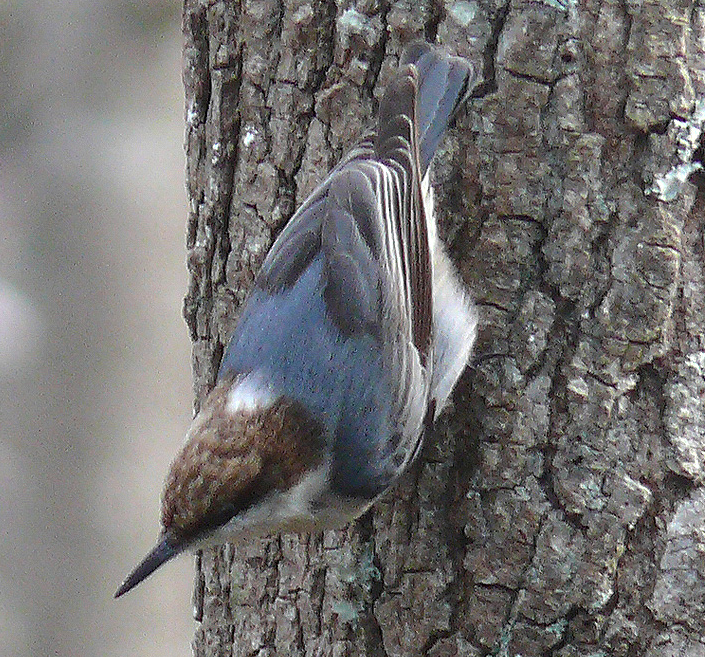
| Appearance | - The Pygmy Nuthatch has a warm gray cap, blue-gray upperparts, and whitish underparts. English Wikipedia
- The species has a whitish spot on the nape that is particularly noticeable in worn summer plumage. English Wikipedia
- The species displays a white subterminal band on its tail during flight. English Wikipedia
- Male Pygmy Nuthatches have a grayish-brown crown, a black eye stripe, and a white line above the eyes. animaldiversity.org
- Male Pygmy Nuthatches have bluish-gray backs and central tail feathers, reddish-brown underbellies, and white spots on their outer tail feathers. animaldiversity.org
- Female Pygmy Nuthatches have a bluish-gray crown and generally paler underparts than males. animaldiversity.org
| - The species has a brown cap, a narrow black eyeline, buff-white cheeks, a chin and belly, and bluish-gray wings. English Wikipedia
- Males and females have similar body sizes and coloration. animaldiversity.org
- Juveniles resemble adults in both coloration and size. animaldiversity.org
|
|---|
| Size | | |
|---|
| Habitat | - Pygmy Nuthatches commonly inhabit long-needle pine forests, particularly those containing ponderosa, Monterey, and Jeffrey pines. animaldiversity.org
- The species reaches its highest densities in undisturbed old-growth forests containing numerous dead pine trees. animaldiversity.org
- Pygmy Nuthatches occupy valleys and mountainous habitats extending to the tree line where old-growth pine trees are abundant. animaldiversity.org
- Breeding habitat in the Guadalupe Mountains includes ponderosa pine stands mixed with oak or Douglas fir at elevations of approximately 2,300–2,600 m. txtbba.tamu.edu
- In Arizona, 92% of recorded breeding occurred in habitats containing ponderosa pine. txtbba.tamu.edu
- In Colorado, 93% of atlas observations were recorded in coniferous forests. txtbba.tamu.edu
| - The species typically inhabits open, mature pine stands with sparse understory vegetation. animaldiversity.org
- Areas subject to frequent prescribed burns provide suitable habitat by maintaining open understories and creating nesting snags. animaldiversity.org
- The species is generally found at elevations below 700 metres. animaldiversity.org
- The species is associated with forests, woodlands, shrublands, savannas, and thickets. audubon.org
- Pine forests provide the species with both food and shelter. nps.gov
|
|---|
| Diet | - During breeding, insects account for approximately 60–85% of the Pygmy Nuthatch diet. animaldiversity.org
- The species consumes beetles, wasps, ants, and caterpillars during the breeding season. animaldiversity.org
- Pine seeds and other plant materials supplement the insect component of the diet. animaldiversity.org
- Pygmy Nuthatches forage on pine bark and needles for weevils and bark and needle beetles. txtbba.tamu.edu
- Pine seeds constitute another important food source for the species. txtbba.tamu.edu
| - The species eats both seeds and insects. nps.gov
- Pine seeds become a more important food source during winter when insect activity decreases. nps.gov
- The species consumes more insects during warmer months when insects are abundant. nps.gov
- The species is particularly attracted to sunflower seeds and suet cakes at feeding stations. English Wikipedia
|
|---|
| Behaviour | - Pygmy Nuthatches forage acrobatically in the foliage of coniferous trees. English Wikipedia
- The species is highly gregarious and forms noisy flocks outside the breeding season. English Wikipedia
- Pygmy Nuthatches roost communally, with more than 100 individuals sometimes occupying one tree cavity. English Wikipedia
- Pygmy Nuthatches move headfirst when climbing both upward and downward on trees. animaldiversity.org
- The species generally makes short flights between trees rather than flying for extended periods. animaldiversity.org
- Pygmy Nuthatches do not migrate. animaldiversity.org
- The species commonly bathes in pools of rainwater and melted snow. animaldiversity.org
- Pygmy Nuthatches sometimes lower their body temperature and metabolic rate during sleep to conserve energy. animaldiversity.org
- During breeding, Pygmy Nuthatches aggressively defend their territories against other birds and organisms. animaldiversity.org
| - The species uses pieces of bark, small twigs, and pine needles as tools when searching for insects. English Wikipedia
- Individuals use loose bark as wedges to remove additional pieces of bark and expose insects. animaldiversity.org
- Individuals wedge seeds into bark depressions and crack them by hammering with their beaks. animaldiversity.org
- The species travels in single-species flocks of four to five birds during the breeding season. animaldiversity.org
- During the non-breeding season, individuals travel in mixed-species flocks containing eight to twenty birds. animaldiversity.org
- The species is bold, inquisitive, and readily approachable by humans. English Wikipedia
- The species is the only member of the family Sittidae documented using tools. animaldiversity.org
|
|---|
| Reproduction | - Pygmy Nuthatches generally form monogamous pair bonds that persist throughout the year. animaldiversity.org
- Male Pygmy Nuthatches court females by bringing them food before mating. animaldiversity.org
- Male and female Pygmy Nuthatches cooperate in nest construction during a courtship period lasting three to six weeks. animaldiversity.org
- Pygmy Nuthatches frequently use previously constructed nests and cavities made by other organisms. animaldiversity.org
- Pygmy Nuthatches nest in cavities in dead conifer stubs, lining the cavity floor with pine cone scales and other soft materials. English Wikipedia
- Pygmy Nuthatches may fill cracks and crevices around nest entrances with fur. English Wikipedia
- Female Pygmy Nuthatches typically lay seven eggs, with reported clutch sizes ranging from five to nine. txtbba.tamu.edu
- Pygmy Nuthatch eggs are white and marked with chestnut-red or purplish-brown spots. animaldiversity.org
- Female Pygmy Nuthatches incubate their eggs for approximately 15 days. txtbba.tamu.edu
- Young Pygmy Nuthatches leave the nest between 14 and 22 days after hatching. txtbba.tamu.edu
- Brood helpers participate in raising young at as many as 40% of Pygmy Nuthatch nests. txtbba.tamu.edu
- Pygmy Nuthatch pairs usually produce one clutch per breeding season. txtbba.tamu.edu
- Young Pygmy Nuthatches become capable of reproduction at one year of age. animaldiversity.org
| - Brown-headed Nuthatches are cooperative breeders, with groups of two to five adults participating in raising young. animaldiversity.org
- Cooperative breeding groups include one to three helper birds in addition to the breeding pair. animaldiversity.org
- Nest construction generally begins in February. animaldiversity.org
- Nests are commonly located in snags, birdhouses, or abandoned woodpecker cavities. animaldiversity.org
- Nest entrances are usually less than 2.5 cm in diameter. animaldiversity.org
- The nest cavity is at least 30 cm deep and less than three metres above the ground. animaldiversity.org
- Females generally lay four to eight eggs per brood between March and July. animaldiversity.org
- Nestlings remain in the nest for approximately 17 to 19 days after hatching. animaldiversity.org
- Young birds fledge approximately 18 to 19 days after hatching. animaldiversity.org
- Most adults produce only one clutch of eggs annually. nps.gov
- Females lay an average of four to six eggs per nest. nps.gov
|
|---|
| Distribution | - Pygmy Nuthatches occur from southern British Columbia through western North America to central Mexico. English Wikipedia
- The species occurs as far east as central Montana and Colorado. animaldiversity.org
- The species occurs from the Pacific Coast to western Montana, the Black Hills of South Dakota, western Nebraska, Colorado, and New Mexico. txtbba.tamu.edu
| - The Brown-headed Nuthatch is endemic to pine forests throughout the southeastern United States. English Wikipedia
- The species occurs as far north as Virginia, as far west as Texas, and as far south as southern Florida. animaldiversity.org
- A small, declining population occurs on the Grand Bahama Islands. animaldiversity.org
- The species occurs along the coastal states of the southeastern United States from North Carolina to Texas. nps.gov
|
|---|
| Conservation | - The Wyoming Natural Diversity Database assigns the Pygmy Nuthatch a state conservation rank ranging from S2 (Imperiled) to S3 (Vulnerable). wgfd.wyo.gov
| - The species is classified as a Species of Conservation Concern by the Missouri Department of Conservation. mdc.mo.gov
|
|---|
| Similar species | - The Brown-headed Nuthatch is a close relative of the Pygmy Nuthatch and breeds in eastern Texas. txtbba.tamu.edu
- The Brown-headed Nuthatch differs from the Pygmy Nuthatch by having an orangey-brown rather than grayish cap, a more conspicuous white nape spot, and less white on the tail. English Wikipedia
| - The Brown-headed Nuthatch is approximately the same size as the Pygmy Nuthatch, and both are identified as the world's smallest nuthatches. English Wikipedia
- The Brown-headed Nuthatch overlaps geographically with Red-breasted and White-breasted Nuthatches, which are larger and differently marked. English Wikipedia
|
|---|
| Other | No checked fact yet | - The Bahama Nuthatch was formerly classified as a subspecies of the Brown-headed Nuthatch but is now recognized as a separate species. English Wikipedia
|
|---|