Comparison

Red Salamander vs Texas Blind Salamander

Red Salamander (Pseudotriton ruber) and Texas Blind Salamander (Eurycea rathbuni) both belong to the subfamily Hemidactyliinae and part ways below it. Both are recorded in 1 country.

Red Salamander

Red Salamander

Pseudotriton ruber

Peter Paplanus, CC BY 2.0, via Wikimedia Commons

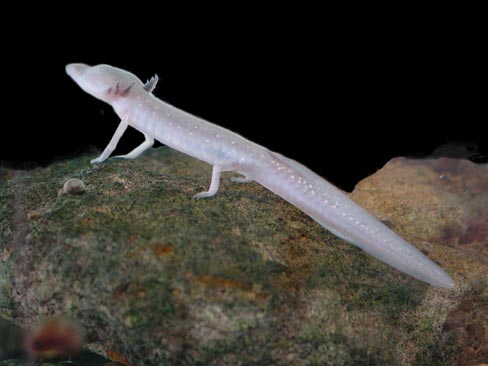
Texas Blind Salamander

Texas Blind Salamander

Eurycea rathbuni

Photograph courtesy of Joe N. Fries, U.S. Fish and Wildlife Service, Public domain, via Wikimedia Commons

Side by side

Red SalamanderTexas Blind Salamander
Scientific namePseudotriton ruber (Sonnini de Manoncourt & Latreille, 1801)Eurycea rathbuni (Stejneger, 1896)
English nameRed SalamanderTexas Blind Salamander
GroupAmphibiansAmphibians
ClassAmphibia AmphibiansAmphibia Amphibians
OrderCaudata SalamandersCaudata Salamanders
FamilyPlethodontidae Lungless SalamandersPlethodontidae Lungless Salamanders
GenusPseudotriton Mud SalamandersEurycea Brook Salamander
Named in18011896
Red List categoryLeast ConcernCritically Endangered
Environmentfreshwater, terrestrialNot recorded
Countries on record1 country1 country
GBIF occurrence records18,410 records388 records

Rows where the two agree are shown in grey.

Where each is found

Both recorded in 1 country

From Catalogue of Life checklists and GBIF occurrence records. A country missing from a list means no record is held, which is not proof of absence.

Checked facts

Red SalamanderTexas Blind Salamander
Appearance
  • Larvae have stout heads and bodies, dark coloration, and distinctive mottling or streaks. English Wikipedia
  • Larvae have purplish-brown upper surfaces and yellowish undersides with black spots. animaldiversity.org
Size
Habitat
  • Adults and larvae occupy temperate forests, small creeks, bogs, ponds, intermittent streams, and freshwater springs. English Wikipedia
  • The species occupies moist environments beneath moss and stones near streams and springs. English Wikipedia
  • Red salamanders are generally associated with smaller water sources rather than large streams. English Wikipedia
  • The species occurs in slow-moving cold streams and springs at elevations from sea level to approximately 1,500 m. animaldiversity.org
  • The species inhabits underground streams and deep pools in caves. English Wikipedia
  • Its underground pools are generally cool, measuring approximately 21–22 °C. English Wikipedia
  • It inhabits underground water-filled caves in the Edwards Aquifer. tpwd.texas.gov
  • The species is usually restricted to caves, although it has also been found in wells. animaldiversity.org
Diet
  • The species consumes insects, earthworms, spiders, small crustaceans, snails, and smaller salamanders. English Wikipedia
  • Larvae consume Chironomidae, Sphaeriidae, terrestrial prey, and other salamanders. English Wikipedia
  • The species captures prey by extending its tongue and retracting it into its mouth. English Wikipedia
  • Its diet includes blind shrimp, snails, and amphipods. English Wikipedia
  • Tiny snails, shrimp, and other aquatic invertebrates form its diet. tpwd.texas.gov
  • Its diet varies according to the food material flowing into its cave habitat. English Wikipedia
Behaviour
  • Red salamanders are primarily nocturnal. amphibiaweb.org
  • During daylight hours, individuals remain beneath cover or inside burrows. amphibiaweb.org
  • Adults migrate from streams into terrestrial habitats during spring and return to aquatic streams in late summer or fall. animaldiversity.org
  • During winter, individuals may become difficult to locate, suggesting seasonal hibernation. animaldiversity.org
  • When threatened, individuals curl their bodies and position their heads beneath their elevated, undulating tails. English Wikipedia
  • Skin secretions make red salamanders unpalatable to predators. English Wikipedia
  • The species hunts by moving its head from side to side while searching the bottom for food. tpwd.texas.gov
  • It detects prey by sensing water-pressure waves in underground water. tpwd.texas.gov
  • The species is neotenic and retains external gills throughout its life. animaldiversity.org
Reproduction
LifespanNo checked fact yet
DistributionNo checked fact yet
Conservation
  • The species is generally common and widespread but has experienced local declines associated with habitat loss. English Wikipedia
  • The species is listed as endangered in Indiana. English Wikipedia
  • Habitat pollution and sediment accumulation are identified as potential threats to the species. English Wikipedia
  • The species was listed as endangered on March 11, 1967. English Wikipedia
  • The species is listed as endangered under the U.S. Endangered Species Act. animaldiversity.org
  • Groundwater pumping for commercial or domestic purposes threatens the species by increasing its vulnerability to predators and potentially causing extinction. English Wikipedia
  • Stormwater runoff and chemical spills are sources of pollution affecting the Edwards Aquifer. English Wikipedia
  • Urban growth, water overuse, and pollution threaten the species' survival. tpwd.texas.gov
  • The species depends on a continuous supply of clean, cool water from the Edwards Aquifer. tpwd.texas.gov
UsesNo checked fact yet
Similar species
  • The mud salamander is the species most similar in appearance to the red salamander. English Wikipedia
  • The red salamander can be distinguished from the mud salamander by its yellow or gold-colored iris and longer snout. animaldiversity.org
  • The Texas blind salamander resembles the European olm. English Wikipedia
  • Unlike the olm, it has four digits on its front limbs and five on its back limbs. English Wikipedia
OtherNo checked fact yet

In brief

Red Salamander

Pseudotriton ruber is endemic to the eastern United States, where it occupies temperate forests, small creeks, bogs, ponds, intermittent streams, and freshwater springs. Full profile

Texas Blind Salamander

Eurycea rathbuni inhabits underground water-filled caves in the Edwards Aquifer. It has vestigial eyes covered by skin, red external gills, and a white body with little skin pigment. Full profile

Compare something else

Page built on 27 November 2026 from the data on the two species pages, where every source is listed.

Cite this page

ScientificNames.org. (2026). Red Salamander vs Texas Blind Salamander. Retrieved November 27, 2026, from https://scientificnames.org/compare/red-salamander-vs-texas-blind-salamander