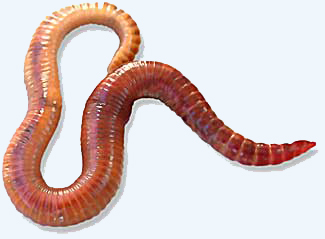
| Appearance | - The worm has a reddish-brown body with small rings and a yellowish tail. English Wikipedia
- The worm has groups of bristles called setae on each body segment. English Wikipedia
| - Eisenia andrei has a darker coloration and less pronounced stripes than Eisenia fetida. English Wikipedia
- The embryos of Eisenia andrei develop at least two distinct muscle groups that cross the ventral midline and initially extend toward the embryo's lateral side. English Wikipedia
|
|---|
| Habitat | - The species inhabits decaying organic material, including rotting vegetation, compost, and manure. English Wikipedia
- The species is epigean and is rarely found in soil. English Wikipedia
- The species generally lives just below the surface to avoid light. English Wikipedia
- The species is naturally found in moist, organic-rich environments such as livestock manure and beneath woodland logs. composting.ces.ncsu.edu
- Individuals outside composting bins may live beneath rocks, pots, leaves, and mulch. ucanr.edu
- The species thrives in aerobic environments. extension.oregonstate.edu
- The species can be maintained in worm bins at temperatures between 55°F and 77°F. extension.oregonstate.edu
- The species requires a bin environment between 59°F and 77°F for active feeding and reproduction. composting.ces.ncsu.edu
| - Eisenia andrei primarily inhabits compost and leaf litter rather than mineral soils. English Wikipedia
- Eisenia andrei is identified as suitable for vermicomposting systems. depts.washington.edu
- The Eisenia andrei specimens used in a New Zealand study were farmed in soil. pmc.ncbi.nlm.nih.gov
|
|---|
| Diet | - The species consumes decaying organic matter. ucanr.edu
- The species can consume most organic materials that are not high in salts or ammonia. composting.ces.ncsu.edu
- The species may consume between 25% and 35% of its body weight daily. composting.ces.ncsu.edu
- The species consumes cardboard and the glue holding its layers together. ucanr.edu
- The species generally avoids dairy products and meat. ucanr.edu
| - The Eisenia andrei specimens used in a New Zealand study were fed vegetable kitchen scraps and eggshells. pmc.ncbi.nlm.nih.gov
|
|---|
| Behaviour | | No checked fact yet |
|---|
| Reproduction | - Each individual can produce approximately three cocoons per week under ideal conditions. English Wikipedia
- Each cocoon may contain between one and nine fertilized eggs. English Wikipedia
- At 25°C, individuals hatch from their cocoons in approximately three weeks. English Wikipedia
- Each egg capsule typically produces an average of three offspring, with a reported range of two to seven. composting.ces.ncsu.edu
- Egg capsules hatch in approximately two weeks according to the Napa Master Gardener account. ucanr.edu
- A juvenile can become reproductively mature and produce offspring within three months. ucanr.edu
- Eight individuals can produce approximately 1,500 adults within six months. ucanr.edu
| |
|---|
| Distribution | No checked fact yet | - The Eisenia andrei specimens evaluated in a nutritional study were sourced in New Zealand. pmc.ncbi.nlm.nih.gov
|
|---|
| Uses | - The species is used to convert domestic and industrial organic waste into compost through vermicomposting. English Wikipedia
- The species is used in vermicomposting systems that process blackwater on site. English Wikipedia
- The species is widely used as fishing bait for tench, bream, and roach. English Wikipedia
- The species is used to produce nutrient-rich compost from food waste and other organic materials. extension.oregonstate.edu
| - Eisenia andrei has been used in the animal feed sector as a protein source for fish, chickens, rabbits, and pigs. pmc.ncbi.nlm.nih.gov
- Eisenia andrei powder contained 53.75% protein on a dry-weight basis in a nutritional study. pmc.ncbi.nlm.nih.gov
- Eisenia andrei powder contained 19.30% fat on a dry-weight basis in a nutritional study. pmc.ncbi.nlm.nih.gov
- Eisenia andrei powder contained 23.26% carbohydrates on a dry-weight basis in a nutritional study. pmc.ncbi.nlm.nih.gov
- The mineral analysis of Eisenia andrei powder identified 11 essential minerals, 23 non-essential minerals, and four heavy metals. pmc.ncbi.nlm.nih.gov
- Potassium and phosphorus were each present at 8220 mg per kg of dry weight in the analyzed Eisenia andrei powder. pmc.ncbi.nlm.nih.gov
- The analyzed Eisenia andrei powder contained 744.7 mg of magnesium per kg of dry weight. pmc.ncbi.nlm.nih.gov
- The analyzed Eisenia andrei powder contained 2396.7 mg of calcium per kg of dry weight. pmc.ncbi.nlm.nih.gov
- The analyzed Eisenia andrei powder contained 244.7 mg of iron per kg of dry weight. pmc.ncbi.nlm.nih.gov
- The analyzed Eisenia andrei powder contained 25.6 mg of manganese per kg of dry weight. pmc.ncbi.nlm.nih.gov
- The analyzed Eisenia andrei powder contained cadmium at 2.2 mg per kg of dry weight. pmc.ncbi.nlm.nih.gov
- The analyzed Eisenia andrei powder contained arsenic at 2.3 mg per kg of dry weight. pmc.ncbi.nlm.nih.gov
- Linoleic acid accounted for 7.96% of the fatty acids in the analyzed Eisenia andrei powder. pmc.ncbi.nlm.nih.gov
- The protein extract from Eisenia andrei powder had an isoelectric pH of approximately 5. pmc.ncbi.nlm.nih.gov
- The protein extract from Eisenia andrei powder exhibited a foaming capacity of 83.3%. pmc.ncbi.nlm.nih.gov
- The protein extract from Eisenia andrei powder had an emulsion stability of 88.8% after 60 minutes. pmc.ncbi.nlm.nih.gov
- The protein extract from Eisenia andrei powder exhibited greater heat coagulation at pH 7.0 than at pH 5.0. pmc.ncbi.nlm.nih.gov
|
|---|
| Similar species | - Eisenia andrei is closely related to Eisenia fetida. English Wikipedia
- Eisenia fetida can be lighter in colour than Eisenia andrei, although morphology is not a reliable identification method. English Wikipedia
| - Eisenia andrei is closely related to Eisenia fetida, which is also known as the brandling or tiger worm. English Wikipedia
|
|---|
| Other | No checked fact yet | - Molecular analyses based on protein isoform electrophoresis confirmed Eisenia andrei as a separate species in the mid-1980s. English Wikipedia
- Eisenia andrei is frequently misidentified as Eisenia fetida. English Wikipedia
|
|---|