Comparison
Rhaphiolepis integerrima vs Indian Hawthorn
Rhaphiolepis integerrima (Rhaphiolepis integerrima) and Indian Hawthorn (Rhaphiolepis indica) both belong to the genus Rhaphiolepis and part ways below it. Both are recorded in 2 countries.
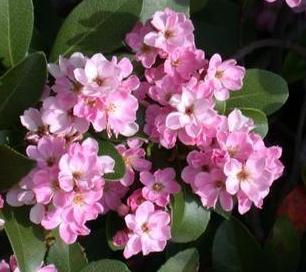

Side by side
| Rhaphiolepis integerrima | Indian Hawthorn | |
|---|---|---|
| Scientific name | Rhaphiolepis integerrima Hook. & Arn. | Rhaphiolepis indica (L.) Lindl. |
| English name | Not recorded | Indian Hawthorn |
| Group | Flowering plants | Flowering plants |
| Class | Magnoliopsida | Magnoliopsida |
| Order | Rosales | Rosales |
| Family | Rosaceae Rose Family | Rosaceae Rose Family |
| Genus | Rhaphiolepis | Rhaphiolepis |
| Red List category | Not recorded | Least Concern |
| Countries on record | 2 countries | 14 countries |
| GBIF occurrence records | 172 records | 7,854 records |
Rows where the two agree are shown in grey.
Where each is found
Both recorded in 2 countries
Only Indian Hawthorn (12)
From Catalogue of Life checklists and GBIF occurrence records. A country missing from a list means no record is held, which is not proof of absence.
Checked facts
| Rhaphiolepis integerrima | Indian Hawthorn | |
|---|---|---|
| Appearance | No checked fact yet |
|
| Size | No checked fact yet |
|
| Habitat | No checked fact yet |
|
| Diet | No checked fact yet |
|
| Behaviour | No checked fact yet |
|
| Reproduction | No checked fact yet |
|
| Distribution | No checked fact yet |
|
| Conservation | No checked fact yet |
|
| Uses | No checked fact yet |
|
In brief
Indian Hawthorn
Indian Hawthorn (Rhaphiolepis indica (L.) Lindl.) is an evergreen shrub in the family Rosaceae, order Rosales, and class Magnoliopsida. It is native to Cambodia, southern and southeastern China, Japan, Laos, Taiwan, Thailand, and Vietnam. It has leathery leaves and white or pink flowers arranged in clusters, followed by dark berries. Full profile
Compare something else
Page built on 26 November 2026 from the data on the two species pages, where every source is listed.
Cite this page
ScientificNames.org. (2026). Rhaphiolepis integerrima vs Indian Hawthorn. Retrieved November 26, 2026, from https://scientificnames.org/compare/rhaphiolepis-integerrima-vs-indian-hawthorn
“Rhaphiolepis integerrima vs Indian Hawthorn.” ScientificNames.org, 2026, scientificnames.org/compare/rhaphiolepis-integerrima-vs-indian-hawthorn. Accessed 26 Nov. 2026.
ScientificNames.org. “Rhaphiolepis integerrima vs Indian Hawthorn.” Accessed November 26, 2026. https://scientificnames.org/compare/rhaphiolepis-integerrima-vs-indian-hawthorn.
@misc{scientificnames_rhaphiolepis_integerrima_vs_indian_hawthorn,
  author = {{ScientificNames.org}},
  title = {Rhaphiolepis integerrima vs Indian Hawthorn},
  year = {2026},
  url = {https://scientificnames.org/compare/rhaphiolepis-integerrima-vs-indian-hawthorn},
  note = {Accessed 2026-11-26}
}