Species · Flowering plants
Indian Hawthorn Rhaphiolepis indica
The scientific name of the Indian Hawthorn is Rhaphiolepis indica. It is a species of flowering plant in the family Rosaceae (rose family), order Rosales.
- Scientific name
- Rhaphiolepis indica (L.) Lindl.
- Common name
- Indian Hawthorn
- Genus
- Rhaphiolepis
- Family
- Rosaceae (Rose Family)
- Order
- Rosales
- Class
- Magnoliopsida
- Red List category
- LC Least Concern
- Recorded in
- 14 countries
- Name status
- accepted in the Catalogue of Life
Overview
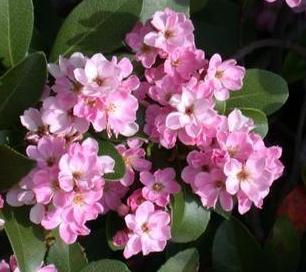
Indian Hawthorn (Rhaphiolepis indica (L.) Lindl.) is an evergreen shrub in the family Rosaceae, order Rosales, and class Magnoliopsida. It is native to Cambodia, southern and southeastern China, Japan, Laos, Taiwan, Thailand, and Vietnam. It has leathery leaves and white or pink flowers arranged in clusters, followed by dark berries.
Written 26 November 2026 from the sources listed below. Each statement was checked against the passage it cites; statements that could not be supported were removed.
Appearance
Indian Hawthorn is an evergreen shrub with dense, rounded or mounding growth. It typically grows 4–6 feet tall and equally wide, and individuals rarely exceed 4 metres in height.[1][2][3]
Young branches are purplish-brown and become greyish-brown as they mature. The leathery, simple, alternate leaves have lanceolate to elliptical shapes and serrated margins, with prominent veins on their undersides. New leaves emerge bronze-colored before developing a deep-green color.[4][5][6][7]
The fruit develops into dark berries that can be bluish-black, black, blue, or purple-lavender.[8][9]
Habitat
Indian Hawthorn occurs on woodland slopes, roadsides, and in bushes beside streams. Its documented natural habitats include elevations of 700–1,600 metres above sea level.[10][11][12]
The shrub grows best in full sunlight but tolerates light shade. It grows in moist, well-drained soils, and established plants tolerate some drought.[13][14]
The species is native to southern China and Southeast Asia. Its documented native range includes Cambodia, southern and southeastern China, Japan, Laos, Taiwan, Thailand, and Vietnam. It has been introduced to New South Wales.[15][16][17]
Diet
The fruit is edible after cooking and can be used to prepare jam.[18]
Behaviour
Birds and small mammals are attracted to the shrub's fruit. Deer frequently browse on the shrub.[19][20]
Reproduction and life cycle
Dark berries develop after flowering and remain on the plant throughout winter. The species can be propagated using seeds or stem cuttings.[21][22]
Conservation
Indian Hawthorn is susceptible to leaf spot disease, particularly Entomosporium leaf spot. It is also susceptible to aphids, scale insects, fire blight, and nematodes.[23][24]
Cold injury can occur when the shrub experiences colder climates or unusually cold winters.[25]
Uses
The shrub is used for hedges, foundation plantings, borders, screens, containers, and specimen plantings.[26]
In Japan, the plant is used to produce dark-brown dye from its dried bark or roots. It has been used in Japan for more than 400 years in the production of pongo silk fabrics.[27][28]
The plant is used in China's Kainan islands to produce shima-tsumugi textiles and fishing nets. It is also used in the dorozome mud-dyeing technique practiced in the Amami Islands.[29][30]
Classification of the Indian Hawthorn
| Kingdom | Plantae |
|---|---|
| Subkingdom | Pteridobiotina |
| Phylum | Tracheophyta |
| Class | Magnoliopsida |
| Order | Rosales |
| Family | Rosaceae (Rose Family) |
| Subfamily | Amygdaloideae |
| Tribe | Maleae |
| Subtribe | Malinae |
| Genus | Rhaphiolepis |
| Species | Rhaphiolepis indica (L.) Lindl. |
Where the Indian Hawthorn is found
Checklists and occurrence records place Rhaphiolepis indica in 14 countries across Asia and Oceania. GBIF holds 7,854 georeferenced records of it.
Countries where it is native or its origin is not stated
- Cambodia 26
- China 2,812
- Hong Kong 760
- India 2
- Indonesia 27
- Japan 1,178
- Laos 14
- Macao 91
- South Korea 592
- Sri Lanka 5
- Taiwan 674
- Thailand 42
- Vietnam 73
Countries where it has been introduced
Regions and cities with the most records
- New South Wales, Australia 1,154
- Guangdong, China 581
- Tsing Yi Town, Hong Kong 574
- Shek Lei, Hong Kong 570
- Kwai Chung, Hong Kong 568
- Tai Wo Hau, Hong Kong 564
- Keng Hau, Hong Kong 562
- Tai Wai, Hong Kong 561
- Mei Foo, Hong Kong 556
- San Tin, Hong Kong 556
- Tsuen Wan, Hong Kong 554
- Mei Foo Sun Chuen, Hong Kong 553
- Sha Tin, Hong Kong 552
- Discovery Park, Hong Kong 549
- Sun Tin Wai, Hong Kong 545
- Fo Tan, Hong Kong 541
- Ting Kau, Hong Kong 540
- So Uk Estate, Hong Kong 539
- Hoi Lai Estate, Hong Kong 538
- So Uk, Hong Kong 538
- Wo Che, Hong Kong 538
- Un Chau Estate, Hong Kong 536
- Wong Tai Sin, Hong Kong 536
- Fu Cheong Estate, Hong Kong 530
- Chuk Yuen, Hong Kong 529
- Chuk Yuen North Estate, Hong Kong 529
- Nam Cheong, Hong Kong 529
- Pok Hong, Hong Kong 528
- Pak Tin Estate, Hong Kong 527
- Lower Wong Tai Sin Estate (I & II), Hong Kong 526
- Sha Tin Wai, Hong Kong 526
- Shek Kip Mei Estate, Hong Kong 526
- Wang Tau Hom, Hong Kong 526
- Wang Tau Hom Estate, Hong Kong 526
- Sham Shui Po, Hong Kong 525
- San Po Kong, Hong Kong 524
16 more countries have a few records outside this range
These countries hold a few records of Rhaphiolepis indica but lie outside the range the checklists give for it. Such records are often zoo or garden specimens, museum material or vagrants, so the species is not counted as occurring there.
Range as the checklists state it
China (Anhui, Fujian, Guangdong, Guangxi, Guizhou, Hainan, Hunan, Jiangxi, Yunnan, Zhejiang); Japan; Taiwan; India [c]; Thailand; Laos; Cambodia; Vietnam; Jawa [I]; Australia [I] (New South Wales [I]); Norfolk Isl. [I]
A number beside a place is its count of GBIF occurrence records. A place without a number comes from a checklist alone. Records show where a species has been observed or collected, which can include escapes and vagrants.
Common names
English
- Indian Hawthorn
- Hong Kong Hawthorn
- India-hawthorn
- Indian-hawthorn
- Sexton's Bride
- Yedda Hawthorn
Names in 16 other languages
- Afrikaans
- Indiese haagdoring
- Catalan
- Rafiolepis de la Xina
- Chinese
- shi ban mu, 春花, 石斑木, 車輪梅
- Danish
- guldranke
- Dutch
- Indiase meidoorn
- French
- Raphiolépide de l'Inde
- German
- chinesischer Traubenapfel
- Hebrew
- בן עוזרר הודי
- Japanese
- アツバシャリンバイ(旧名), シャリンバイ(旧名), タチシャリンバイ(旧名), マルバシャリンバイ(旧名), モッコクモドキ
- Korean
- 다정큼나무
- Russian
- Рафиолепис индийский
- Slovak
- hložík indočínsky
- Spanish
- Manzanillo
- Swedish
- indisk lagerkvitten
- Thai
- ไทรปัตตาเวีย
- Turkish
- Hint Alıcı
Synonyms
45 other scientific names have been used for this species and are now treated as synonyms of Rhaphiolepis indica.
- Crataegus chinensis (Blume) Steud.
- Crataegus indica L.
- Crataegus rubra Lour.
- Crataegus sieboldii (Blume) Steud.
- Crataegus sinensis Loisel.
- Eriobotrya chinensis (Blume) G.Don
- Mespilus chinensis Blume
- Mespilus indica (L.) Poir.
- Mespilus rubra Stokes
- Mespilus sieboldii Blume
- Mespilus sinensis Poir.
- Opa japonica (Siebold & Zucc.) Seem.
- Opa metrosideros Lour.
- Photinia sieboldii G.Don
- Pyrus mekongensis (Cardot) M.F.Fay & Christenh.
- Pyrus rhaphiolepis M.F.Fay & Christenh.
- Raphiolepis indica (L.) Lindl.
- Rhaphiolepis crataegoides M.Roem.
- Rhaphiolepis delacourii André
- Rhaphiolepis fragrans E.T.Geddes
- Rhaphiolepis gracilis Nakai
- Rhaphiolepis impressivena Masam.
- Rhaphiolepis indica f. impressivena (Masam.) S.S.Ying
- Rhaphiolepis indica f. minor (Makino) H.Ohashi
- Rhaphiolepis indica f. salicifolia G.Nicholson
- Rhaphiolepis indica var. crataegoides Nakai
- Rhaphiolepis indica var. latifolia Cardot
- Rhaphiolepis indica var. mekongensis Cardot
- Rhaphiolepis indica var. minor (Makino) Kitam.
- Rhaphiolepis indica var. typica Nakai
- Rhaphiolepis japonica Siebold & Zucc.
- Rhaphiolepis kerrii E.T.Geddes
- Rhaphiolepis loureiroi Spreng.
- Rhaphiolepis mekongensis (Cardot) Tagane & H.Toyama
- Rhaphiolepis minor (Makino) Koidz.
- Rhaphiolepis parvibracteolata Merr.
- Rhaphiolepis pheostemon Lindl.
- Rhaphiolepis rubra (Lour.) Lindl.
- Rhaphiolepis rubra var. foliosa Nakai
- Rhaphiolepis rubra var. lanceolata Nakai
Showing 40 of 45.
Subspecies and varieties
Related species
-
 Japanese-hawthornRhaphiolepis umbellata
- Rhaphiolepis ferruginea
- Rhaphiolepis integerrima
- Rhaphiolepis major
- Rhaphiolepis philippinensis
- Rhaphiolepis brevipetiolata
- Rhaphiolepis jiulongjiangensis
- Rhaphiolepis lanceolata
Compare
Questions and answers
What is the scientific name of the Indian Hawthorn?
The scientific name of the Indian Hawthorn is Rhaphiolepis indica. Written with its author, the full name is Rhaphiolepis indica (L.) Lindl..
Which family does the Indian Hawthorn belong to?
Rhaphiolepis indica belongs to the family Rosaceae, in the order Rosales and the class Magnoliopsida.
Where is the Indian Hawthorn found?
Checklists and occurrence records place Rhaphiolepis indica in 14 countries, including China, Japan, Hong Kong, Taiwan, South Korea and Macao.
What is the conservation status of the Indian Hawthorn?
The IUCN Red List category recorded for Rhaphiolepis indica is Least Concern (LC).
What other names does the Indian Hawthorn have?
Rhaphiolepis indica is also known in English as Hong Kong Hawthorn, India-hawthorn, Indian-hawthorn, Sexton's Bride and Yedda Hawthorn.
What is Indian Hawthorn good for?
Indian Hawthorn is cultivated for its ornamental flowers and foliage and is popular in bonsai cultivation. It is used for hedges, foundation plantings, borders, screens, containers, and specimen plantings. Its dried bark or roots are also used to produce dyes and textiles.[31][32][26][27][28][29][30]
Does Indian Hawthorn like sun or shade?
Indian Hawthorn grows best in full sunlight but tolerates light shade.[13]
What is the habitat of hawthorn?
Indian Hawthorn occurs on woodland slopes, roadsides, and in bushes beside streams. Its documented natural habitats include elevations of 700–1,600 metres above sea level.[10][11][12]
Can you eat Indian Hawthorn berries?
The fruit is edible after cooking and can be used to prepare jam.[18]
Where is Indian Hawthorn native to?
Indian Hawthorn is native to Cambodia, southern and southeastern China, Japan, Laos, Taiwan, Thailand, and Vietnam.[16]
Sources
Passages the profile rests on
- Rhaphiolepis indica is an evergreen shrub with dense, rounded or mounding growth. Source passage: “Indian hawthorn is a dense, mounding, broadleaf evergreen shrub cultivated for its foliage and flowers.” — plants.ces.ncsu.edu
- The species typically grows 4–6 feet tall and equally wide. Source passage: “Indian hawthorn grows 4 to 6 feet tall and equally as wide.” — plants.ces.ncsu.edu
- Individuals rarely exceed 4 metres in height. Source passage: “which rarely reach a size of 4 m in height.” — English Wikipedia
- Young branches are purplish-brown, becoming greyish-brown as they mature. Source passage: “The branches are purple brown when young, greyish brown when old” — English Wikipedia
- The leaves are leathery, simple, and alternate, with lanceolate to elliptical shapes and serrated margins. Source passage: “lanceolate to elliptical, leathery, serrate margins, simple, alternate” — plants.ces.ncsu.edu
- New leaves emerge bronze-colored before developing a deep-green color. Source passage: “The leaves initially emerge as bronze colored and transition to deep green.” — plants.ces.ncsu.edu
- The leaves have prominent veins on their undersides. Source passage: “coriaceous, abaxially prominent veins” — English Wikipedia
- The fruit develops into dark berries that can be bluish-black. Source passage: “bluish-black berries appear in the late summer and persist through winter” — plants.ces.ncsu.edu
- The berries can be black, blue, or purple-lavender. Source passage: “Fruit Color: Black Blue Purple/Lavender” — plants.ces.ncsu.edu
- The species occurs on woodland slopes and along streams. Source passage: “where it is found on woodland slopes and along streams.” — plants.ces.ncsu.edu
- It grows on slopes, roadsides, and bushes beside streams. Source passage: “It is found on slopes, roadsides, bushes on the sides of streams” — English Wikipedia
- Its documented natural habitats include elevations of 700–1,600 metres above sea level. Source passage: “at an altitude of 700–1600 meters above sea level” — English Wikipedia
- The shrub grows best in full sunlight, although it tolerates light shade. Source passage: “This shrub prefers full sun. It tolerates light shade” — plants.ces.ncsu.edu
- The species grows in moist, well-drained soils and established plants tolerate some drought. Source passage: “Moist, well-drained soils are needed, although established shrubs have some drought tolerance.” — plants.ces.ncsu.edu
- The species is native to southern China and Southeast Asia. Source passage: “It is native to southern China and Southeast Asia” — plants.ces.ncsu.edu
- Its documented native range includes Cambodia, southern and southeastern China, Japan, Laos, Taiwan, Thailand, and Vietnam. Source passage: “Native: Cambodia, China South-Central and Southeast, Japan, Laos, Taiwan, Thailand, Vietnam” — plants.ces.ncsu.edu
- The species has been introduced to New South Wales. Source passage: “Introduced: New South Wales” — plants.ces.ncsu.edu
- The fruit is edible after cooking and can be used to prepare jam. Source passage: “The fruit is edible when cooked, and can be used to make jam.” — English Wikipedia
- Birds and small mammals are attracted to the species' fruit. Source passage: “Birds and small mammals are attracted to the fruit.” — plants.ces.ncsu.edu
- Deer frequently browse on the shrub. Source passage: “It is frequently browsed by deer.” — plants.ces.ncsu.edu
- Dark berries develop after flowering and remain on the plant throughout winter. Source passage: “Dark berries appear after flowering and persist through the winter months.” — plants.ces.ncsu.edu
- The species can be propagated using seeds or stem cuttings. Source passage: “Recommended Propagation Strategy: Seed Stem Cutting” — plants.ces.ncsu.edu
- The species is susceptible to leaf spot disease, particularly Entomosporium leaf spot. Source passage: “Entomosporium leaf spot is the most common disease of this shrub” — plants.ces.ncsu.edu
- The shrub is also susceptible to aphids, scale insects, fire blight, and nematodes. Source passage: “The shrub is susceptible to leaf spots, aphids, scale, fire blight, and nematodes.” — plants.ces.ncsu.edu
- Cold injury can occur when the shrub experiences colder climates or unusually cold winters. Source passage: “Cold injury can occur in colder climates or during unseasonably cold winters.” — plants.ces.ncsu.edu
- The species is used for hedges, foundation plantings, borders, screens, containers, and specimen plantings. Source passage: “It is often utilized in the coastal plains, as a specimen plant, in mass plantings, foundation planting, border planting, screens, containers, banks, or hedges.” — plants.ces.ncsu.edu
- The plant is used in Japan to produce dark-brown dye from its dried bark or roots. Source passage: “a dark brown dye is made by boiling its dried bark or root” — English Wikipedia
- The species has been used in Japan for more than 400 years in the production of pongo silk fabrics. Source passage: “This plant has been used in Japan for over 400 years in a technique for making pongo silk fabrics.” — English Wikipedia
- The plant is used in China's Kainan islands to produce shima-tsumugi textiles and fishing nets. Source passage: “In the Kainan islands in China it is used to make shima-tsumugi textiles and some fishing nets.” — English Wikipedia
- The species is used in the dorozome mud-dyeing technique practiced in the Amami Islands. Source passage: “Additionally, the plant is used in a Japanese mud dyeing technique known as dorozome from the Amami Islands.” — English Wikipedia
- The species is cultivated for its ornamental flowers and foliage. Source passage: “Indian hawthorn is a dense, mounding, broadleaf evergreen shrub cultivated for its foliage and flowers.” — plants.ces.ncsu.edu
- The shrub is popular in bonsai cultivation. Source passage: “and is popular in bonsai culture.” — English Wikipedia
Data
- Catalogue of Life, 2026-10-16 XR cc by
- Global Biodiversity Information Facility CC BY 4.0
- Wikidata CC0
- GeoNames CC BY 4.0
- Wikimedia Commons per image; credit shown with each image
- Within the Catalogue of Life, this name comes from Synonymic Checklists of the Vascular Plants of the World cc by
References
- Lindl. (1820). Bot. Reg. 6: t. 468 (1820). where the name was published
This species in other databases
- Catalogue of Life 4S4H5
- Wikidata Q3205640
- iNaturalist 179305
- World Flora Online wfo-0001016273
- GRIN 30869
Page built on 29 November 2026. See how the catalog is made and all sources and licences.
Cite this page
ScientificNames.org. (2026). Rhaphiolepis indica (Indian Hawthorn). Retrieved November 29, 2026, from https://scientificnames.org/species/rhaphiolepis-indica
“Rhaphiolepis indica (Indian Hawthorn).” ScientificNames.org, 2026, scientificnames.org/species/rhaphiolepis-indica. Accessed 29 Nov. 2026.
ScientificNames.org. “Rhaphiolepis indica (Indian Hawthorn).” Accessed November 29, 2026. https://scientificnames.org/species/rhaphiolepis-indica.
@misc{scientificnames_rhaphiolepis_indica_indian_hawthorn,
  author = {{ScientificNames.org}},
  title = {Rhaphiolepis indica (Indian Hawthorn)},
  year = {2026},
  url = {https://scientificnames.org/species/rhaphiolepis-indica},
  note = {Accessed 2026-11-29}
}