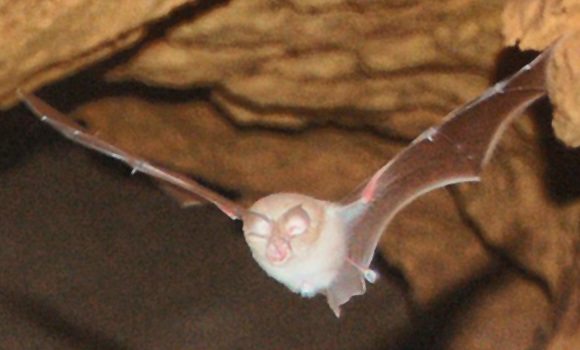
| Appearance | - Its fur is light chestnut in color. English Wikipedia
- Its noseleaf has a forward-slanting sella with heart-shaped basal lobes that nearly obscure the nostrils. English Wikipedia
- Its noseleaf has a deep indentation between the sella and the lancet. English Wikipedia
- Its skull is slender in appearance but has a heavy snout. English Wikipedia
- The space between its pterygoid bones is unusually deep and barrel-like. English Wikipedia
- Its ears have 10–12 internal folds. English Wikipedia
- Members of the maclaudi group have large ears and a reduced connection between the sella and lancet. English Wikipedia
| - The Mediterranean horseshoe bat has fluffy fur with a light grey base. English Wikipedia
- The Mediterranean horseshoe bat has grey-brown dorsal fur that sometimes has a slight reddish tinge. English Wikipedia
- The Mediterranean horseshoe bat has grey-white or yellow-white fur on its underside. English Wikipedia
- The upper connecting process of the Mediterranean horseshoe bat is pointed and slightly bent downwards. English Wikipedia
- The upper connecting process is distinctly longer than the lower connecting process. English Wikipedia
- The Mediterranean horseshoe bat has light brown horseshoe-shaped facial structures and lips. animaldiversity.org
- The ears and wing membranes of the Mediterranean horseshoe bat are light grey. animaldiversity.org
- The Mediterranean horseshoe bat has broad wings. animaldiversity.org
- The second phalanx of the Mediterranean horseshoe bat's fourth finger is more than twice as long as the first phalanx. animaldiversity.org
- The Mediterranean horseshoe bat cannot completely wrap its body in its wing membranes because of its wing anatomy. animaldiversity.org
|
|---|
| Size | - Its leafnoses measure 15–16 mm in width. English Wikipedia
- Among the six species in the maclaudi group, Rhinolophus maclaudi is the largest. English Wikipedia
- The West African members of the maclaudi group are larger than its East African members. English Wikipedia
| |
|---|
| Habitat | - The species inhabits moist savannas, caves, and other subterranean environments. English Wikipedia
- Most recorded specimens have been found in the Guinean forest-savanna mosaic ecoregion. English Wikipedia
- The holotype was collected on Conakry Island in the coastal plains ecoregion. English Wikipedia
| - The Mediterranean horseshoe bat inhabits warm, forested foothills and mountain regions. animaldiversity.org
- The Mediterranean horseshoe bat favors karst formations containing numerous caves near water sources. animaldiversity.org
- The Mediterranean horseshoe bat favors broadleaved woodlands and olive groves. animaldiversity.org
- The Mediterranean horseshoe bat uses caves and underground shelters as summer roosts. animaldiversity.org
- The Mediterranean horseshoe bat uses warm attics as roosts in more northern parts of its range. animaldiversity.org
- Winter roosts of the Mediterranean horseshoe bat include caves and tunnels with temperatures around 10°C. animaldiversity.org
|
|---|
| Diet | No checked fact yet | - The Mediterranean horseshoe bat feeds on moths and other insects. animaldiversity.org
- The Mediterranean horseshoe bat consumes large quantities of moths and other insects. animaldiversity.org
|
|---|
| Behaviour | - The species uses caves as daytime roosting sites. English Wikipedia
- At least one individual has been found roosting inside a house. English Wikipedia
- Individuals roost either alone or in small colonies containing up to six bats. English Wikipedia
- The species shares caves with Angolan rousette bats, large-eared slit-faced bats, Guinean horseshoe bats, Rüppell's horseshoe bats, Dent's horseshoe bats, Jones's roundleaf bats, and Noack's roundleaf bats. English Wikipedia
- Cave-dwelling bats are hunted approximately twice annually for special occasions. English Wikipedia
| - The Mediterranean horseshoe bat often roosts alongside other bat species, including other horseshoe bats. animaldiversity.org
- The Mediterranean horseshoe bat generally remains in the same area but may migrate up to 134 km. animaldiversity.org
- The Mediterranean horseshoe bat typically forages alone. animaldiversity.org
- The Mediterranean horseshoe bat is nocturnal and uses echolocation to locate prey. animaldiversity.org
- The Mediterranean horseshoe bat emerges in late twilight to feed. animaldiversity.org
- The Mediterranean horseshoe bat hunts at low altitudes on warm slopes and among relatively dense trees or shrubs. animaldiversity.org
- The Mediterranean horseshoe bat has slow, agile flight and can hover. animaldiversity.org
- The Mediterranean horseshoe bat produces echolocation calls at frequencies of 101–108 kHz. animaldiversity.org
|
|---|
| Reproduction | No checked fact yet | - Maternity roosts of the Mediterranean horseshoe bat commonly contain 50–400 females, sometimes accompanied by males. English Wikipedia
- Births in the Mediterranean horseshoe bat occur from mid-June or July. English Wikipedia
- Young Mediterranean horseshoe bats become independent at approximately four weeks of age. English Wikipedia
- Female Mediterranean horseshoe bats have their first offspring at two to three years of age. English Wikipedia
- Mediterranean horseshoe bats mate in autumn, with mating potentially continuing into winter. English Wikipedia
- Female Mediterranean horseshoe bats give birth to one offspring per breeding event. animaldiversity.org
- A newborn Mediterranean horseshoe bat weighs approximately 4 g. animaldiversity.org
- Young Mediterranean horseshoe bats are ready to fly in early to mid-August, or by mid-July in Bulgaria. animaldiversity.org
- Breeding in the Mediterranean horseshoe bat is thought to occur once annually. animaldiversity.org
|
|---|
| Distribution | | - The Mediterranean horseshoe bat occurs in the Mediterranean region and Balkan Peninsula. English Wikipedia
- The Mediterranean horseshoe bat occurs on Sicily, Sardinia, and Corsica. animaldiversity.org
- The northernmost reported range of the Mediterranean horseshoe bat includes Slovakia, northern Italy, and southern France. animaldiversity.org
- The Mediterranean horseshoe bat has also been reported in northern Africa. animaldiversity.org
|
|---|
| Conservation | - The species is classified as endangered by the IUCN. English Wikipedia
- Bat Conservation International included the species in its worldwide priority list of 35 species in 2013. English Wikipedia
- Habitat loss threatens the species. English Wikipedia
- Bushmeat consumption poses a serious threat to the species' survival. English Wikipedia
- There is likely domestic trade in the species' meat within Guinea, although it is not exported from the country. English Wikipedia
- The caves occupied by Maclaud's horseshoe bats are experiencing increasing exploitation. English Wikipedia
- Guinea prohibited the consumption of bat meat in 2014 because of concerns about Ebola transmission. English Wikipedia
- Guinea had not lifted its bat-meat consumption ban following the easing of restrictions in many West African countries in 2016. English Wikipedia
- The Fouta Djallon Plateau is thought to experience relatively little bushmeat exploitation. English Wikipedia
- Potential threats include habitat degradation caused by logging and mining. English Wikipedia
- Bat Conservation International received a Disney Conservation Fund grant in 2014 for a proposal to protect the species' roosts and educate Guinean communities about its threats. English Wikipedia
| - The Mediterranean horseshoe bat was assessed as Near Threatened in the IUCN Red List account dated 2016. English Wikipedia
- The Mediterranean horseshoe bat experienced a reported general population decline over 27 years. English Wikipedia
- Agricultural expansion and urbanization are identified as contributors to the Mediterranean horseshoe bat's population decline through loss of foraging vegetation. English Wikipedia
- Disturbance from caving and cave tourism threatens the Mediterranean horseshoe bat because it mainly roosts in caves and underground shelters. English Wikipedia
- Protection of roosting sites is identified as an important long-term conservation strategy for the Mediterranean horseshoe bat. English Wikipedia
- The Mediterranean horseshoe bat experienced a 70% population decline in France between 1940 and 1980. animaldiversity.org
- Pesticide use is identified as a possible contributor to declines in Mediterranean horseshoe bat populations. animaldiversity.org
|
|---|
| Uses | | - The Mediterranean horseshoe bat provides insect control within its ecosystem. animaldiversity.org
|
|---|
| Similar species | - Maclaud's horseshoe bat is the defining species of the maclaudi group, which contains six species. English Wikipedia
- Rhinolophus maclaudi and Rhinolophus ziama are the two West African members of the maclaudi group. English Wikipedia
| No checked fact yet |
|---|