Species · Mammals
Maclaud's Horseshoe Bat Rhinolophus maclaudi
The scientific name of the Maclaud's Horseshoe Bat is Rhinolophus maclaudi. It is a species of mammal in the family Rhinolophidae (horseshoe bat), order Chiroptera. The name dates from 1897.
- Scientific name
- Rhinolophus maclaudi Pousargues, 1897
- Common name
- Maclaud's Horseshoe Bat
- Genus
- Rhinolophus
- Family
- Rhinolophidae (Horseshoe Bat)
- Order
- Chiroptera
- Class
- Mammalia
- Red List category
- EN Endangered
- Recorded in
- 3 countries
- Name status
- accepted in the Catalogue of Life
Overview
Maclaud's Horseshoe Bat is the defining species of the maclaudi group, which contains six species. It is endemic to Guinea. It is the largest of the six species in the maclaudi group.
Written 27 November 2026 from the sources listed below. Each statement was checked against the passage it cites; statements that could not be supported were removed.
Appearance
Its fur is light chestnut in color. Its noseleaf has a forward-slanting sella with heart-shaped basal lobes that nearly obscure the nostrils, and a deep indentation between the sella and the lancet.[1][2][3]
Its skull is slender in appearance but has a heavy snout. The space between its pterygoid bones is unusually deep and barrel-like.[4][5]
Its ears have 10–12 internal folds. Its leafnoses measure 15–16 mm in width.[6][7]
Similar species
Maclaud's Horseshoe Bat is the defining species of the maclaudi group, which contains six species. Members of the group have large ears and a reduced connection between the sella and lancet.[8][9]
Rhinolophus maclaudi and Rhinolophus ziama are the two West African members of the maclaudi group. The West African members are larger than its East African members.[10][11]
Among the six species in the maclaudi group, Rhinolophus maclaudi is the largest.[12]
Habitat
The species inhabits moist savannas, caves, and other subterranean environments. Most recorded specimens have been found in the Guinean forest-savanna mosaic ecoregion.[13][14]
The holotype was collected on Conakry Island in the coastal plains ecoregion.[15]
Behaviour
The species uses caves as daytime roosting sites. Individuals roost either alone or in small colonies containing up to six bats.[16][17]
At least one individual has been found roosting inside a house.[18]
The species shares caves with Angolan rousette bats, large-eared slit-faced bats, Guinean horseshoe bats, Rüppell's horseshoe bats, Dent's horseshoe bats, Jones's roundleaf bats, and Noack's roundleaf bats.[19]
Cave-dwelling bats are hunted approximately twice annually for special occasions.[20]
Uses
Maclaud's Horseshoe Bat is consumed as bushmeat in Guinea. There is likely domestic trade in its meat within Guinea, although it is not exported from the country.[21][22]
Conservation
The species is classified as endangered by the IUCN. Bat Conservation International included it in its worldwide priority list of 35 species in 2013.[23][24]
Habitat loss threatens the species. Potential threats include habitat degradation caused by logging and mining.[25][26]
Bushmeat consumption poses a serious threat to the species' survival. The caves occupied by Maclaud's horseshoe bats are experiencing increasing exploitation.[27][28]
Guinea prohibited the consumption of bat meat in 2014 because of concerns about Ebola transmission. The country had not lifted its bat-meat consumption ban following the easing of restrictions in many West African countries in 2016.[29][30]
The Fouta Djallon Plateau is thought to experience relatively little bushmeat exploitation.[31]
Bat Conservation International received a Disney Conservation Fund grant in 2014 for a proposal to protect the species' roosts and educate Guinean communities about its threats.[32]
Classification of the Maclaud's Horseshoe Bat
| Kingdom | Animalia |
|---|---|
| Phylum | Chordata |
| Subphylum | Vertebrata |
| Infraphylum | Gnathostomata |
| Parvphylum | Osteichthyes |
| Megaclass | Tetrapoda |
| Class | Mammalia (Mammal) |
| Subclass | Theria |
| Infraclass | Eutheria |
| Order | Chiroptera (Bat) |
| Suborder | Yinpterochiroptera |
| Superfamily | Rhinolophoidea |
| Family | Rhinolophidae (Horseshoe Bat) |
| Genus | Rhinolophus (Horseshoe Bat) |
| Species | Rhinolophus maclaudi Pousargues, 1897 |
Where the Maclaud's Horseshoe Bat is found
Checklists and occurrence records place Rhinolophus maclaudi in 3 countries across Africa. GBIF holds 32 georeferenced records of it.
Countries
Regions and cities with the most records
- Kanungu, Uganda 10
- Ntungamo, Uganda 10
- Butembo, Democratic Republic of the Congo 4
- Katwa, Democratic Republic of the Congo 4
Range as the checklists state it
Africa
A number beside a place is its count of GBIF occurrence records. A place without a number comes from a checklist alone. Records show where a species has been observed or collected, which can include escapes and vagrants.
Common names
English
- Maclaud's Horseshoe Bat
- Maclaud's Horseshoe Bat.
Names in 8 other languages
- Czech
- vrápenec Maclaudův
- Dutch
- Maclaudhoefijzerneus
- Finnish
- korvaherkko
- French
- Rhinolophe de Maclaud
- German
- Maclauds Hufeisennase, Maclauds Jufeisennase
- Japanese
- マクロードキクガシラコウモリ
- Polish
- podkowiec galeriowy
- Russian
- Подковонос Маклауда
Related species
-
 Greater Horseshoe BatRhinolophus ferrumequinum
-
 Lesser Horseshoe BatRhinolophus hipposideros
-
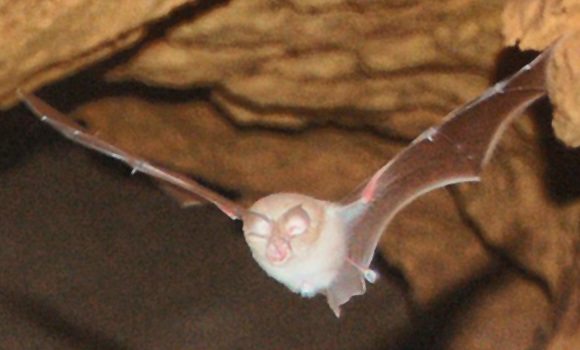 Mediterranean Horseshoe BatRhinolophus euryale
-
 Intermediate Horseshoe BatRhinolophus affinis
-
 Blasius's Horseshoe BatRhinolophus blasii
-
 Mehely's Horseshoe BatRhinolophus mehelyi
- Andaman Horseshoe BatRhinolophus cognatus
-
 Least Horseshoe BatRhinolophus pusillus
Compare
Questions and answers
What is the scientific name of the Maclaud's Horseshoe Bat?
The scientific name of the Maclaud's Horseshoe Bat is Rhinolophus maclaudi. Written with its author, the full name is Rhinolophus maclaudi Pousargues, 1897.
Which family does the Maclaud's Horseshoe Bat belong to?
Rhinolophus maclaudi belongs to the family Rhinolophidae, in the order Chiroptera and the class Mammalia.
Where is the Maclaud's Horseshoe Bat found?
Checklists and occurrence records place Rhinolophus maclaudi in 3 countries: Uganda, Democratic Republic of the Congo and Guinea.
What is the conservation status of the Maclaud's Horseshoe Bat?
The IUCN Red List category recorded for Rhinolophus maclaudi is Endangered (EN).
What other names does the Maclaud's Horseshoe Bat have?
Rhinolophus maclaudi is also known in English as Maclaud's Horseshoe Bat..
Sources
Passages the profile rests on
- Its fur is light chestnut in color. Source passage: “They are a light chestnut in color.” — English Wikipedia
- Its noseleaf has a forward-slanting sella with heart-shaped basal lobes that nearly obscure the nostrils. Source passage: “This species has a noseleaf characterized by a forward-slanting sella that has heart-shaped, basal lobes that almost obscure the nostrils.” — English Wikipedia
- Its noseleaf has a deep indentation between the sella and the lancet. Source passage: “There is a deep indentation between the sella and the lancet.” — English Wikipedia
- Its skull is slender in appearance but has a heavy snout. Source passage: “The skulls of this species are slender in appearance, but with heavy snouts.” — English Wikipedia
- The space between its pterygoid bones is unusually deep and barrel-like. Source passage: “The space between the pterygoid bones of the skull is unusually deep and barrel-like.” — English Wikipedia
- Its ears have 10–12 internal folds. Source passage: “with 10-12 internal folds.” — English Wikipedia
- Its leafnoses measure 15–16 mm in width. Source passage: “Their leafnoses are 15–16 mm (0.59–0.63 in) wide.” — English Wikipedia
- Maclaud's horseshoe bat is the defining species of the maclaudi group, which contains six species. Source passage: “Maclaud's horseshoe bat is the identifier of one of these groups, called the maclaudi group, which currently consists of six species” — English Wikipedia
- Members of the maclaudi group have large ears and a reduced connection between the sella and lancet. Source passage: “Members of this group have large ears, and a diminished connection between the sella and lancet.” — English Wikipedia
- Rhinolophus maclaudi and Rhinolophus ziama are the two West African members of the maclaudi group. Source passage: “R. maclaudi and R. ziama are considered the two West African taxa” — English Wikipedia
- The West African members of the maclaudi group are larger than its East African members. Source passage: “The West African species are larger in size than the East African species” — English Wikipedia
- Among the six species in the maclaudi group, Rhinolophus maclaudi is the largest. Source passage: “with R. maclaudi as the largest bat of the species group.” — English Wikipedia
- The species inhabits moist savannas, caves, and other subterranean environments. Source passage: “Its natural habitats are moist savanna, caves and other subterranean habitats.” — English Wikipedia
- Most recorded specimens have been found in the Guinean forest-savanna mosaic ecoregion. Source passage: “Most of the specimens detected so far have been in the Guinean forest-savanna mosaic ecoregion” — English Wikipedia
- The holotype was collected on Conakry Island in the coastal plains ecoregion. Source passage: “the holotype was collected on Conakry Island, which is in the coastal plains ecoregion.” — English Wikipedia
- The species uses caves as daytime roosting sites. Source passage: “These bats use caves for roosts during the day” — English Wikipedia
- Individuals roost either alone or in small colonies containing up to six bats. Source passage: “They roost singly or form small colonies, consisting of up to six individuals.” — English Wikipedia
- At least one individual has been found roosting inside a house. Source passage: “although at least one individual was found inside a house.” — English Wikipedia
- The species shares caves with Angolan rousette bats, large-eared slit-faced bats, Guinean horseshoe bats, Rüppell's horseshoe bats, Dent's horseshoe bats, Jones's roundleaf bats, and Noack's roundleaf bats. Source passage: “They are found in caves also occupied by Angolan rousette bats, Large-eared slit-faced bats, Guinean horseshoe bats, Rüppell's horseshoe bats, Dent's horseshoe bat, Jones's roundleaf bats, and Noack's roundleaf bats.” — English Wikipedia
- Cave-dwelling bats are hunted approximately twice annually for special occasions. Source passage: “Cave-dwelling bats are hunted approximately twice a year for "special occasions,"” — English Wikipedia
- Maclaud's horseshoe bat is consumed as bushmeat in Guinea. Source passage: “Maclaud's horseshoe bat is threatened by bushmeat consumption.” — English Wikipedia
- There is likely domestic trade in the species' meat within Guinea, although it is not exported from the country. Source passage: “While the Maclaud's horseshoe bat's meat is not exported from the country, there is likely trade within Guinea of its meat.” — English Wikipedia
- The species is classified as endangered by the IUCN. Source passage: “It is one of five African microbat species to be listed as endangered by the IUCN.” — English Wikipedia
- Bat Conservation International included the species in its worldwide priority list of 35 species in 2013. Source passage: “In 2013, Bat Conservation International listed this species as one of the 35 species of its worldwide priority list of conservation.” — English Wikipedia
- Habitat loss threatens the species. Source passage: “It is threatened by habitat loss.” — English Wikipedia
- Potential threats include habitat degradation caused by logging and mining. Source passage: “so threats likely include habitat degradation via logging and mining.” — English Wikipedia
- Bushmeat consumption poses a serious threat to the species' survival. Source passage: “The species is regularly eaten, at serious threat to its survival.” — English Wikipedia
- The caves occupied by Maclaud's horseshoe bats are experiencing increasing exploitation. Source passage: “the caves of Maclaud's horseshoe bats are increasingly exploited.” — English Wikipedia
- Guinea prohibited the consumption of bat meat in 2014 because of concerns about Ebola transmission. Source passage: “Guineans were banned from eating bat meat in 2014 over concerns of spreading Ebola.” — English Wikipedia
- Guinea had not lifted its bat-meat consumption ban following the easing of restrictions in many West African countries in 2016. Source passage: “However, Guinea has yet to lift the ban.” — English Wikipedia
- The Fouta Djallon Plateau is thought to experience relatively little bushmeat exploitation. Source passage: “The Fouta Djallon Plateau, where the bats were most recently encountered, likely has a low level of bushmeat exploitation” — English Wikipedia
- Bat Conservation International received a Disney Conservation Fund grant in 2014 for a proposal to protect the species' roosts and educate Guinean communities about its threats. Source passage: “In 2014, Bat Conservation International was awarded a grant from the Disney Conservation Fund for a proposal to protect their roosts and educate people of Guinea about the threats facing the species.” — English Wikipedia
- Maclaud's horseshoe bat is endemic to Guinea. Source passage: “It is endemic to Guinea.” — English Wikipedia
Data
- Catalogue of Life, 2026-10-16 XR cc by
- Global Biodiversity Information Facility CC BY 4.0
- Wikidata CC0
- GeoNames CC BY 4.0
- Within the Catalogue of Life, this name comes from The Integrated Taxonomic Information System cc0
References
- Bull. Mus. Natn. Hist. Nat. Paris vol.3 p.358 where the name was published
- Allen, Glover M. (1939). A checklist of African mammals. Bulletin of the Museum of Comparative Zoology at Harvard College, Vol. 83.
- Wilson, Don E., and DeeAnn M. Reeder, eds. (1993). Mammal Species of the World: A Taxonomic and Geographic Reference, 2nd Ed., 3rd Printing.
- Wilson, Don E., and F. Russell Cole. (2000). Common Names of Mammals of the World.
- Simmons, Nancy B. / Wilson, Don E., and DeeAnn M. Reeder, eds. (2005). Order Chiroptera. Mammal Species of the World: A Taxonomic and Geographic Reference, 3rd Ed., Vols. 1 & 2.
- Wilson, D. E., and R. A. Mittermeier, eds. (2019). Handbook of the Mammals of the World. Vol. 9: Bats.
This species in other databases
Page built on 28 November 2026. See how the catalog is made and all sources and licences.
Cite this page
ScientificNames.org. (2026). Rhinolophus maclaudi (Maclaud's Horseshoe Bat). Retrieved November 28, 2026, from https://scientificnames.org/species/rhinolophus-maclaudi
“Rhinolophus maclaudi (Maclaud's Horseshoe Bat).” ScientificNames.org, 2026, scientificnames.org/species/rhinolophus-maclaudi. Accessed 28 Nov. 2026.
ScientificNames.org. “Rhinolophus maclaudi (Maclaud's Horseshoe Bat).” Accessed November 28, 2026. https://scientificnames.org/species/rhinolophus-maclaudi.
@misc{scientificnames_rhinolophus_maclaudi_maclauds_horseshoe_bat,
  author = {{ScientificNames.org}},
  title = {Rhinolophus maclaudi (Maclaud's Horseshoe Bat)},
  year = {2026},
  url = {https://scientificnames.org/species/rhinolophus-maclaudi},
  note = {Accessed 2026-11-28}
}