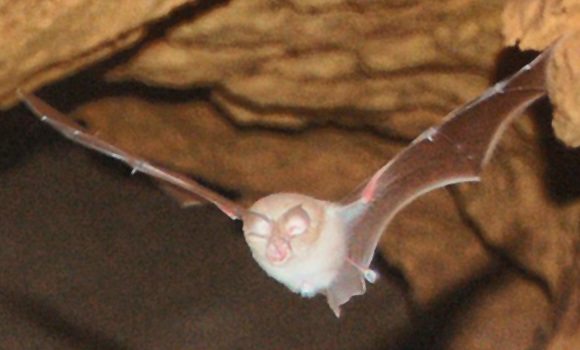
| Appearance | - The species is distinguishable from other horseshoe bats by its exceptionally long ears. English Wikipedia
- Its dorsal fur is light brown. bio.bris.ac.uk
- Its ventral fur is buffy. bio.bris.ac.uk
- The horseshoe-shaped noseleaf is wide enough to cover the muzzle and has a distinct central notch. bio.bris.ac.uk
- A secondary noseleaf is present but is often hidden by the horseshoe-shaped noseleaf. bio.bris.ac.uk
- The sella is long, rounded and broad. bio.bris.ac.uk
- The connecting process of the noseleaf is high. bio.bris.ac.uk
- The lancet is long, has convex lateral margins and ends in a rounded tip. bio.bris.ac.uk
| - The Mediterranean horseshoe bat has fluffy fur with a light grey base. English Wikipedia
- The Mediterranean horseshoe bat has grey-brown dorsal fur that sometimes has a slight reddish tinge. English Wikipedia
- The Mediterranean horseshoe bat has grey-white or yellow-white fur on its underside. English Wikipedia
- The upper connecting process of the Mediterranean horseshoe bat is pointed and slightly bent downwards. English Wikipedia
- The upper connecting process is distinctly longer than the lower connecting process. English Wikipedia
- The Mediterranean horseshoe bat has light brown horseshoe-shaped facial structures and lips. animaldiversity.org
- The ears and wing membranes of the Mediterranean horseshoe bat are light grey. animaldiversity.org
- The Mediterranean horseshoe bat has broad wings. animaldiversity.org
- The second phalanx of the Mediterranean horseshoe bat's fourth finger is more than twice as long as the first phalanx. animaldiversity.org
- The Mediterranean horseshoe bat cannot completely wrap its body in its wing membranes because of its wing anatomy. animaldiversity.org
|
|---|
| Size | - Recorded forearm lengths range from 46.9 to 49.9 mm in a sample of five individuals. bio.bris.ac.uk
| |
|---|
| Habitat | - The species has been recorded in lowland forest at elevations between 200 and 1,050 metres. bio.bris.ac.uk
- The species has also been recorded at elevations of 1,661 and 1,692 metres. bio.bris.ac.uk
- The species generally roosts in caves and mines. bio.bris.ac.uk
| - The Mediterranean horseshoe bat inhabits warm, forested foothills and mountain regions. animaldiversity.org
- The Mediterranean horseshoe bat favors karst formations containing numerous caves near water sources. animaldiversity.org
- The Mediterranean horseshoe bat favors broadleaved woodlands and olive groves. animaldiversity.org
- The Mediterranean horseshoe bat uses caves and underground shelters as summer roosts. animaldiversity.org
- The Mediterranean horseshoe bat uses warm attics as roosts in more northern parts of its range. animaldiversity.org
- Winter roosts of the Mediterranean horseshoe bat include caves and tunnels with temperatures around 10°C. animaldiversity.org
|
|---|
| Diet | | - The Mediterranean horseshoe bat feeds on moths and other insects. animaldiversity.org
- The Mediterranean horseshoe bat consumes large quantities of moths and other insects. animaldiversity.org
|
|---|
| Behaviour | - The species is usually found roosting in small numbers. bio.bris.ac.uk
- The species frequently shares cave roosts with other bat species. bio.bris.ac.uk
- An observation published by Blandford described the species emerging from its daytime roost during early twilight. bio.bris.ac.uk
- Blandford described the species as flying rapidly and at high levels while catching insects. bio.bris.ac.uk
- Its echolocation call consists of a long constant-frequency signal with a brief frequency-modulated beginning and ending. bio.bris.ac.uk
- An individual recorded in Beijing produced an echolocation call at 53.9 kHz. bio.bris.ac.uk
- Large individuals in Guangxi with forearm lengths of 48–49.1 mm produced calls at frequencies of 46.4–47.2 kHz. bio.bris.ac.uk
- Echolocation calls recorded in Laos had a frequency of 51 kHz. bio.bris.ac.uk
- A bat recorded in Sichuan produced an echolocation call with a frequency of most energy of 52.2 kHz. bio.bris.ac.uk
| - The Mediterranean horseshoe bat often roosts alongside other bat species, including other horseshoe bats. animaldiversity.org
- The Mediterranean horseshoe bat generally remains in the same area but may migrate up to 134 km. animaldiversity.org
- The Mediterranean horseshoe bat typically forages alone. animaldiversity.org
- The Mediterranean horseshoe bat is nocturnal and uses echolocation to locate prey. animaldiversity.org
- The Mediterranean horseshoe bat emerges in late twilight to feed. animaldiversity.org
- The Mediterranean horseshoe bat hunts at low altitudes on warm slopes and among relatively dense trees or shrubs. animaldiversity.org
- The Mediterranean horseshoe bat has slow, agile flight and can hover. animaldiversity.org
- The Mediterranean horseshoe bat produces echolocation calls at frequencies of 101–108 kHz. animaldiversity.org
|
|---|
| Reproduction | No checked fact yet | - Maternity roosts of the Mediterranean horseshoe bat commonly contain 50–400 females, sometimes accompanied by males. English Wikipedia
- Births in the Mediterranean horseshoe bat occur from mid-June or July. English Wikipedia
- Young Mediterranean horseshoe bats become independent at approximately four weeks of age. English Wikipedia
- Female Mediterranean horseshoe bats have their first offspring at two to three years of age. English Wikipedia
- Mediterranean horseshoe bats mate in autumn, with mating potentially continuing into winter. English Wikipedia
- Female Mediterranean horseshoe bats give birth to one offspring per breeding event. animaldiversity.org
- A newborn Mediterranean horseshoe bat weighs approximately 4 g. animaldiversity.org
- Young Mediterranean horseshoe bats are ready to fly in early to mid-August, or by mid-July in Bulgaria. animaldiversity.org
- Breeding in the Mediterranean horseshoe bat is thought to occur once annually. animaldiversity.org
|
|---|
| Distribution | - The species has been reported from Bangladesh, China, India, Indonesia, Laos, Malaysia, Myanmar, Nepal, Pakistan, the Philippines, Thailand and Vietnam. English Wikipedia
- Some Chinese distribution records may represent either Rhinolophus macrotis or Rhinolophus siamensis. bio.bris.ac.uk
| - The Mediterranean horseshoe bat occurs in the Mediterranean region and Balkan Peninsula. English Wikipedia
- The Mediterranean horseshoe bat occurs on Sicily, Sardinia, and Corsica. animaldiversity.org
- The northernmost reported range of the Mediterranean horseshoe bat includes Slovakia, northern Italy, and southern France. animaldiversity.org
- The Mediterranean horseshoe bat has also been reported in northern Africa. animaldiversity.org
|
|---|
| Conservation | - The species was assessed as Lower Risk/Least Concern in the 2006 IUCN Red List assessment cited by the document. bio.bris.ac.uk
- The species was described as geographically widespread but little studied. bio.bris.ac.uk
- The species was not listed under China's 1989 Law on the Protection of Wildlife. bio.bris.ac.uk
- Protection of caves and forests was recommended because they are important habitats for the species. bio.bris.ac.uk
- No population-size estimate was available for the species in China in the document. bio.bris.ac.uk
| - The Mediterranean horseshoe bat was assessed as Near Threatened in the IUCN Red List account dated 2016. English Wikipedia
- The Mediterranean horseshoe bat experienced a reported general population decline over 27 years. English Wikipedia
- Agricultural expansion and urbanization are identified as contributors to the Mediterranean horseshoe bat's population decline through loss of foraging vegetation. English Wikipedia
- Disturbance from caving and cave tourism threatens the Mediterranean horseshoe bat because it mainly roosts in caves and underground shelters. English Wikipedia
- Protection of roosting sites is identified as an important long-term conservation strategy for the Mediterranean horseshoe bat. English Wikipedia
- The Mediterranean horseshoe bat experienced a 70% population decline in France between 1940 and 1980. animaldiversity.org
- Pesticide use is identified as a possible contributor to declines in Mediterranean horseshoe bat populations. animaldiversity.org
|
|---|
| Uses | No checked fact yet | - The Mediterranean horseshoe bat provides insect control within its ecosystem. animaldiversity.org
|
|---|
| Other | - The taxon may comprise cryptic species. bio.bris.ac.uk
- Small bats assigned to the macrotis group may actually belong to Rhinolophus siamensis. bio.bris.ac.uk
| No checked fact yet |
|---|