Species · Mammals
Big-eared Horseshoe Bat Rhinolophus macrotis
The scientific name of the Big-eared Horseshoe Bat is Rhinolophus macrotis. It is a species of mammal in the family Rhinolophidae (horseshoe bat), order Chiroptera. The name dates from 1844.
- Scientific name
- Rhinolophus macrotis Blyth, 1844
- Common name
- Big-eared Horseshoe Bat
- Genus
- Rhinolophus
- Family
- Rhinolophidae (Horseshoe Bat)
- Order
- Chiroptera
- Class
- Mammalia
- Red List category
- LC Least Concern
- Recorded in
- 8 countries
- Name status
- accepted in the Catalogue of Life
Overview
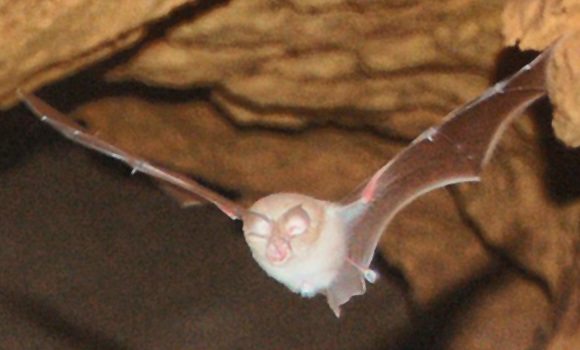
Rhinolophus macrotis has been reported from Bangladesh, China, India, Indonesia, Laos, Malaysia, Myanmar, Nepal, Pakistan, the Philippines, Thailand and Vietnam. It is distinguishable from other horseshoe bats by its exceptionally long ears.
Written 27 November 2026 from the sources listed below. Each statement was checked against the passage it cites; statements that could not be supported were removed.
Appearance
The Big-eared Horseshoe Bat has exceptionally long ears. Its dorsal fur is light brown, while its ventral fur is buffy.[1][2][3]
Its horseshoe-shaped noseleaf is wide enough to cover the muzzle and has a distinct central notch. A secondary noseleaf is present but is often hidden by the horseshoe-shaped noseleaf.[4][5]
The sella is long, rounded and broad, and the connecting process of the noseleaf is high. The lancet is long, has convex lateral margins and ends in a rounded tip.[6][7][8]
Recorded forearm lengths range from 46.9 to 49.9 mm in a sample of five individuals.[9]
Habitat
The species has been recorded in lowland forest at elevations between 200 and 1,050 metres. Other records document it at elevations of 1,661 and 1,692 metres.[10][11]
It generally roosts in caves and mines.[12]
Behaviour
The species is usually found roosting in small numbers and frequently shares cave roosts with other bat species.[13][14]
An observation published by Blandford described the species emerging from its daytime roost during early twilight. It was described as flying rapidly and at high levels while catching insects.[15][16]
Its echolocation call consists of a long constant-frequency signal with a brief frequency-modulated beginning and ending.[17]
An individual recorded in Beijing produced an echolocation call at 53.9 kHz. Large individuals in Guangxi with forearm lengths of 48–49.1 mm produced calls at frequencies of 46.4–47.2 kHz.[18][19]
Echolocation calls recorded in Laos had a frequency of 51 kHz. A bat recorded in Sichuan produced an echolocation call with a frequency of most energy of 52.2 kHz.[20][21]
Diet
Reported prey of the Big-eared Horseshoe Bat include beetles and small flies.[22][23]
Conservation
The species was assessed as Lower Risk/Least Concern in the 2006 IUCN Red List assessment cited by the document. It was described as geographically widespread but little studied.[24][25]
The species was not listed under China's 1989 Law on the Protection of Wildlife. No population-size estimate was available for the species in China in the document.[26][27]
Protection of caves and forests was recommended because they are important habitats for the species.[28]
Similar species
Some Chinese distribution records may represent either Rhinolophus macrotis or Rhinolophus siamensis. Small bats assigned to the macrotis group may actually belong to Rhinolophus siamensis.[29][30]
The taxon may comprise cryptic species.[31]
Classification of the Big-eared Horseshoe Bat
| Kingdom | Animalia |
|---|---|
| Phylum | Chordata |
| Subphylum | Vertebrata |
| Infraphylum | Gnathostomata |
| Parvphylum | Osteichthyes |
| Megaclass | Tetrapoda |
| Class | Mammalia (Mammal) |
| Subclass | Theria |
| Infraclass | Eutheria |
| Order | Chiroptera (Bat) |
| Suborder | Yinpterochiroptera |
| Superfamily | Rhinolophoidea |
| Family | Rhinolophidae (Horseshoe Bat) |
| Genus | Rhinolophus (Horseshoe Bat) |
| Species | Rhinolophus macrotis Blyth, 1844 |
Where the Big-eared Horseshoe Bat is found
Checklists and occurrence records place Rhinolophus macrotis in 8 countries across Asia. GBIF holds 318 georeferenced records of it.
Countries
Regions and cities with the most records
- Yunnan, China 31
- Lucban, Philippines 17
- Lucena, Philippines 17
- Pagbilao, Philippines 17
- Sariaya, Philippines 17
- Tayabas, Philippines 17
- Mauban, Philippines 14
- Jagna, Philippines 11
- Goa, Philippines 9
- Khammouane Province, Laos 9
- Longquan, China 9
- Meghalaya, India 9
- Thakhèk, Laos 8
- Alaminos, Philippines 7
- Bay, Philippines 7
- Cabuyao, Philippines 7
- Calamba, Philippines 7
- Calauan, Philippines 7
- Del Remedio, Philippines 7
- Los Baños, Philippines 7
- Malvar, Philippines 7
- Mamatid, Philippines 7
- San Pablo, Philippines 7
- Santo Tomas, Philippines 7
- Tanauan, Philippines 7
- Victoria, Philippines 7
- Calabanga, Philippines 6
- Dumaguete, Philippines 6
- San Jose, Philippines 6
- Shella, India 6
- Sibulan, Philippines 6
- Guizhou, China 5
- Magarao, Philippines 5
- Naga, Philippines 5
- Pila, Philippines 5
- Tuyen Quang, Vietnam 5
Range as the checklists state it
Southern Asia
A number beside a place is its count of GBIF occurrence records. A place without a number comes from a checklist alone. Records show where a species has been observed or collected, which can include escapes and vagrants.
Common names
English
- Big-eared Horseshoe Bat
Names in 9 other languages
- Czech
- vrápenec velkouchý
- Finnish
- vuoristoherkko
- German
- Großohr-Hufeisennase, Großohrige Hufeisennase
- Japanese
- オオミミキクガシラコウモリ
- Korean
- 큰귀관박쥐
- Malay
- Kelawar Ladam Telinga Panjang
- Polish
- Podkowiec wielkouchy
- Russian
- Длинноухий подковонос
- Thai
- ค้างคาวมงกุฎหูโตเล็ก
Synonyms
One other scientific name has been used for this species and is now treated as a synonym of Rhinolophus macrotis.
- Rhinolopus macrotis Blyth, 1844
Subspecies and varieties
- Rhinolophus macrotis dohrni (Big-eared Horseshoe Bat.) subspecies
- Rhinolophus macrotis hirsutus subspecies
- Rhinolophus macrotis macrotis (Big-eared Horseshoe Bat.) subspecies
- Rhinolophus macrotis topalius subspecies
Related species
-
 Greater Horseshoe BatRhinolophus ferrumequinum
-
 Lesser Horseshoe BatRhinolophus hipposideros
-
 Mediterranean Horseshoe BatRhinolophus euryale
-
 Intermediate Horseshoe BatRhinolophus affinis
-
 Blasius's Horseshoe BatRhinolophus blasii
-
 Mehely's Horseshoe BatRhinolophus mehelyi
- Andaman Horseshoe BatRhinolophus cognatus
-
 Least Horseshoe BatRhinolophus pusillus
Compare
Questions and answers
What is the scientific name of the Big-eared Horseshoe Bat?
The scientific name of the Big-eared Horseshoe Bat is Rhinolophus macrotis. Written with its author, the full name is Rhinolophus macrotis Blyth, 1844.
Which family does the Big-eared Horseshoe Bat belong to?
Rhinolophus macrotis belongs to the family Rhinolophidae, in the order Chiroptera and the class Mammalia.
Where is the Big-eared Horseshoe Bat found?
Checklists and occurrence records place Rhinolophus macrotis in 8 countries, including Philippines, China, Vietnam, Laos, Malaysia and Thailand.
What is the conservation status of the Big-eared Horseshoe Bat?
The IUCN Red List category recorded for Rhinolophus macrotis is Least Concern (LC).
What kind of bat has very large ears?
The Big-eared Horseshoe Bat is distinguishable from other horseshoe bats by its exceptionally long ears.[1]
Sources
Passages the profile rests on
- The species is distinguishable from other horseshoe bats by its exceptionally long ears. Source passage: “The big-eared horseshoe bat can be differentiated from other horseshoe bats by its very long ears and a tongue-shaped sella that is long and broad.” — English Wikipedia
- Its dorsal fur is light brown. Source passage: “Dorsal fur is light brown.” — bio.bris.ac.uk
- Its ventral fur is buffy. Source passage: “Ventral fur is buffy.” — bio.bris.ac.uk
- The horseshoe-shaped noseleaf is wide enough to cover the muzzle and has a distinct central notch. Source passage: “The horseshoe is wide, covering the muzzle and is distinctly notched in the middle.” — bio.bris.ac.uk
- A secondary noseleaf is present but is often hidden by the horseshoe-shaped noseleaf. Source passage: “A secondary noseleaf is present, but this is often concealed by the horseshoe.” — bio.bris.ac.uk
- The sella is long, rounded and broad. Source passage: “The sella is long, rounded and broad.” — bio.bris.ac.uk
- The connecting process of the noseleaf is high. Source passage: “The connecting process is high.” — bio.bris.ac.uk
- The lancet is long, has convex lateral margins and ends in a rounded tip. Source passage: “The lancet is long with convex lateral margins and a rounded tip” — bio.bris.ac.uk
- Recorded forearm lengths range from 46.9 to 49.9 mm in a sample of five individuals. Source passage: “Forearm length 46.9 - 49.9 mm (n = 5)” — bio.bris.ac.uk
- The species has been recorded in lowland forest at elevations between 200 and 1,050 metres. Source passage: “was recorded in lowland forest from 200 metres to 1050 metres.” — bio.bris.ac.uk
- The species has also been recorded at elevations of 1,661 and 1,692 metres. Source passage: “Csorba et al . (2003) note that this species is found at altitudes of 1661 and 1692 metres” — bio.bris.ac.uk
- The species generally roosts in caves and mines. Source passage: “Generally roosts in caves and mines.” — bio.bris.ac.uk
- The species is usually found roosting in small numbers. Source passage: “Usually found in small numbers.” — bio.bris.ac.uk
- The species frequently shares cave roosts with other bat species. Source passage: “This species often shares cave roosts with other bat species.” — bio.bris.ac.uk
- An observation published by Blandford described the species emerging from its daytime roost during early twilight. Source passage: “Blandford (1888-91) stated that it emerges from the day roost during early twilight” — bio.bris.ac.uk
- Blandford described the species as flying rapidly and at high levels while catching insects. Source passage: “flies rapidly and at high levels while catching beetles and small files” — bio.bris.ac.uk
- Its echolocation call consists of a long constant-frequency signal with a brief frequency-modulated beginning and ending. Source passage: “The echolocation call is a long constant frequency signal, with a brief frequency-modulated start and tail.” — bio.bris.ac.uk
- An individual recorded in Beijing produced an echolocation call at 53.9 kHz. Source passage: “One bat in Beijing called at 53.9 kHz.” — bio.bris.ac.uk
- Large individuals in Guangxi with forearm lengths of 48–49.1 mm produced calls at frequencies of 46.4–47.2 kHz. Source passage: “Large bats (48-49.1 mm forearm length) in Guangxi called at 46.4-47.2 kHz.” — bio.bris.ac.uk
- Echolocation calls recorded in Laos had a frequency of 51 kHz. Source passage: “Elsewhere, frequencies of 51 kHz have been recorded in Lao PDR” — bio.bris.ac.uk
- A bat recorded in Sichuan produced an echolocation call with a frequency of most energy of 52.2 kHz. Source passage: “Echolocation calls from a bat in Sichuan (frequency of most energy 52.2 kHz)” — bio.bris.ac.uk
- Beetles have been reported as prey of the species. Source passage: “while catching beetles and small files” — bio.bris.ac.uk
- Small flies have been reported as prey of the species. Source passage: “while catching beetles and small files” — bio.bris.ac.uk
- The species was assessed as Lower Risk/Least Concern in the 2006 IUCN Red List assessment cited by the document. Source passage: “Big-eared horseshoe bats are LR/lc, assessed by the Red List of Threatened Species (IUCN, 2006)” — bio.bris.ac.uk
- The species was described as geographically widespread but little studied. Source passage: “the species is geographically widespread, although little studied.” — bio.bris.ac.uk
- The species was not listed under China's 1989 Law on the Protection of Wildlife. Source passage: “The species is not listed in the Law of the People's Republic of China on the Protection of Wildlife in 1989.” — bio.bris.ac.uk
- No population-size estimate was available for the species in China in the document. Source passage: “There is no estimation of population size in China.” — bio.bris.ac.uk
- Protection of caves and forests was recommended because they are important habitats for the species. Source passage: “Caves and forests should be protected as important habitats.” — bio.bris.ac.uk
- Some Chinese distribution records may represent either Rhinolophus macrotis or Rhinolophus siamensis. Source passage: “Records probably refer to both R. macrotis and R. siamensis.” — bio.bris.ac.uk
- Small bats assigned to the macrotis group may actually belong to Rhinolophus siamensis. Source passage: “Small bats in the macrotis group probably belong top the taxon R. siamensis however.” — bio.bris.ac.uk
- The taxon may comprise cryptic species. Source passage: “This taxon may include cryptic species” — bio.bris.ac.uk
- The species has been reported from Bangladesh, China, India, Indonesia, Laos, Malaysia, Myanmar, Nepal, Pakistan, the Philippines, Thailand and Vietnam. Source passage: “including Bangladesh, China, India, Indonesia, Laos, Malaysia, Myanmar, Nepal, Pakistan, Philippines, Thailand, and Vietnam.” — English Wikipedia
Data
- Catalogue of Life, 2026-10-16 XR cc by
- Global Biodiversity Information Facility CC BY 4.0
- Wikidata CC0
- GeoNames CC BY 4.0
- Within the Catalogue of Life, this name comes from The Integrated Taxonomic Information System cc0
References
- J. Asiat. Soc. Bengal vol.13 p.485 where the name was published
- Ellerman, J. R., and T. C. S. Morrison-Scott. (1951). Checklist of Palaearctic and Indian Mammals 1758 to 1946.
- Wilson, Don E., and DeeAnn M. Reeder, eds. (1993). Mammal Species of the World: A Taxonomic and Geographic Reference, 2nd Ed., 3rd Printing.
- Wilson, Don E., and F. Russell Cole. (2000). Common Names of Mammals of the World.
- Simmons, Nancy B. / Wilson, Don E., and DeeAnn M. Reeder, eds. (2005). Order Chiroptera. Mammal Species of the World: A Taxonomic and Geographic Reference, 3rd Ed., Vols. 1 & 2.
- Wilson, D. E., and R. A. Mittermeier, eds. (2019). Handbook of the Mammals of the World. Vol. 9: Bats.
This species in other databases
Page built on 28 November 2026. See how the catalog is made and all sources and licences.
Cite this page
ScientificNames.org. (2026). Rhinolophus macrotis (Big-eared Horseshoe Bat). Retrieved November 28, 2026, from https://scientificnames.org/species/rhinolophus-macrotis
“Rhinolophus macrotis (Big-eared Horseshoe Bat).” ScientificNames.org, 2026, scientificnames.org/species/rhinolophus-macrotis. Accessed 28 Nov. 2026.
ScientificNames.org. “Rhinolophus macrotis (Big-eared Horseshoe Bat).” Accessed November 28, 2026. https://scientificnames.org/species/rhinolophus-macrotis.
@misc{scientificnames_rhinolophus_macrotis_big_eared_horseshoe_bat,
  author = {{ScientificNames.org}},
  title = {Rhinolophus macrotis (Big-eared Horseshoe Bat)},
  year = {2026},
  url = {https://scientificnames.org/species/rhinolophus-macrotis},
  note = {Accessed 2026-11-28}
}