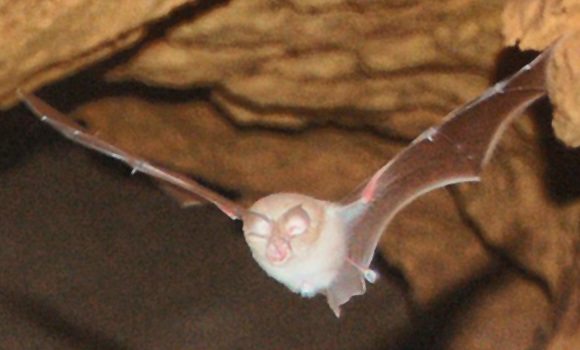
| Appearance | - The bat has dark brown dorsal fur with grayish hair bases and pale brown ventral fur. English Wikipedia
| - The Mediterranean horseshoe bat has fluffy fur with a light grey base. English Wikipedia
- The Mediterranean horseshoe bat has grey-brown dorsal fur that sometimes has a slight reddish tinge. English Wikipedia
- The Mediterranean horseshoe bat has grey-white or yellow-white fur on its underside. English Wikipedia
- The upper connecting process of the Mediterranean horseshoe bat is pointed and slightly bent downwards. English Wikipedia
- The upper connecting process is distinctly longer than the lower connecting process. English Wikipedia
- The Mediterranean horseshoe bat has light brown horseshoe-shaped facial structures and lips. animaldiversity.org
- The ears and wing membranes of the Mediterranean horseshoe bat are light grey. animaldiversity.org
- The Mediterranean horseshoe bat has broad wings. animaldiversity.org
- The second phalanx of the Mediterranean horseshoe bat's fourth finger is more than twice as long as the first phalanx. animaldiversity.org
- The Mediterranean horseshoe bat cannot completely wrap its body in its wing membranes because of its wing anatomy. animaldiversity.org
|
|---|
| Size | | |
|---|
| Habitat | | - The Mediterranean horseshoe bat inhabits warm, forested foothills and mountain regions. animaldiversity.org
- The Mediterranean horseshoe bat favors karst formations containing numerous caves near water sources. animaldiversity.org
- The Mediterranean horseshoe bat favors broadleaved woodlands and olive groves. animaldiversity.org
- The Mediterranean horseshoe bat uses caves and underground shelters as summer roosts. animaldiversity.org
- The Mediterranean horseshoe bat uses warm attics as roosts in more northern parts of its range. animaldiversity.org
- Winter roosts of the Mediterranean horseshoe bat include caves and tunnels with temperatures around 10°C. animaldiversity.org
|
|---|
| Diet | No checked fact yet | - The Mediterranean horseshoe bat feeds on moths and other insects. animaldiversity.org
- The Mediterranean horseshoe bat consumes large quantities of moths and other insects. animaldiversity.org
|
|---|
| Behaviour | No checked fact yet | - The Mediterranean horseshoe bat often roosts alongside other bat species, including other horseshoe bats. animaldiversity.org
- The Mediterranean horseshoe bat generally remains in the same area but may migrate up to 134 km. animaldiversity.org
- The Mediterranean horseshoe bat typically forages alone. animaldiversity.org
- The Mediterranean horseshoe bat is nocturnal and uses echolocation to locate prey. animaldiversity.org
- The Mediterranean horseshoe bat emerges in late twilight to feed. animaldiversity.org
- The Mediterranean horseshoe bat hunts at low altitudes on warm slopes and among relatively dense trees or shrubs. animaldiversity.org
- The Mediterranean horseshoe bat has slow, agile flight and can hover. animaldiversity.org
- The Mediterranean horseshoe bat produces echolocation calls at frequencies of 101–108 kHz. animaldiversity.org
|
|---|
| Reproduction | No checked fact yet | - Maternity roosts of the Mediterranean horseshoe bat commonly contain 50–400 females, sometimes accompanied by males. English Wikipedia
- Births in the Mediterranean horseshoe bat occur from mid-June or July. English Wikipedia
- Young Mediterranean horseshoe bats become independent at approximately four weeks of age. English Wikipedia
- Female Mediterranean horseshoe bats have their first offspring at two to three years of age. English Wikipedia
- Mediterranean horseshoe bats mate in autumn, with mating potentially continuing into winter. English Wikipedia
- Female Mediterranean horseshoe bats give birth to one offspring per breeding event. animaldiversity.org
- A newborn Mediterranean horseshoe bat weighs approximately 4 g. animaldiversity.org
- Young Mediterranean horseshoe bats are ready to fly in early to mid-August, or by mid-July in Bulgaria. animaldiversity.org
- Breeding in the Mediterranean horseshoe bat is thought to occur once annually. animaldiversity.org
|
|---|
| Distribution | - The species is known from nine localities across three locations on Borneo. English Wikipedia
- The species has been recorded at six caves in Sarawak, Malaysia. English Wikipedia
- The species has been recorded at two sites in Central Kalimantan, Indonesia. English Wikipedia
- The species has been recorded at one site in East Kalimantan, Indonesia. English Wikipedia
| - The Mediterranean horseshoe bat occurs in the Mediterranean region and Balkan Peninsula. English Wikipedia
- The Mediterranean horseshoe bat occurs on Sicily, Sardinia, and Corsica. animaldiversity.org
- The northernmost reported range of the Mediterranean horseshoe bat includes Slovakia, northern Italy, and southern France. animaldiversity.org
- The Mediterranean horseshoe bat has also been reported in northern Africa. animaldiversity.org
|
|---|
| Conservation | - The species is classified as endangered by the IUCN. English Wikipedia
- Disturbance from guano mining threatens caves inhabited by the species on Borneo. English Wikipedia
- Ecotourism is identified as a source of disturbance threatening caves in the species' range. English Wikipedia
- The collection of edible-nest swiftlet nests is identified as a threat to caves in the species' range. English Wikipedia
- Palm oil plantations contribute to the loss of foraging habitat for insectivorous bats in the species' range. English Wikipedia
- Cocoa plantations contribute to the loss of foraging habitat for insectivorous bats in the species' range. English Wikipedia
| - The Mediterranean horseshoe bat was assessed as Near Threatened in the IUCN Red List account dated 2016. English Wikipedia
- The Mediterranean horseshoe bat experienced a reported general population decline over 27 years. English Wikipedia
- Agricultural expansion and urbanization are identified as contributors to the Mediterranean horseshoe bat's population decline through loss of foraging vegetation. English Wikipedia
- Disturbance from caving and cave tourism threatens the Mediterranean horseshoe bat because it mainly roosts in caves and underground shelters. English Wikipedia
- Protection of roosting sites is identified as an important long-term conservation strategy for the Mediterranean horseshoe bat. English Wikipedia
- The Mediterranean horseshoe bat experienced a 70% population decline in France between 1940 and 1980. animaldiversity.org
- Pesticide use is identified as a possible contributor to declines in Mediterranean horseshoe bat populations. animaldiversity.org
|
|---|
| Uses | No checked fact yet | - The Mediterranean horseshoe bat provides insect control within its ecosystem. animaldiversity.org
|
|---|
| Similar species | - The species was initially described as a subspecies of the arcuate horseshoe bat. English Wikipedia
- The original description distinguished the species from Rhinolophus arcuatus by its larger body and skull. English Wikipedia
- The species belongs to the euryotis species group within the horseshoe bat genus. English Wikipedia
- The Sulawesi population formerly identified as Rhinolophus arcuatus proconsulis was elevated to species rank as Rhinolophus belligerator in 2013. English Wikipedia
| No checked fact yet |
|---|