Species · Mammals
Bornean Woolly Horseshoe Bat Rhinolophus proconsulis
The scientific name of the Bornean Woolly Horseshoe Bat is Rhinolophus proconsulis. It is a species of mammal in the family Rhinolophidae (horseshoe bat), order Chiroptera. The name dates from 1959.
- Scientific name
- Rhinolophus proconsulis Hill, 1959
- Common name
- Bornean Woolly Horseshoe Bat
- Genus
- Rhinolophus
- Family
- Rhinolophidae (Horseshoe Bat)
- Order
- Chiroptera
- Class
- Mammalia
- Red List category
- EN Endangered
- Name status
- accepted in the Catalogue of Life
Overview
Rhinolophus proconsulis is known from nine localities across three locations on Borneo, including sites in Sarawak, Central Kalimantan, and East Kalimantan. It has dark brown dorsal fur with grayish hair bases and pale brown ventral fur.
Written 27 November 2026 from the sources listed below. Each statement was checked against the passage it cites; statements that could not be supported were removed.
Habitat
The Bornean Woolly Horseshoe Bat roosts in limestone caves during the day.[1]
The species has been recorded at six caves in Sarawak, Malaysia, two sites in Central Kalimantan, Indonesia, and one site in East Kalimantan, Indonesia.[2][3][4]
Appearance
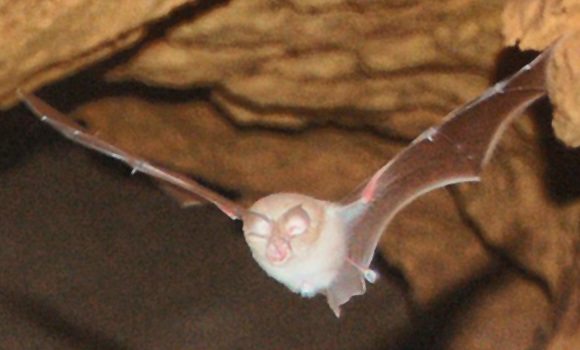
The bat has dark brown dorsal fur with grayish hair bases and pale brown ventral fur.[5]
Its forearm measures 46.8–48.3 mm in length, and its horseshoe measures 9.3–9.7 mm in length.[6][7]
Conservation
The Bornean Woolly Horseshoe Bat is classified as endangered by the IUCN.[8]
Disturbance from guano mining, ecotourism, and the collection of edible-nest swiftlet nests threatens caves inhabited by the species in its range.[9][10][11]
Palm oil and cocoa plantations contribute to the loss of foraging habitat for insectivorous bats in the species' range.[12][13]
Similar species
The species was initially described as a subspecies of the arcuate horseshoe bat. Its original description distinguished it from Rhinolophus arcuatus by its larger body and skull.[14][15]
The Bornean Woolly Horseshoe Bat belongs to the euryotis species group within the horseshoe bat genus.[16]
The Sulawesi population formerly identified as Rhinolophus arcuatus proconsulis was elevated to species rank as Rhinolophus belligerator in 2013.[17]
Classification of the Bornean Woolly Horseshoe Bat
| Kingdom | Animalia |
|---|---|
| Phylum | Chordata |
| Subphylum | Vertebrata |
| Infraphylum | Gnathostomata |
| Parvphylum | Osteichthyes |
| Megaclass | Tetrapoda |
| Class | Mammalia (Mammal) |
| Subclass | Theria |
| Infraclass | Eutheria |
| Order | Chiroptera (Bat) |
| Suborder | Yinpterochiroptera |
| Superfamily | Rhinolophoidea |
| Family | Rhinolophidae (Horseshoe Bat) |
| Genus | Rhinolophus (Horseshoe Bat) |
| Species | Rhinolophus proconsulis Hill, 1959 |
Where the Bornean Woolly Horseshoe Bat is found
Checklists place Rhinolophus proconsulis in Asia.
Range as the checklists state it
Southern Asia
A number beside a place is its count of GBIF occurrence records. A place without a number comes from a checklist alone. Records show where a species has been observed or collected, which can include escapes and vagrants.
Common names
English
- Bornean Woolly Horseshoe Bat
- Proconsul's Horseshoe Bat
Names in 1 other language
- German
- Wollhaarige Borneo-Hufeisennase
Synonyms
2 other scientific names have been used for this species and are now treated as synonyms of Rhinolophus proconsulis.
- Rhinolophus arcuatus proconsulis Hill, 1959
- Rhinolophus arcuatus proconsulis Hill, 1988
Related species
-
 Greater Horseshoe BatRhinolophus ferrumequinum
-
 Lesser Horseshoe BatRhinolophus hipposideros
-
 Mediterranean Horseshoe BatRhinolophus euryale
-
 Intermediate Horseshoe BatRhinolophus affinis
-
 Blasius's Horseshoe BatRhinolophus blasii
-
 Mehely's Horseshoe BatRhinolophus mehelyi
- Andaman Horseshoe BatRhinolophus cognatus
-
 Least Horseshoe BatRhinolophus pusillus
Compare
Questions and answers
What is the scientific name of the Bornean Woolly Horseshoe Bat?
The scientific name of the Bornean Woolly Horseshoe Bat is Rhinolophus proconsulis. Written with its author, the full name is Rhinolophus proconsulis Hill, 1959.
Which family does the Bornean Woolly Horseshoe Bat belong to?
Rhinolophus proconsulis belongs to the family Rhinolophidae, in the order Chiroptera and the class Mammalia.
What is the conservation status of the Bornean Woolly Horseshoe Bat?
The IUCN Red List category recorded for Rhinolophus proconsulis is Endangered (EN).
What other names does the Bornean Woolly Horseshoe Bat have?
Rhinolophus proconsulis is also known in English as Proconsul's Horseshoe Bat.
Sources
Passages the profile rests on
- The species roosts in limestone caves during the day. Source passage: “During the day, it roosts in limestone caves.” — English Wikipedia
- The species has been recorded at six caves in Sarawak, Malaysia. Source passage: “It has been documented in six caves in Sarawak, Malaysia, two sites in Central Kalimantan, Indonesia, and one site in East Kalimantan, Indonesia.” — English Wikipedia
- The species has been recorded at two sites in Central Kalimantan, Indonesia. Source passage: “It has been documented in six caves in Sarawak, Malaysia, two sites in Central Kalimantan, Indonesia, and one site in East Kalimantan, Indonesia.” — English Wikipedia
- The species has been recorded at one site in East Kalimantan, Indonesia. Source passage: “It has been documented in six caves in Sarawak, Malaysia, two sites in Central Kalimantan, Indonesia, and one site in East Kalimantan, Indonesia.” — English Wikipedia
- The bat has dark brown dorsal fur with grayish hair bases and pale brown ventral fur. Source passage: “The fur on its back is dark brown; the bases of the hairs on the back are grayish. Fur on the ventral surface is pale brown.” — English Wikipedia
- Its forearm measures 46.8–48.3 mm in length. Source passage: “Its forearm is 46.8–48.3 mm (1.84–1.90 in) long.” — English Wikipedia
- Its horseshoe measures 9.3–9.7 mm in length. Source passage: “Its horseshoe is 9.3–9.7 mm (0.37–0.38 in) long.” — English Wikipedia
- The species is classified as endangered by the IUCN. Source passage: “It is currently evaluated as endangered by the IUCN.” — English Wikipedia
- Disturbance from guano mining threatens caves inhabited by the species on Borneo. Source passage: “Caves in Borneo are threatened by disturbance via guano mining, ecotourism, and collecting nests of edible-nest swiftlets.” — English Wikipedia
- Ecotourism is identified as a source of disturbance threatening caves in the species' range. Source passage: “Caves in Borneo are threatened by disturbance via guano mining, ecotourism, and collecting nests of edible-nest swiftlets.” — English Wikipedia
- The collection of edible-nest swiftlet nests is identified as a threat to caves in the species' range. Source passage: “Caves in Borneo are threatened by disturbance via guano mining, ecotourism, and collecting nests of edible-nest swiftlets.” — English Wikipedia
- Palm oil plantations contribute to the loss of foraging habitat for insectivorous bats in the species' range. Source passage: “Palm oil plantations and cocoa plantations are resulting in the loss of foraging habitat for insectivorous bats.” — English Wikipedia
- Cocoa plantations contribute to the loss of foraging habitat for insectivorous bats in the species' range. Source passage: “Palm oil plantations and cocoa plantations are resulting in the loss of foraging habitat for insectivorous bats.” — English Wikipedia
- The species was initially described as a subspecies of the arcuate horseshoe bat. Source passage: “This bat was initially described in 1959 from specimens in Borneo as a subspecies of the arcuate horseshoe bat and given the name Rhinolophus arcuatus proconsulis.” — English Wikipedia
- The original description distinguished the species from Rhinolophus arcuatus by its larger body and skull. Source passage: “the subspecies was similar in appearance to R. arcuatus, with the exception of its larger body and skull size.” — English Wikipedia
- The species belongs to the euryotis species group within the horseshoe bat genus. Source passage: “Like the arcuate horseshoe bat, R. proconsulis is placed in the euryotis species group of the horseshoe bat genus.” — English Wikipedia
- The Sulawesi population formerly identified as Rhinolophus arcuatus proconsulis was elevated to species rank as Rhinolophus belligerator in 2013. Source passage: “The Sulawesi "R. a. procunsulis" was also elevated to species rank in the 2013 paper; it is now called Rhinolophus belligerator.” — English Wikipedia
- The species is known from nine localities across three locations on Borneo. Source passage: “It is known from nine localities in three locations.” — English Wikipedia
Data
- Catalogue of Life, 2026-10-16 XR cc by
- Wikidata CC0
- Within the Catalogue of Life, this name comes from The Integrated Taxonomic Information System cc0
References
- Patrick, Lorelei E., Even S. McCulloch, and Luis Ruedas. (2013). Systematics and biogeography of the arcuate horseshoe bat species complex (Chiroptera, Rhinolophidae). Zoologica Scripta, Vol. 42, No. 6.
- Wilson, D. E., and R. A. Mittermeier, eds. (2019). Handbook of the Mammals of the World. Vol. 9: Bats.
This species in other databases
Page built on 28 November 2026. See how the catalog is made and all sources and licences.
Cite this page
ScientificNames.org. (2026). Rhinolophus proconsulis (Bornean Woolly Horseshoe Bat). Retrieved November 28, 2026, from https://scientificnames.org/species/rhinolophus-proconsulis
“Rhinolophus proconsulis (Bornean Woolly Horseshoe Bat).” ScientificNames.org, 2026, scientificnames.org/species/rhinolophus-proconsulis. Accessed 28 Nov. 2026.
ScientificNames.org. “Rhinolophus proconsulis (Bornean Woolly Horseshoe Bat).” Accessed November 28, 2026. https://scientificnames.org/species/rhinolophus-proconsulis.
@misc{scientificnames_rhinolophus_proconsulis_bornean_woolly_horseshoe_bat,
  author = {{ScientificNames.org}},
  title = {Rhinolophus proconsulis (Bornean Woolly Horseshoe Bat)},
  year = {2026},
  url = {https://scientificnames.org/species/rhinolophus-proconsulis},
  note = {Accessed 2026-11-28}
}