Comparison
Rhytidarex buddlei vs Otway Black Snail
Rhytidarex buddlei (Rhytidarex buddlei) and Otway Black Snail (Victaphanta compacta) both belong to the subfamily Rhytidinae and part ways below it.

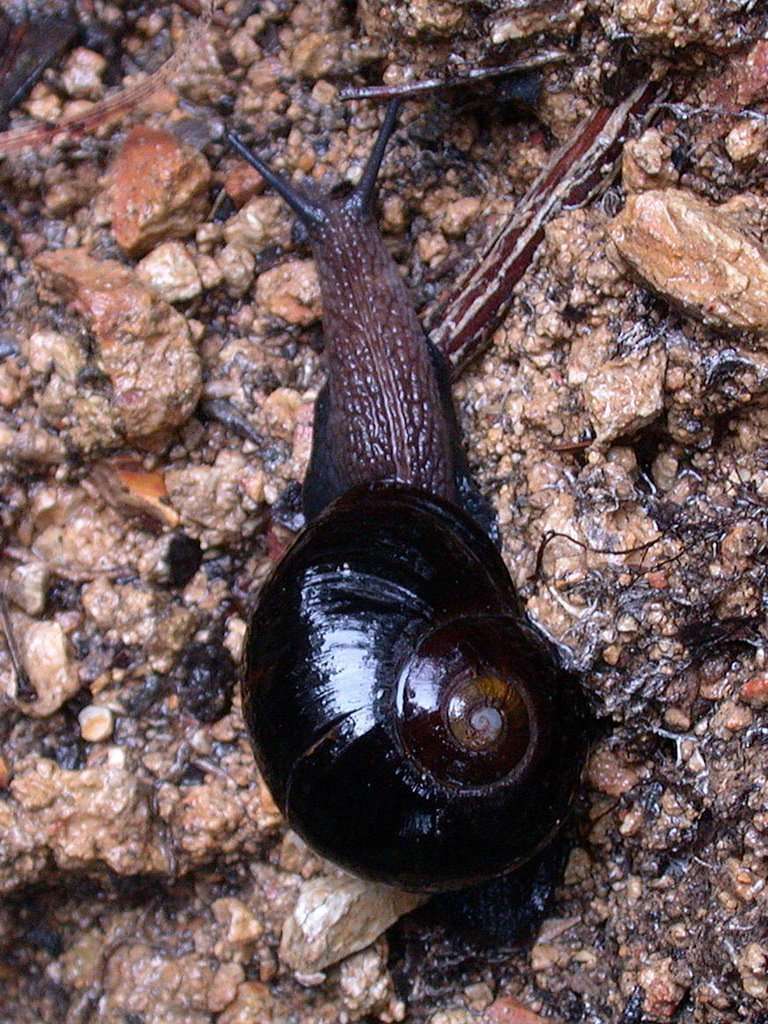


Side by side
| Rhytidarex buddlei | Otway Black Snail | |
|---|---|---|
| Scientific name | Rhytidarex buddlei (A. W. B. Powell, 1948) | Victaphanta compacta (J. C. Cox & Hedley, 1912) |
| English name | Not recorded | Otway Black Snail |
| Group | Molluscs | Molluscs |
| Class | Gastropoda Gastropod | Gastropoda Gastropod |
| Family | Rhytididae Cannibal Snails | Rhytididae Cannibal Snails |
| Genus | Rhytidarex | Victaphanta Australian Carnivorous Snails |
| Named in | 1948 | 1912 |
| Red List category | Not recorded | Endangered |
| Environment | terrestrial | terrestrial |
| Countries on record | Not recorded | 1 country |
| GBIF occurrence records | Not recorded | 706 records |
Rows where the two agree are shown in grey.
Where each is found
Only Otway Black Snail (1)
From Catalogue of Life checklists and GBIF occurrence records. A country missing from a list means no record is held, which is not proof of absence.
Checked facts
| Rhytidarex buddlei | Otway Black Snail | |
|---|---|---|
| Appearance |
|
|
| Size |
|
|
| Habitat |
|
|
| Diet |
|
|
| Behaviour |
|
|
| Distribution |
|
|
| Conservation |
| No checked fact yet |
| Similar species |
|
|
| Name origin |
| No checked fact yet |
| Other |
| No checked fact yet |
In brief
Rhytidarex buddlei
Rhytidarex buddlei is endemic to Moekawa, also known as South West Island, in the Manawatāwhi (Three Kings Islands) of New Zealand. It has a thin, depressed shell with a deep, stepped umbilicus and dense radial wrinkle-like striae on the dorsal surface. Full profile
Otway Black Snail
The Otway Black Snail is a carnivorous land snail. It inhabits cold temperate rainforests in Australia and is endemic to the Otway Ranges in Victoria, Australia. It is distinguished from other Victaphanta species by its globulous shell and lack of an orange foot frill and orange mucus. Full profile
Compare something else
Page built on 28 November 2026 from the data on the two species pages, where every source is listed.
Cite this page
ScientificNames.org. (2026). Rhytidarex buddlei vs Otway Black Snail. Retrieved November 28, 2026, from https://scientificnames.org/compare/rhytidarex-buddlei-vs-otway-black-snail
“Rhytidarex buddlei vs Otway Black Snail.” ScientificNames.org, 2026, scientificnames.org/compare/rhytidarex-buddlei-vs-otway-black-snail. Accessed 28 Nov. 2026.
ScientificNames.org. “Rhytidarex buddlei vs Otway Black Snail.” Accessed November 28, 2026. https://scientificnames.org/compare/rhytidarex-buddlei-vs-otway-black-snail.
@misc{scientificnames_rhytidarex_buddlei_vs_otway_black_snail,
  author = {{ScientificNames.org}},
  title = {Rhytidarex buddlei vs Otway Black Snail},
  year = {2026},
  url = {https://scientificnames.org/compare/rhytidarex-buddlei-vs-otway-black-snail},
  note = {Accessed 2026-11-28}
}