Species · Molluscs
Rhytidarex buddlei
Rhytidarex buddlei has no English name on record in the checklists used here. It is a species of mollusc in the family Rhytididae (cannibal snails). The name dates from 1948.
- Scientific name
- Rhytidarex buddlei (A. W. B. Powell, 1948)
- Genus
- Rhytidarex
- Family
- Rhytididae (Cannibal Snails)
- Class
- Gastropoda
- Environment
- terrestrial
- Name status
- accepted in the Catalogue of Life

Overview
Rhytidarex buddlei is endemic to Moekawa, also known as South West Island, in the Manawatāwhi (Three Kings Islands) of New Zealand. It has a thin, depressed shell with a deep, stepped umbilicus and dense radial wrinkle-like striae on the dorsal surface.
Written 28 November 2026 from the sources listed below. Each statement was checked against the passage it cites; statements that could not be supported were removed.
Appearance
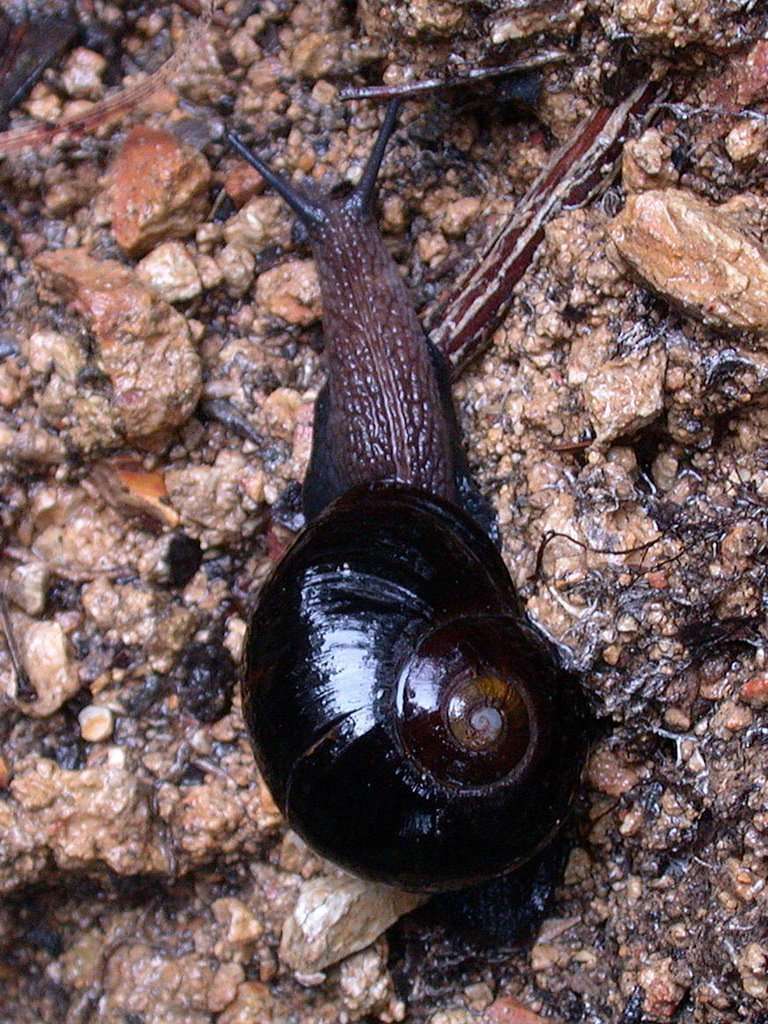
The shell is thin and depressed, with rapidly increasing whorls. It has four and a half whorls, including a protoconch of one and a half whorls, and a narrowly rounded periphery that is scarcely keeled.[1][2][3]
The shell has a deep, stepped umbilicus. Its dorsal surface has dense radial wrinkle-like striae that become hammered in appearance over the later whorls, while the underside is mostly smooth below the periphery.[4][5][6]
Traces of a thin brownish outer layer remain on the shell. Its diameter ranges from 51 to 64 mm, and it reaches a height of 29 mm.[7][8][9]
Similar species
Rhytidarex buddlei can be distinguished from Rhytidarex johnsoni by its larger size, tighter coiling and wider umbilicus.[10]
It is the largest known member among the genera Rhytidarex, Rhytida and Amborhytida.[11]
Habitat
The species typically inhabits mixed broadleaf shrubland. It is found in leaf litter beneath Phormium and similar plants.[12][13]
Diet
The species' diet is unknown, although it is considered likely to prey on invertebrates.[14]
Behaviour
The species is thought to prey on invertebrates.[15]
Conservation
The species is classified as Nationally Critical under the New Zealand Threat Classification System. It was reported as critically endangered in a phylogeographic study of kauri snails and their relatives from Northland, New Zealand.[16][17]
The species was widespread across Moekawa during the eighteenth century. By 2002, its distribution had contracted to approximately 0.03 hectares, and the estimated surviving population was between 50 and 100 individuals.[18][19][20]
The expansion of Meryta sinclairii on the island is considered a likely cause of the species' range contraction.[21]
Classification of Rhytidarex buddlei
| Kingdom | Animalia |
|---|---|
| Phylum | Mollusca |
| Class | Gastropoda (Gastropod) |
| Subclass | Heterobranchia |
| Infraclass | Euthyneura |
| Subterclass | Tectipleura |
| Superorder | Eupulmonata |
| Infraorder | Rhytidoidei |
| Superfamily | Rhytidoidea |
| Family | Rhytididae (Cannibal Snails) |
| Subfamily | Rhytidinae |
| Genus | Rhytidarex |
| Species | Rhytidarex buddlei (A. W. B. Powell, 1948) |
Synonyms
One other scientific name has been used for this species and is now treated as a synonym of Rhytidarex buddlei.
- Rhytida (Rhytidarex) buddlei A. W. B. Powell, 1948
Related species
-
 Rhytidarex johnsoni
-
 Gippsland Black SnailVictaphanta atramentaria
-
 Otway Black SnailVictaphanta compacta
-
 Kauri SnailParyphanta busbyi
-
 Mount Augustus SnailPowelliphanta augusta
-
 Powelliphanta hochstetteri
-
 Schizoglossa novoseelandica
- Powelliphanta patrickensis
Compare
Questions and answers
How long does the species take to reach adult size?
The species likely takes several years to reach its adult size.[22]
Where is Rhytidarex buddlei found?
It is endemic to Moekawa, also known as South West Island, in the Manawatāwhi (Three Kings Islands) of New Zealand.[23]
Where is the holotype held?
The holotype is held at the Auckland War Memorial Museum.[24]
When were specimens other than the holotype discovered?
No specimens other than the holotype were discovered until the mid-1990s.[25]
Sources
Passages the profile rests on
- The species has a thin, depressed shell with rapidly increasing whorls. Source passage: “thin and depressed with rapidly increasing whorls.” — English Wikipedia
- The shell has four and a half whorls, including a protoconch of one and a half whorls. Source passage: “Whorls 4½, including a protoconch of 1½ whorls” — English Wikipedia
- The shell has a narrowly rounded periphery that is scarcely keeled. Source passage: “Periphery narrowly rounded, scarcely carinated.” — English Wikipedia
- The shell has a deep, stepped umbilicus. Source passage: “Umbilicus deep, gradate” — English Wikipedia
- The dorsal shell surface has dense radial wrinkle-like striae that become hammered in appearance over the later whorls. Source passage: “dense radial wrinkle-striae becoming malleated over the later whorls.” — English Wikipedia
- The underside of the shell is mostly smooth below the periphery. Source passage: “The base from below the periphery is more or less smooth as in johnsoni.” — English Wikipedia
- The shell retains traces of a thin brownish outer layer. Source passage: “Traces of a thin brownish epidermis remain.” — English Wikipedia
- The shell diameter ranges from 51 to 64 mm. Source passage: “The shells of the species have a diameter of between 51–64 mm (2.0–2.5 in)” — English Wikipedia
- The shell reaches a height of 29 mm. Source passage: “and a height of 29 mm (1.1 in)” — English Wikipedia
- The species can be distinguished from Rhytidarex johnsoni by its larger size, tighter coiling and wider umbilicus. Source passage: “The species can be differentiated from R. johnsoni due to its size, and by having more tight wound coiling and wider umbilicus.” — English Wikipedia
- The species is the largest known member among the genera Rhytidarex, Rhytida and Amborhytida. Source passage: “making the species the largest known member across the genera of Rhytidarex, Rhytida and Amborhytida.” — English Wikipedia
- The species typically inhabits mixed broadleaf shrubland. Source passage: “The species typically lives in mixed broadleaf shrubland” — English Wikipedia
- The species is found in leaf litter beneath Phormium and similar plants. Source passage: “found in leaf litter underneath Phormium and similar species.” — English Wikipedia
- The species' diet is unknown, although it is considered likely to prey on invertebrates. Source passage: “While the diet and lifestyle of the species is unknown, it likely preys on invertebrates.” — English Wikipedia
- The species is thought to prey on invertebrates. Source passage: “it likely preys on invertebrates.” — English Wikipedia
- The species is classified as Nationally Critical under the New Zealand Threat Classification System. Source passage: “Under the New Zealand Threat Classification System, this species is listed as "Nationally Critical".” — English Wikipedia
- The species was reported as critically endangered in a phylogeographic study of kauri snails and their relatives from Northland, New Zealand. Source passage: “Rhytidarex buddlei (Powell, 1948), which is critically endan-” — academia.edu
- The species was widespread across Moekawa during the eighteenth century. Source passage: “Widespread across Moekawa / South West Island during the 18th century” — English Wikipedia
- By 2002, the species' distribution had contracted to approximately 0.03 hectares. Source passage: “by 2002 the species had become restricted to an area of approximately 0.03 ha (0.074 acres)” — English Wikipedia
- The estimated surviving population was between 50 and 100 individuals by 2002. Source passage: “By 2002, only an estimated 50-100 individuals remained.” — English Wikipedia
- The expansion of Meryta sinclairii on the island is considered a likely cause of the species' range contraction. Source passage: “likely due to the expansion of Meryta sinclairii on the island.” — English Wikipedia
- The species likely takes several years to reach its adult size. Source passage: “The species likely takes several years to attain its adult size.” — English Wikipedia
- The species is endemic to Moekawa, also known as South West Island, in the Manawatāwhi (Three Kings Islands) of New Zealand. Source passage: “It is endemic to Moekawa / South West Island of Manawatāwhi / Three Kings Islands, New Zealand” — English Wikipedia
- The holotype of the species is held at the Auckland War Memorial Museum. Source passage: “The holotype of the species is held by the Auckland War Memorial Museum.” — English Wikipedia
- No specimens other than the holotype were discovered until the mid-1990s. Source passage: “Other than the holotype, no specimens of the species were found until the mid-1990s.” — English Wikipedia
- The species was named after Major Geoffrey Armstrong Buddle, one of the two collectors of its holotype. Source passage: “Powell named the species after Major Geoffrey Armstrong Buddle, one of the two collectors of the holotype” — English Wikipedia
- The name honours Buddle's natural history collections and observations in the Three Kings Islands. Source passage: “in recognition of his natural history collections and observations in Manawatāwhi / Three Kings Islands.” — English Wikipedia
Data
- Catalogue of Life, 2026-10-16 XR cc by
- Wikidata CC0
- Wikimedia Commons per image; credit shown with each image
- Within the Catalogue of Life, this name comes from World Register of Marine Species cc by
This species in other databases
Page built on 28 November 2026. See how the catalog is made and all sources and licences.
Cite this page
ScientificNames.org. (2026). Rhytidarex buddlei. Retrieved November 28, 2026, from https://scientificnames.org/species/rhytidarex-buddlei
“Rhytidarex buddlei.” ScientificNames.org, 2026, scientificnames.org/species/rhytidarex-buddlei. Accessed 28 Nov. 2026.
ScientificNames.org. “Rhytidarex buddlei.” Accessed November 28, 2026. https://scientificnames.org/species/rhytidarex-buddlei.
@misc{scientificnames_rhytidarex_buddlei,
  author = {{ScientificNames.org}},
  title = {Rhytidarex buddlei},
  year = {2026},
  url = {https://scientificnames.org/species/rhytidarex-buddlei},
  note = {Accessed 2026-11-28}
}