Comparison

Club Pygmy Octopus vs Mimic Octopus

Club Pygmy Octopus (Robsonella huttoni) and Mimic Octopus (Thaumoctopus mimicus) both belong to the family Octopodidae (scuttles) and part ways below it.

Club Pygmy Octopus

Club Pygmy Octopus

Robsonella huttoni

Apteryx54, CC BY 4.0, via Wikimedia Commons

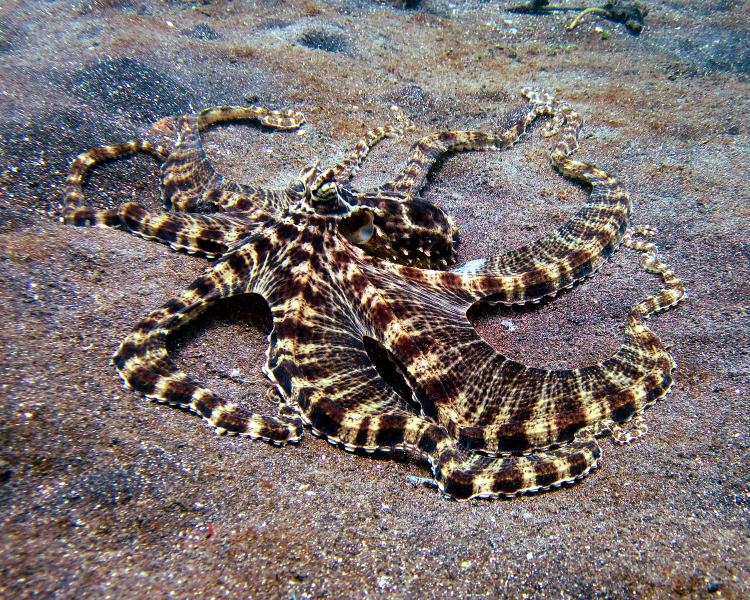
Mimic Octopus

Mimic Octopus

Thaumoctopus mimicus

Steve Childs, CC BY 2.0, via Wikimedia Commons

Side by side

Club Pygmy OctopusMimic Octopus
Scientific nameRobsonella huttoni Benham, 1943Thaumoctopus mimicus M. Norman & Hochberg, 2005
English nameClub Pygmy OctopusMimic Octopus
GroupMolluscsMolluscs
ClassCephalopoda CephalopodCephalopoda Cephalopod
FamilyOctopodidae ScuttlesOctopodidae Scuttles
GenusRobsonellaThaumoctopus Mimic Octopus
Named in19432005
Red List categoryNot recordedLeast Concern
Environmentmarinemarine
Countries on record1 country6 countries
GBIF occurrence records209 records220 records

Rows where the two agree are shown in grey.

Where each is found

Only Club Pygmy Octopus (1)

Only Mimic Octopus (6)

From Catalogue of Life checklists and GBIF occurrence records. A country missing from a list means no record is held, which is not proof of absence.

Checked facts

Club Pygmy OctopusMimic Octopus
Appearance
  • The tenth to thirteenth suckers on adult individuals are notably enlarged. English Wikipedia
  • Adult males have a modified third arm used to store and transfer spermatophores. English Wikipedia
  • The species usually has seven gill lamellae, although individuals with six or eight have also been recorded. English Wikipedia
  • Newly hatched paralarvae have large eyes and semitransparent bodies. English Wikipedia
  • Paralarvae have between 29 and 50 chromatophores distributed across their upper and lower body surfaces. English Wikipedia
  • The species has a natural beige or light-brown coloration with brown bands. English Wikipedia
  • Individuals commonly display contrasting white and brown stripes. English Wikipedia
  • The species has small horn-like projections above each eye. English Wikipedia
  • Its body is slender, with its arms approximately pencil-width at their widest. English Wikipedia
SizeNo checked fact yet
  • The species reaches approximately 60 cm in total length, including its arms. English Wikipedia
Habitat
Diet
  • The species has been reported as prey for various seabirds and fish. English Wikipedia
Behaviour
  • The species exhibits an apparent age-related shift in its distribution along the shore, with older individuals occurring nearer the shore. English Wikipedia
  • Paralarvae have been observed avoiding water temperatures below 15°C and above 23.1°C under experimental conditions. English Wikipedia
  • Paralarvae develop spasms and tissue denaturation when exposed to temperatures above 23.1°C. English Wikipedia
  • The species uses chromatophores to camouflage itself. English Wikipedia
  • The species can imitate multiple marine animal species to avoid predators. English Wikipedia
  • The species has been observed imitating as many as 18 different marine animals. English Wikipedia
  • The species imitates lionfish by extending its arms radially. English Wikipedia
  • The species imitates sea snakes by concealing six arms and holding two parallel to one another. English Wikipedia
  • The species imitates jellyfish by inflating its mantle and trailing its arms. English Wikipedia
  • The species imitates flatfish by positioning all eight arms behind its body while swimming. English Wikipedia
  • The species can use mimicry to approach wary prey. English Wikipedia
  • The species propels itself over the seabed using jets of water expelled through its siphon. sites.evergreen.edu
  • The species can imitate a lionfish by spreading its tentacles away from its head. sites.evergreen.edu
  • The species can imitate a jellyfish by expanding its head and trailing its limbs. sites.evergreen.edu
  • The species can flatten its body and move its tentacles to one side to imitate a flatfish. sites.evergreen.edu
Reproduction
  • Females have been observed laying eggs throughout the year, with laying occurring most frequently between October and March. English Wikipedia
  • Females attach egg clumps to hard surfaces using a naturally produced cement. English Wikipedia
  • Females produce approximately 3,800 to 6,500 eggs. English Wikipedia
  • Individual egg clumps generally contain approximately 50 to 125 eggs. English Wikipedia
  • Egg clumps consist of strands that can reach 25.8 mm in length. English Wikipedia
  • Egg incubation lasts between 43 and 158 days, depending on temperature. English Wikipedia
  • Higher temperatures shorten the embryonic development period. English Wikipedia
  • Eggs incubated under cooler conditions for longer periods tended to have higher survival rates. English Wikipedia
  • Most eggs in one study hatched within a single two-day burst. English Wikipedia
  • The paralarval stage lasts approximately 40 to 70 days. English Wikipedia
No checked fact yet
Distribution
  • The species is native to New Zealand and Australia. English Wikipedia
  • The species occurs throughout New Zealand, including its subantarctic islands, except Campbell Island. English Wikipedia
  • In Australia, the species is known from Tasmania and southern Australia. English Wikipedia
  • Only paralarval specimens have been collected from Macquarie Island. English Wikipedia
  • Relatively small individuals have been recorded in southern Australia. English Wikipedia
No checked fact yet
Conservation
  • The species was classified as Data Deficient by the IUCN as of 2018. English Wikipedia
  • Rising ocean temperatures associated with climate change may restrict the species' distribution. English Wikipedia
  • The species is not commercially fished but is occasionally caught as bycatch. English Wikipedia
No checked fact yet
Other
  • The species was first described in 1943 by zoologist William Benham. English Wikipedia
  • The species was transferred to the genus Robsonella in 2020 based on genetic data. English Wikipedia
No checked fact yet

In brief

Club Pygmy Octopus

Robsonella huttoni inhabits intertidal and subtidal reefs in New Zealand and Australia, living on the seafloor at depths from the sea surface to 386 metres. Full profile

Mimic Octopus

Thaumoctopus mimicus inhabits muddy river-mouth bottoms, estuaries, and shallow offshore waters, primarily on sandy or silty seabeds at depths below 15 meters. Full profile

Compare something else

Page built on 28 November 2026 from the data on the two species pages, where every source is listed.

Cite this page

ScientificNames.org. (2026). Club Pygmy Octopus vs Mimic Octopus. Retrieved November 28, 2026, from https://scientificnames.org/compare/club-pygmy-octopus-vs-mimic-octopus