Comparison
Dune Saffronwood vs Japanese Spindle
Dune Saffronwood (Robsonodendron maritimum) and Japanese Spindle (Euonymus japonicus) both belong to the family Celastraceae (staff-tree family) and part ways below it.

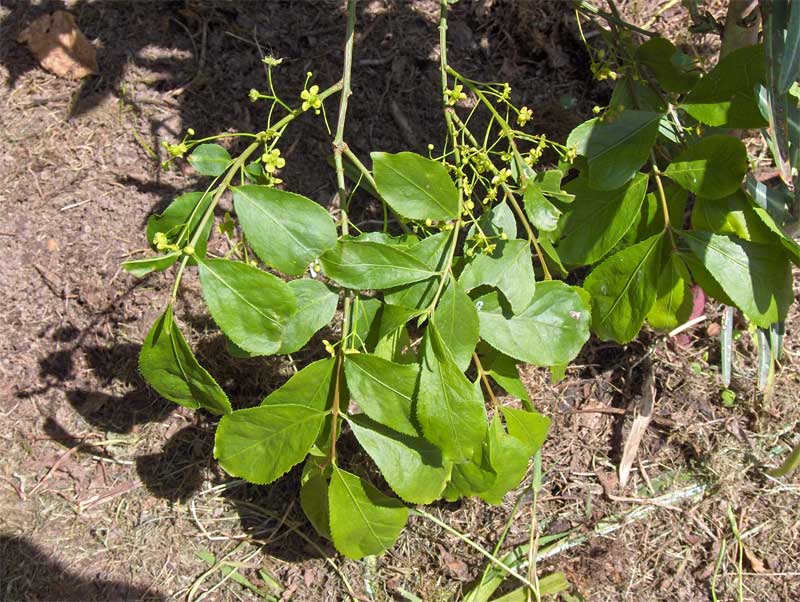


Side by side
| Dune Saffronwood | Japanese Spindle | |
|---|---|---|
| Scientific name | Robsonodendron maritimum (Bolus) R.H.Archer | Euonymus japonicus Thunb. |
| English name | Dune Saffronwood | Japanese Spindle |
| Group | Flowering plants | Flowering plants |
| Class | Magnoliopsida | Magnoliopsida |
| Order | Celastrales | Celastrales |
| Family | Celastraceae Staff-tree Family | Celastraceae Staff-tree Family |
| Genus | Robsonodendron | Euonymus Spindle |
| Countries on record | 1 country | 32 countries |
| GBIF occurrence records | 283 records | 12,074 records |
Rows where the two agree are shown in grey.
Where each is found
Only Dune Saffronwood (1)
Only Japanese Spindle (32)
- Armenia
- Bolivia
- Cambodia
- China
- Colombia
- Croatia
- Georgia
- Germany
- Guernsey
- India
- Indonesia
- Iran
- Ireland
- Japan
- Jersey
- Laos
- Myanmar
- New Zealand
- North Korea
- Pakistan
- Philippines
- Slovakia
- South Korea
- Taiwan
- Tajikistan
- Thailand
- Turkey
- Turkmenistan
- United Kingdom
- United States
- Uzbekistan
- Vietnam
From Catalogue of Life checklists and GBIF occurrence records. A country missing from a list means no record is held, which is not proof of absence.
Checked facts
| Dune Saffronwood | Japanese Spindle | |
|---|---|---|
| Appearance |
|
|
| Size | No checked fact yet |
|
| Habitat |
|
|
| Behaviour |
|
|
| Reproduction |
| No checked fact yet |
| Distribution |
|
|
| Uses | No checked fact yet |
|
| Similar species | No checked fact yet |
|
In brief
Dune Saffronwood
Dune Saffronwood is a small, shrubby, evergreen tree. It is native to coastal regions of South Africa, with a natural range extending from Cape Town along the coast to the Eastern Cape. In areas with strong winds, the tree becomes shaped and effectively pruned by the wind. Full profile
Japanese Spindle
Japanese Spindle is an evergreen shrub or small tree. The species is native to Japan, Korea and China. Its leaves grow in opposite pairs and have an oval shape. Full profile
Compare something else
Page built on 29 November 2026 from the data on the two species pages, where every source is listed.
Cite this page
ScientificNames.org. (2026). Dune Saffronwood vs Japanese Spindle. Retrieved November 29, 2026, from https://scientificnames.org/compare/dune-saffronwood-vs-japanese-spindle
“Dune Saffronwood vs Japanese Spindle.” ScientificNames.org, 2026, scientificnames.org/compare/dune-saffronwood-vs-japanese-spindle. Accessed 29 Nov. 2026.
ScientificNames.org. “Dune Saffronwood vs Japanese Spindle.” Accessed November 29, 2026. https://scientificnames.org/compare/dune-saffronwood-vs-japanese-spindle.
@misc{scientificnames_dune_saffronwood_vs_japanese_spindle,
  author = {{ScientificNames.org}},
  title = {Dune Saffronwood vs Japanese Spindle},
  year = {2026},
  url = {https://scientificnames.org/compare/dune-saffronwood-vs-japanese-spindle},
  note = {Accessed 2026-11-29}
}