Comparison

Pink Hagfish vs Pacific Hagfish

Pink Hagfish (Rubicundus eos) and Pacific Hagfish (Eptatretus stoutii) both belong to the family Myxinidae (hagfishes) and part ways below it.

Pink Hagfish

Rubicundus eos
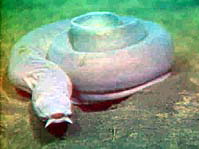
Pacific Hagfish

Pacific Hagfish

Eptatretus stoutii

Lmozero, Public domain, via Wikimedia Commons

Side by side

Pink HagfishPacific Hagfish
Scientific nameRubicundus eos (Fernholm, 1991)Eptatretus stoutii (Lockington, 1878)
English namePink HagfishPacific Hagfish
GroupFishesFishes
ClassMyxiniMyxini
OrderMyxiniformes HagfishMyxiniformes Hagfish
FamilyMyxinidae HagfishesMyxinidae Hagfishes
GenusRubicundusEptatretus
Named in19911878
Red List categoryNot recordedData Deficient
Environmentmarinemarine
Countries on recordNot recorded3 countries
GBIF occurrence recordsNot recorded964 records

Rows where the two agree are shown in grey.

Where each is found

Only Pacific Hagfish (3)

From Catalogue of Life checklists and GBIF occurrence records. A country missing from a list means no record is held, which is not proof of absence.

Checked facts

Pink HagfishPacific Hagfish
Appearance
  • The Pacific hagfish has an elongated body resembling that of an eel. English Wikipedia
  • Its body coloration ranges from dark brown and gray to brownish red, sometimes with blue or purple tints. English Wikipedia
  • Its belly is lighter in color and sometimes has larger white patches. English Wikipedia
  • The species lacks true fins but has a dorsal fin-fold. English Wikipedia
  • Its mouth lacks jaws and is surrounded by eight barbels. English Wikipedia
  • The Pacific hagfish has no externally visible eyes and possesses a single nostril above its mouth. English Wikipedia
  • It has between 10 and 14 gill pores positioned approximately one-quarter of the body length behind the front. English Wikipedia
  • Its skin is loosely fitted and slimy, with slime glands capable of producing large quantities of slime. English Wikipedia
SizeNo checked fact yet
Habitat
  • The species inhabits fine silt and clay seabeds on continental shelves and upper continental slopes. English Wikipedia
  • It occurs at depths ranging from 16 to 966 metres. English Wikipedia
  • The Pacific hagfish typically inhabits muddy seabeds but is occasionally found on rocky bottoms. animaldiversity.org
  • The species is more commonly found at depths between 40 and 100 metres. animaldiversity.org
  • Pacific hagfish inhabit cold marine waters. animaldiversity.org
DietNo checked fact yet
  • The Pacific hagfish probably consumes polychaete worms and other invertebrates found on the seabed. English Wikipedia
  • It feeds on the internal organs of dead, dying, or incapacitated large fish. English Wikipedia
  • Pacific hagfish consume dead or dying fish and mammals and probably also eat marine invertebrates. animaldiversity.org
  • The species can absorb amino acids through its skin. English Wikipedia
  • Pacific hagfish can absorb l-alanine and glycine through both their skin and gill surfaces. pmc.ncbi.nlm.nih.gov
  • The species can obtain dissolved organic nutrients directly from its surrounding environment through its skin and gills. pmc.ncbi.nlm.nih.gov
BehaviourNo checked fact yet
  • The Pacific hagfish produces large quantities of slime as a defensive response. English Wikipedia
  • Its slime expands rapidly upon contact with seawater. animaldiversity.org
  • The species can tie its body into knots to remove slime, evade predators, and generate force when tearing flesh. animaldiversity.org
  • The Pacific hagfish has been observed preferring a coiled resting position. English Wikipedia
  • The species can squeeze through openings narrower than half its body width. English Wikipedia
  • Pacific hagfish use an undulatory swimming motion that propels them forward through waves travelling along their bodies. English Wikipedia
  • The species can survive for several months without eating. animaldiversity.org
ReproductionNo checked fact yet
  • Pacific hagfish fertilize their eggs externally after females lay them. English Wikipedia
  • Females lay approximately 28 eggs on average. English Wikipedia
  • The eggs measure approximately 5 mm in diameter. English Wikipedia
  • Females protect their fertilized eggs by remaining in their burrows during this period. English Wikipedia
  • The species has an approximately equal male-to-female sex ratio. English Wikipedia
  • Pacific hagfish reproduce repeatedly, with irregular spawning intervals that can extend to two or three years. English Wikipedia
  • Juvenile Pacific hagfish exhibit hermaphroditism before differentiating into separate sexes after maturity. English Wikipedia
  • Pacific hagfish hatch as fully functional individuals without an intermediate larval stage. animaldiversity.org
  • Females generally deposit between 20 and 30 eggs at a time. animaldiversity.org
  • There is no parental involvement after egg-laying. animaldiversity.org
Distribution
  • Rubicundus eos is known only from a single specimen collected off the coast of New Zealand. English Wikipedia
  • The Pacific hagfish occurs in the Northeast Pacific from southeastern Alaska to Baja California, Mexico. English Wikipedia
  • The species was recorded off the coast of Costa Rica in 2015. English Wikipedia
ConservationNo checked fact yet
UsesNo checked fact yet
  • Pacific hagfish meat is consumed in Korea, where approximately five million pounds are eaten annually. animaldiversity.org
  • Pacific hagfish skin is processed into accessories including purses, wallets, and boots. animaldiversity.org
  • A hagfish fishery on the United States West Coast primarily supplies the Asian leather market. English Wikipedia
  • Pacific hagfish are sometimes kept in public aquariums. animaldiversity.org
Other
  • Rubicundus eos was originally classified in the genus Eptatretus. English Wikipedia
  • Rubicundus eos was reclassified into the genus Rubicundus following a 2013 analysis. English Wikipedia
  • Rubicundus is considered the sister genus to the remaining hagfish species. English Wikipedia
No checked fact yet

In brief

Pink Hagfish

Pink Hagfish inhabits deep waters of the Tasman Sea. Pink Hagfish has pink coloration and is known only from a single specimen collected off the coast of New Zealand. Full profile

Pacific Hagfish

Eptatretus stoutii occurs in the Northeast Pacific from southeastern Alaska to Baja California, Mexico, and has also been recorded off the coast of Costa Rica. It has a jawless mouth surrounded by eight barbels and produces large quantities of slime as a defensive response. Full profile

Compare something else

Page built on 27 November 2026 from the data on the two species pages, where every source is listed.

Cite this page

ScientificNames.org. (2026). Pink Hagfish vs Pacific Hagfish. Retrieved November 27, 2026, from https://scientificnames.org/compare/pink-hagfish-vs-pacific-hagfish