Species · Fishes
Pacific Hagfish Eptatretus stoutii
The scientific name of the Pacific Hagfish is Eptatretus stoutii. It is a species of fish in the family Myxinidae (hagfishes), order Myxiniformes. The name dates from 1878.
- Scientific name
- Eptatretus stoutii (Lockington, 1878)
- Common name
- Pacific Hagfish
- Genus
- Eptatretus
- Family
- Myxinidae (Hagfishes)
- Order
- Myxiniformes
- Class
- Myxini
- Red List category
- DD Data Deficient
- Environment
- marine
- Recorded in
- 3 countries
- Name status
- accepted in the Catalogue of Life
Overview
Eptatretus stoutii occurs in the Northeast Pacific from southeastern Alaska to Baja California, Mexico, and has also been recorded off the coast of Costa Rica. It has a jawless mouth surrounded by eight barbels and produces large quantities of slime as a defensive response.
Written 26 November 2026 from the sources listed below. Each statement was checked against the passage it cites; statements that could not be supported were removed.
Appearance
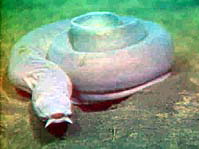
The Pacific Hagfish has an elongated body resembling that of an eel. Its coloration ranges from dark brown and gray to brownish red, sometimes with blue or purple tints, while its belly is lighter and sometimes has larger white patches.[1][2][3]
It lacks true fins but has a dorsal fin-fold. Its mouth lacks jaws and is surrounded by eight barbels, and it has no externally visible eyes and a single nostril above its mouth.[4][5][6]
It has between 10 and 14 gill pores positioned approximately one-quarter of the body length behind the front. Its skin is loosely fitted and slimy, with slime glands capable of producing large quantities of slime.[7][8]
Reported body lengths range from 30 to 63.5 cm, with a reported maximum body length of 63 cm. Typical body length at maturity is approximately 42 cm, and reported body weight ranges from 0.8 to 1.4 kg.[9][10][11][12]
Habitat
The Pacific Hagfish inhabits fine silt and clay seabeds on continental shelves and upper continental slopes. It typically occurs on muddy seabeds but is occasionally found on rocky bottoms.[13][14]
It occurs at depths ranging from 16 to 966 metres and is more commonly found between 40 and 100 metres. It inhabits cold marine waters.[15][16][17]
Diet
The Pacific Hagfish feeds on the internal organs of dead, dying or incapacitated large fish. It also consumes dead or dying fish and mammals and probably eats marine invertebrates, including polychaete worms and other invertebrates found on the seabed.[18][19][20]
It can absorb amino acids through its skin, including l-alanine and glycine through both its skin and gill surfaces. It can obtain dissolved organic nutrients directly from its surroundings through its skin and gills.[21][22][23]
Behaviour
The Pacific Hagfish produces large quantities of slime as a defensive response. The slime expands rapidly upon contact with seawater.[24][25]
It can tie its body into knots to remove slime, evade predators and generate force when tearing flesh. It has been observed preferring a coiled resting position.[26][27]
It can squeeze through openings narrower than half its body width. It swims using an undulatory motion that propels it forward through waves travelling along its body.[28][29]
The Pacific Hagfish can survive for several months without eating.[30]
Reproduction and life cycle
Pacific hagfish fertilize their eggs externally after females lay them. Females generally deposit between 20 and 30 eggs at a time, with an average of approximately 28 eggs, each measuring approximately 5 mm in diameter.[31][32][33][34]
Females protect their fertilized eggs by remaining in their burrows during this period. There is no parental involvement after egg-laying.[35][36]
The species has an approximately equal male-to-female sex ratio. Juveniles exhibit hermaphroditism before differentiating into separate sexes after maturity.[37][38]
Pacific hagfish reproduce repeatedly, with irregular spawning intervals that can extend to two or three years. They hatch as fully functional individuals without an intermediate larval stage.[39][40]
Conservation
The conservation status of the Pacific Hagfish is classified as data deficient. The species remains common throughout its range.[41][42]
Uses
Pacific Hagfish meat is consumed in Korea, where approximately five million pounds are eaten annually. Its skin is processed into accessories including purses, wallets and boots.[43][44]
A hagfish fishery on the United States West Coast primarily supplies the Asian leather market. Pacific hagfish are also sometimes kept in public aquariums.[45][46]
Classification of the Pacific Hagfish
| Kingdom | Animalia |
|---|---|
| Phylum | Chordata |
| Subphylum | Vertebrata |
| Infraphylum | Agnatha |
| Superclass | Cyclostomi |
| Class | Myxini |
| Order | Myxiniformes (Hagfish) |
| Family | Myxinidae (Hagfishes) |
| Subfamily | Eptatretinae |
| Genus | Eptatretus |
| Species | Eptatretus stoutii (Lockington, 1878) |
Where the Pacific Hagfish is found
Checklists and occurrence records place Eptatretus stoutii in 3 countries. GBIF holds 964 georeferenced records of it.
Countries
Regions and cities with the most records
- California, United States 54
- Marina, United States 40
- Pacific Grove, United States 39
- Seaside, United States 27
- Monterey, United States 25
- San Diego, United States 22
- British Columbia, Canada 18
- Imperial Beach, United States 17
- Encinitas, United States 15
- Coronado, United States 14
- Torrance, United States 12
- Carlsbad, United States 11
- Lomita, United States 11
- Oceanside, United States 11
- Rancho Palos Verdes, United States 11
- Carson, United States 10
- Hermosa Beach, United States 10
- Redondo Beach, United States 10
- West Carson, United States 10
- Chula Vista, United States 9
- Vista, United States 9
- El Segundo, United States 8
- Manhattan Beach, United States 8
- Long Beach, United States 7
- Watsonville, United States 7
- Hawthorne, United States 6
- La Joya, Mexico 6
- Lawndale, United States 6
- Pórticos de San Antonio, Mexico 6
- Tijuana, Mexico 6
- Villa del Prado 2da Sección, Mexico 6
- Fallbrook, United States 5
- Goleta, United States 5
- Isla Vista, United States 5
- Las Delicias, Mexico 5
- Prunedale, United States 5
A number beside a place is its count of GBIF occurrence records. A place without a number comes from a checklist alone. Records show where a species has been observed or collected, which can include escapes and vagrants.
Common names
English
- Pacific Hagfish
- California Hagfish
Names in 10 other languages
- Czech
- pasliznatka Stoutova
- Dutch
- Blinde prik
- Finnish
- tyynenmerenlimaaja
- French
- myxine brune
- German
- Pazifischer Inger, Pazifischer Schleimaal
- Polish
- śluzica brunatna
- Portuguese
- Peixe-bruxa-do-Pacífico
- Russian
- Тихоокеанский пиявкорот
- Spanish
- Mixinido del Pacifico, bruja pintada
- Thai
- ปลาปากกลม
Synonyms
4 other scientific names have been used for this species and are now treated as synonyms of Eptatretus stoutii.
- Bdellostoma stouti Lockington, 1878
- Bdellostoma stoutii Lockington, 1878
- Eptatretus stouti (Lockington, 1878)
- Polistotrema stoutii (Lockington, 1878)
Related species
-
 Inshore HagfishEptatretus burgeri
- Goliath HagfishEptatretus goliath
-
 Sixgill HagfishEptatretus hexatrema
-
 Black HagfishEptatretus deani
-
 Broadgilled HagfishEptatretus cirrhatus
-
 Chilean HagfishEptatretus polytrema
-
 Gulf HagfishEptatretus springeri
- Bischoff's HagfishEptatretus bischoffii
Compare
Questions and answers
What is the scientific name of the Pacific Hagfish?
The scientific name of the Pacific Hagfish is Eptatretus stoutii. Written with its author, the full name is Eptatretus stoutii (Lockington, 1878).
Which family does the Pacific Hagfish belong to?
Eptatretus stoutii belongs to the family Myxinidae, in the order Myxiniformes and the class Myxini.
Where is the Pacific Hagfish found?
Checklists and occurrence records place Eptatretus stoutii in 3 countries: United States, Canada and Mexico.
What is the conservation status of the Pacific Hagfish?
The IUCN Red List category recorded for Eptatretus stoutii is Data Deficient (DD).
What other names does the Pacific Hagfish have?
Eptatretus stoutii is also known in English as California Hagfish.
Can hagfish be eaten?
Yes. Pacific Hagfish meat is consumed in Korea, where approximately five million pounds are eaten annually.[43]
What is the largest hagfish ever known?
The reported maximum body length of the Pacific Hagfish is 63 cm.[9]
Where do Pacific hagfish live?
They occur in the Northeast Pacific from southeastern Alaska to Baja California, Mexico. The species was also recorded off the coast of Costa Rica in 2015.[47][48]
Sources
Passages the profile rests on
- The Pacific hagfish has an elongated body resembling that of an eel. Source passage: “The Pacific hagfish has a long, eel-like body, but is not closely related to eels.” — English Wikipedia
- Its body coloration ranges from dark brown and gray to brownish red, sometimes with blue or purple tints. Source passage: “It is dark brown, gray or brownish red, often tinted with blue or purple.” — English Wikipedia
- Its belly is lighter in color and sometimes has larger white patches. Source passage: “The belly is lighter and sometimes has larger white patches.” — English Wikipedia
- The species lacks true fins but has a dorsal fin-fold. Source passage: “It has no true fins, but there is a dorsal fin-fold.” — English Wikipedia
- Its mouth lacks jaws and is surrounded by eight barbels. Source passage: “The head, as in all agnathans, does not have jaws, and the sucker-like mouth is always open, with 8 barbels around it.” — English Wikipedia
- The Pacific hagfish has no externally visible eyes and possesses a single nostril above its mouth. Source passage: “There are no visible eyes. Hagfish also only have one nostril, which is located above the mouth.” — English Wikipedia
- It has between 10 and 14 gill pores positioned approximately one-quarter of the body length behind the front. Source passage: “Starting about one quarter of their body length from the front are 10–14 gill pores.” — English Wikipedia
- Its skin is loosely fitted and slimy, with slime glands capable of producing large quantities of slime. Source passage: “Hagfish have loosely fitted, slimy skins, and are notorious for their slime-production capability.” — English Wikipedia
- Reported maximum body length is 63 cm. Source passage: “Maximum body lengths of 63 cm (25 in) have been reported;” — English Wikipedia
- Typical body length at maturity is approximately 42 cm. Source passage: “typical length at maturity is around 42 cm (17 in).” — English Wikipedia
- Reported body lengths range from 30 to 63.5 cm. Source passage: “They are from 30 to 63.5 cm in length and from 0.8 to 1.4 kg.” — animaldiversity.org
- Reported body weight ranges from 0.8 to 1.4 kg. Source passage: “They are from 30 to 63.5 cm in length and from 0.8 to 1.4 kg.” — animaldiversity.org
- The species inhabits fine silt and clay seabeds on continental shelves and upper continental slopes. Source passage: “It inhabits fine silt and clay bottoms on the continental shelves and upper slopes” — English Wikipedia
- The Pacific hagfish typically inhabits muddy seabeds but is occasionally found on rocky bottoms. Source passage: “Pacific hagfish are found typically on muddy bottoms to depths of 633 meters, but can also be found occasionally on rocky bottoms.” — animaldiversity.org
- It occurs at depths ranging from 16 to 966 metres. Source passage: “at depths from 16–966 metres (52–3,169 ft).” — English Wikipedia
- The species is more commonly found at depths between 40 and 100 metres. Source passage: “They are more common at shallower depths, from 40 to 100 meters.” — animaldiversity.org
- Pacific hagfish inhabit cold marine waters. Source passage: “Eptatretus stouti (Pacific hagfish) are found in cold marine waters of the antitropical north and south Pacific Ocean on muddy sea floors.” — animaldiversity.org
- The Pacific hagfish probably consumes polychaete worms and other invertebrates found on the seabed. Source passage: “While Pacific hagfish likely take polychaete worms and other invertebrates from the sea floor,” — English Wikipedia
- It feeds on the internal organs of dead, dying, or incapacitated large fish. Source passage: “they are also known to enter dead, dying or inhibited large fish through the mouth or the anus, and feed on their viscera.” — English Wikipedia
- Pacific hagfish consume dead or dying fish and mammals and probably also eat marine invertebrates. Source passage: “Pacific hagfish feed on a variety of dead or dying organisms, including fish and mammals, but also probably include marine invertebrates in their diet.” — animaldiversity.org
- The species can absorb amino acids through its skin. Source passage: “The Pacific hagfish's skin can absorb amino acids.” — English Wikipedia
- Pacific hagfish can absorb l-alanine and glycine through both their skin and gill surfaces. Source passage: “l-alanine and glycine were absorbed via specific transport pathways across both gill and skin surfaces,” — pmc.ncbi.nlm.nih.gov
- The species can obtain dissolved organic nutrients directly from its surrounding environment through its skin and gills. Source passage: “The ability to absorb dissolved organic matter across the skin and gill may be an adaptation to a scavenging lifestyle,” — pmc.ncbi.nlm.nih.gov
- The Pacific hagfish produces large quantities of slime as a defensive response. Source passage: “They can excrete copious amounts of slime in self-defense.” — English Wikipedia
- Its slime expands rapidly upon contact with seawater. Source passage: “Upon contact with seawater, the slime rapidly expands into a sticky gel that can sometimes suffocate an attacker.” — animaldiversity.org
- The species can tie its body into knots to remove slime, evade predators, and generate force when tearing flesh. Source passage: “This can be used to elude predators, to bury into a carcass, to gain leverage to tear off pieces of flesh, or clean itself of slime.” — animaldiversity.org
- The Pacific hagfish has been observed preferring a coiled resting position. Source passage: “Compared to other species of hagfish, the Pacific hagfish has also been observed preferring a coiled position when resting.” — English Wikipedia
- The species can squeeze through openings narrower than half its body width. Source passage: “In fact, the Pacific hagfish is able to fit through spaces that are less than one half of its total body width.” — English Wikipedia
- Pacific hagfish use an undulatory swimming motion that propels them forward through waves travelling along their bodies. Source passage: “This means that hagfish pass a wave down the length of their body which propels them forward, beginning at their head.” — English Wikipedia
- The species can survive for several months without eating. Source passage: “Hagfish can go several months without eating.” — animaldiversity.org
- Pacific hagfish fertilize their eggs externally after females lay them. Source passage: “Hagfish fertilize their eggs externally after the female has laid them.” — English Wikipedia
- Females lay approximately 28 eggs on average. Source passage: “On average females lay about 28 eggs,” — English Wikipedia
- The eggs measure approximately 5 mm in diameter. Source passage: “about 5 mm (0.20 in) in diameter,” — English Wikipedia
- Females generally deposit between 20 and 30 eggs at a time. Source passage: “From 20 to 30 eggs are usually deposited at a time.” — animaldiversity.org
- Females protect their fertilized eggs by remaining in their burrows during this period. Source passage: “Females will however try to stay in their burrows during this period to ensure the protection of their eggs.” — English Wikipedia
- There is no parental involvement after egg-laying. Source passage: “There is no parental involvement after egg-laying.” — animaldiversity.org
- The species has an approximately equal male-to-female sex ratio. Source passage: “Pacific hagfish also have a sex ratio of roughly 1:1.” — English Wikipedia
- Juvenile Pacific hagfish exhibit hermaphroditism before differentiating into separate sexes after maturity. Source passage: “Pacific hagfish juveniles also exhibit hermaphroditism, and do not become differentiated into separate sexes until after maturity.” — English Wikipedia
- Pacific hagfish reproduce repeatedly, with irregular spawning intervals that can extend to two or three years. Source passage: “E. stoutii is iteroparous, and spawns on an irregular time schedule. These cycles can take up to 2–3 years before new spawning.” — English Wikipedia
- Pacific hagfish hatch as fully functional individuals without an intermediate larval stage. Source passage: “Pacific hagfish hatch from an egg in fully functional form without any intermediate larval stage.” — animaldiversity.org
- The conservation status of the Pacific hagfish is classified as data deficient. Source passage: “Conservation status for this species is data deficient.” — English Wikipedia
- The species remains common throughout its range. Source passage: “Pacific hagfish remain common throughout their range.” — animaldiversity.org
- Pacific hagfish meat is consumed in Korea, where approximately five million pounds are eaten annually. Source passage: “In Korea, approximately 5 million pounds of Pacific hagfish meat is consumed yearly,” — animaldiversity.org
- Pacific hagfish skin is processed into accessories including purses, wallets, and boots. Source passage: “and in many countries the skin is commonly processed into "eelskin" accessories such as purses, wallets, and boots.” — animaldiversity.org
- A hagfish fishery on the United States West Coast primarily supplies the Asian leather market. Source passage: “There is a well-developed hagfish fishery on the US West Coast that mostly supplies the Asian leather-market.” — English Wikipedia
- Pacific hagfish are sometimes kept in public aquariums. Source passage: “Hagfish are sometimes found in public aquariums,” — animaldiversity.org
- The Pacific hagfish occurs in the Northeast Pacific from southeastern Alaska to Baja California, Mexico. Source passage: “The Pacific hagfish occurs in the Northeast Pacific Ocean from southeast Alaska to Baja California, Mexico.” — English Wikipedia
- The species was recorded off the coast of Costa Rica in 2015. Source passage: “The Pacific hagfish also was discovered off the coast of Costa Rica in 2015,” — English Wikipedia
Data
- Catalogue of Life, 2026-10-16 XR cc by
- Global Biodiversity Information Facility CC BY 4.0
- Wikidata CC0
- GeoNames CC BY 4.0
- Wikimedia Commons per image; credit shown with each image
- Within the Catalogue of Life, this name comes from World Register of Marine Species cc by
This species in other databases
- Catalogue of Life 6FZ3N
- Wikidata Q683492
- iNaturalist 100268
- WoRMS urn:lsid:marinespecies.org:taxname:279298
- ITIS 622244
Page built on 29 November 2026. See how the catalog is made and all sources and licences.
Cite this page
ScientificNames.org. (2026). Eptatretus stoutii (Pacific Hagfish). Retrieved November 29, 2026, from https://scientificnames.org/species/eptatretus-stoutii
“Eptatretus stoutii (Pacific Hagfish).” ScientificNames.org, 2026, scientificnames.org/species/eptatretus-stoutii. Accessed 29 Nov. 2026.
ScientificNames.org. “Eptatretus stoutii (Pacific Hagfish).” Accessed November 29, 2026. https://scientificnames.org/species/eptatretus-stoutii.
@misc{scientificnames_eptatretus_stoutii_pacific_hagfish,
  author = {{ScientificNames.org}},
  title = {Eptatretus stoutii (Pacific Hagfish)},
  year = {2026},
  url = {https://scientificnames.org/species/eptatretus-stoutii},
  note = {Accessed 2026-11-29}
}