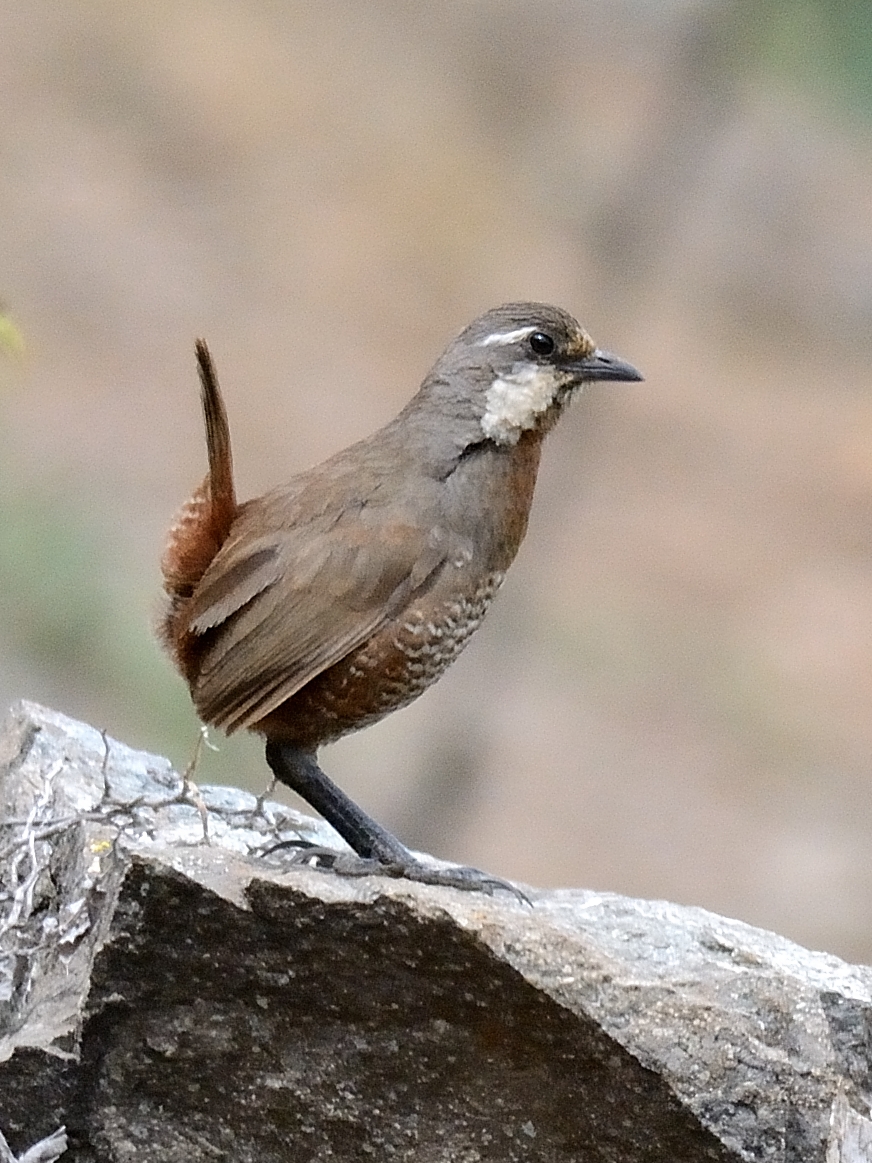
| Appearance | - The nominate subspecies has a grayish-brown head, a white supercilium, and reddish-brown back, wings, and rump. English Wikipedia
- The nominate subspecies has a white throat with black streaks along its sides. English Wikipedia
- Most of the bird's breast is white. English Wikipedia
- Its flanks and vent have black, brown, and white barring. English Wikipedia
- The upper breast has a yellow to orange-brown band that gives the species its common name. English Wikipedia
- The subspecies L. t. erithacus has a browner head and a larger, darker breast band than the nominate subspecies. English Wikipedia
- The subspecies L. t. dugandi has a rufous breast band that extends into the neck and throat. English Wikipedia
- The species has a gray upper body, white underparts, a diffuse red-brown breast band, and variable black barring. ebird.org
| - The adult plumage is predominantly cinnamon brown, with white barring on the breast, belly and undertail-coverts. English Wikipedia
- The species has a heavy bill, a cocked tail and disproportionately large feet. English Wikipedia
- Adult birds have a dark eyestripe, a white eyebrow and a broad white stripe along each side of the throat. English Wikipedia
- The bill and legs are black in adult birds. English Wikipedia
- Males and females have similar plumage, although females are usually smaller. English Wikipedia
- Juveniles have an unbarred rump and fainter barring on the flanks compared with adults. English Wikipedia
- The atacamae subspecies is smaller and paler than the nominate subspecies, with whiter underparts. English Wikipedia
- The species is characterized by a large, stocky body shape, prominent white moustaches and a boldly barred belly. ebird.org
|
|---|
| Size | | |
|---|
| Habitat | - The species primarily inhabits humid terra firme forest. English Wikipedia
- The species also inhabits seasonally flooded várzea forest. English Wikipedia
- The species is associated with subtropical or tropical moist lowland habitat. inaturalist.org
- The species occupies the understory of rainforests. ebird.org
- The species primarily inhabits forest with ground that remains dry throughout the year. English Wikipedia
- The rusty-belted tapaculo is the only member of its family reported to inhabit Amazonian rainforest. English Wikipedia
| - The species inhabits hillsides with some shrubs and low tree cover. English Wikipedia
- The species prefers habitats with low water content in the soil. English Wikipedia
- The atacamae subspecies occurs in semi-desert habitat containing scattered rocks and boulders. English Wikipedia
|
|---|
| Diet | | - The species feeds mainly on invertebrates, including insects and earthworms. English Wikipedia
- The species also consumes seeds and fruits. English Wikipedia
- The Moustached Turca displaces rocks and forages near plants when searching for seeds and fruits. English Wikipedia
|
|---|
| Behaviour | | - The Moustached Turca is primarily ground-dwelling and can run quickly. English Wikipedia
- The species rarely flies and uses flight only for short distances. English Wikipedia
- The species vocalizes mainly in the morning and at dusk, although calls and songs can occur throughout the day. English Wikipedia
- Its song consists of low hooting notes lasting between five and ten seconds. English Wikipedia
- The species commonly sings and produces bubbling calls while perched on exposed rocks or high boulders. English Wikipedia
|
|---|
| Reproduction | | - Nesting begins in July, and chicks hatch between August and December. English Wikipedia
- Adults have been observed beginning nest construction at the end of July. English Wikipedia
- Adults have been observed carrying food to nests until January. English Wikipedia
- The species excavates nesting tunnels measuring between 0.4 and 2.2 metres deep in earth banks on steep rocky hillsides. English Wikipedia
- The nesting burrow ends in a cavity approximately 25 centimetres wide. English Wikipedia
- The megapodius subspecies usually lays two eggs, with an occasional third egg. English Wikipedia
- The atacamae subspecies typically lays three eggs. English Wikipedia
- Eggs of the atacamae subspecies average 32.1 millimetres in length and 24.6 millimetres in width. English Wikipedia
|
|---|
| Distribution | - The species occurs in Brazil, Bolivia, Colombia, Ecuador, and Peru. English Wikipedia
- The nominate subspecies occurs in western and central Amazonian Brazil. English Wikipedia
- The nominate subspecies is believed to occur in southeastern Peru and northern Bolivia. English Wikipedia
- The subspecies L. t. dugandi occurs in southeastern Colombia and adjacent western Brazil. English Wikipedia
- The subspecies L. t. erithacus occurs in eastern Ecuador and eastern Peru. English Wikipedia
- The species generally occurs at elevations up to 600 m. English Wikipedia
- The species reaches elevations of 900 m in some locations. English Wikipedia
- In Peru, the species occurs at elevations up to 1,000 m. English Wikipedia
| - The Moustached Turca is endemic to Chile. English Wikipedia
- The nominate megapodius subspecies occurs in central Chile. English Wikipedia
- The atacamae subspecies occurs in the Atacama Region of Chile. English Wikipedia
- Reproductive individuals have been recorded at elevations between sea level and 2,000 metres in the Andean foothills. English Wikipedia
- Non-reproductive individuals have been recorded at elevations reaching 3,200 metres. English Wikipedia
|
|---|
| Conservation | - The rusty-belted tapaculo has been assessed as Least Concern by the IUCN. English Wikipedia
- The species' population size is unknown but is believed to be fairly large and stable. English Wikipedia
- The species occurs in several large protected areas. English Wikipedia
- The species was most recently assessed for the IUCN Red List in 2022. iucnredlist.org
| |
|---|
| Similar species | - The spotted bamboowren (Psilorhamphus guttatus) is the species' closest genetic relative. English Wikipedia
| - The White-throated Tapaculo is a potential identification confusion because it shares the Moustached Turca's environment. English Wikipedia
- The White-throated Tapaculo is smaller and lacks the Moustached Turca's distinctive white moustache. English Wikipedia
|
|---|
| Name origin | No checked fact yet | - The specific name megapodius derives from ancient Greek words meaning big feet. English Wikipedia
|
|---|
| Other | - The rusty-belted tapaculo is the only species classified in the genus Liosceles. English Wikipedia
- The genus and species were first described by Philip Lutley Sclater in 1865. English Wikipedia
- Three subspecies are recognized: L. t. thoracicus, L. t. dugandi, and L. t. erithacus. English Wikipedia
| - The species was first described by Heinrich von Kittlitz in 1830. English Wikipedia
- Two subspecies are recognized: Pteroptochos megapodius megapodius and Pteroptochos megapodius atacamae. English Wikipedia
|
|---|