Comparison

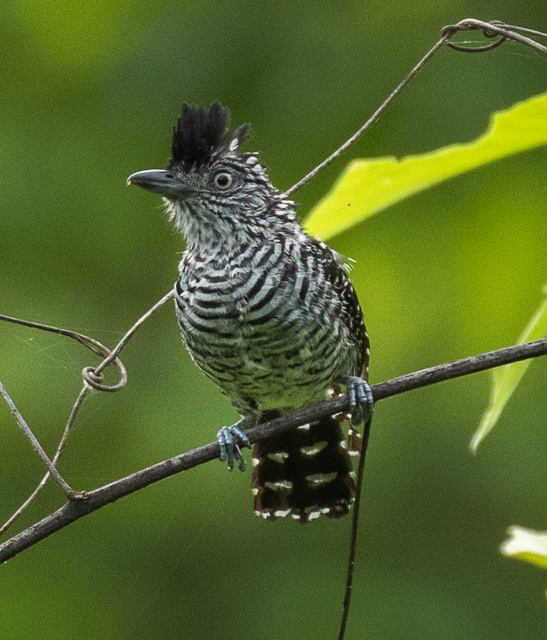
Black-crested Antshrike vs Barred Antshrike

Black-crested Antshrike (Sakesphorus canadensis) and Barred Antshrike (Thamnophilus doliatus) both belong to the family Thamnophilidae (antbird) and part ways below it. Both are recorded in 8 countries.

Black-crested Antshrike

Black-crested Antshrike

Sakesphorus canadensis

Félix Uribe from Rionegro, Antioquia, Colombia, CC BY-SA 2.0, via Wikimedia Commons

Barred Antshrike

Barred Antshrike

Thamnophilus doliatus

Francesco Veronesi from Italy, CC BY-SA 2.0, via Wikimedia Commons

Side by side

Black-crested AntshrikeBarred Antshrike
Scientific nameSakesphorus canadensis (Linnaeus, 1766)Thamnophilus doliatus (Linnaeus, 1764)
English nameBlack-crested AntshrikeBarred Antshrike
GroupBirdsBirds
ClassAves BirdAves Bird
OrderPasseriformes PasserinePasseriformes Passerine
FamilyThamnophilidae AntbirdThamnophilidae Antbird
GenusSakesphorus AntshrikesThamnophilus Antshrikes
Named in17661764
Red List categoryLeast ConcernLeast Concern
EnvironmentNot recordedterrestrial
Countries on record8 countries21 countries
GBIF occurrence records39,258 records268,780 records

Rows where the two agree are shown in grey.

Where each is found

Both recorded in 8 countries

Only Barred Antshrike (13)

From Catalogue of Life checklists and GBIF occurrence records. A country missing from a list means no record is held, which is not proof of absence.

Checked facts

Black-crested AntshrikeBarred Antshrike
Appearance
  • Both sexes possess a bushy crest and exhibit pronounced sexual dimorphism. English Wikipedia
  • Adult males of the nominate subspecies have predominantly black-and-white barred plumage. English Wikipedia
  • Adult females of the nominate subspecies have cinnamon-rufous crests and upperparts. English Wikipedia
  • Adults of both sexes have pale yellow irises, black upper mandibles, bluish-gray lower mandibles, and lead-gray legs and feet. English Wikipedia
  • Juvenile males have black and light yellowish-brown barring. English Wikipedia
Size
Habitat
  • The Coiba Island subspecies inhabits tropical deciduous forest. English Wikipedia
  • The Tobago subspecies inhabits mature humid forest. English Wikipedia
  • The eastern Brazilian subspecies T. d. capistratus primarily inhabits caatinga and restinga. English Wikipedia
  • In eastern Colombia, the species frequently occurs on river islands. English Wikipedia
  • In Ecuador, northern Peru, and much of Brazilian Amazonia, the species occurs almost exclusively on river islands. English Wikipedia
  • In southern Bolivia, Paraguay, and Argentina, its habitats include savanna, scrub, secondary forest, and riverine belts. English Wikipedia
  • In Mexico, Central America, and Colombia, the species occurs from sea level to approximately 1,500 m elevation. English Wikipedia
  • In Venezuela, the species reaches elevations of 2,000 m, although most records are below 1,250 m. English Wikipedia
  • In Ecuador, the species occurs only below 250 m elevation. English Wikipedia
Diet
  • Its diet consists primarily of mature and larval insects, supplemented by other arthropods, small lizards, fruit, and seeds. English Wikipedia
  • The species also feeds on prey escaping army ant swarms. English Wikipedia
Behaviour
  • The species forages either alone or in pairs. English Wikipedia
  • It sometimes joins mixed-species feeding flocks. English Wikipedia
  • It typically feeds from ground level to approximately 15 m above the ground. English Wikipedia
  • While foraging, it hops through dense vegetation and gleans prey from leaves, stems, vines, and branches. English Wikipedia
  • The species has been observed dropping to the ground to capture prey. English Wikipedia
  • The species is presumed to remain resident throughout the year across its range. English Wikipedia
  • The species remains resident throughout its geographical range year-round. English Wikipedia
  • Individuals typically forage in closely associated pairs within dense foliage from ground level to approximately 3 m, occasionally reaching 10 m. English Wikipedia
  • The species almost never participates in mixed-species feeding flocks. English Wikipedia
  • It captures prey by rapidly stabbing at leaves, stems, branches, and trunks. English Wikipedia
  • Both sexes sing while stretching their necks, bowing forward, and pumping their tails up and down. English Wikipedia
Reproduction
  • The species is monogamous, and breeding pairs vigorously defend territories throughout the year. English Wikipedia
  • Territory sizes measured in one study ranged from approximately 2,500 to 4,200 square metres. English Wikipedia
  • Breeding has been recorded in every month of the year somewhere within the species' range. English Wikipedia
  • In Trinidad and Tobago, the species apparently breeds throughout the year. English Wikipedia
  • The nest is an open, tightly woven cup with thin walls constructed from fungal and vegetable fibers, vines, grasses, and twigs. English Wikipedia
  • The nest is generally suspended by its rim from a branch fork at heights reaching 10 m above the ground. English Wikipedia
  • Both sexes participate in nest construction. English Wikipedia
  • The usual clutch contains two eggs, although clutches of three have been reported in Trinidad. English Wikipedia
  • Both parents incubate eggs during daylight, while only the female incubates at night. English Wikipedia
  • A Costa Rican study recorded an incubation period of 13 days after the second egg was laid. English Wikipedia
  • Studies in multiple countries recorded a period of 10–13 days between hatching and fledging. English Wikipedia
  • Both parents brood and feed the nestlings. English Wikipedia
Distribution
  • The species occurs in Trinidad, Colombia, Venezuela, the Guianas, Brazil, and Peru. English Wikipedia
  • The species occurs in Mexico, every Central American country, Trinidad and Tobago, and all mainland South American countries except Chile and Uruguay. English Wikipedia
  • One accepted occurrence record exists from southern Texas. English Wikipedia
  • The subspecies T. d. intermedius occurs from San Luis Potosí and Tamaulipas in east-central Mexico south through Central America to Costa Rica and possibly Panama. English Wikipedia
  • The subspecies T. d. nesiotes occurs on the Pearl Islands in the Gulf of Panama. English Wikipedia
  • The subspecies T. d. eremnus occurs on Coiba Island off western Panama. English Wikipedia
Conservation
  • The black-crested antshrike was assessed for the IUCN Red List in 2016. iucnredlist.org
  • The species is considered common throughout its range. English Wikipedia
  • The population size is unknown and believed to be decreasing. English Wikipedia
  • No immediate threats have been identified for the species. English Wikipedia
  • Some local populations restricted to dry forest may be more sensitive to potential threats. English Wikipedia
  • The IUCN classifies the species as Least Concern. English Wikipedia
  • The estimated population comprises at least 50 million mature individuals and is considered stable. English Wikipedia
  • Deforestation, habitat destruction, and habitat fragmentation are identified as challenges to the species' survival. English Wikipedia
Name originNo checked fact yet
  • The specific epithet doliatus derives from Neo-Latin and means barred. English Wikipedia
Other
  • The species belongs to the family Thamnophilidae. English Wikipedia
  • The species is placed in the genus Sakesphorus, established by Charles Chubb in 1918. English Wikipedia
No checked fact yet

In brief

Black-crested Antshrike

The Black-crested Antshrike is a bird in the family Thamnophilidae, genus Sakesphorus, and order Passeriformes. It occurs in Trinidad, Colombia, Venezuela, the Guianas, Brazil, and Peru. Both sexes have a shaggy crest, and the species measures 14–18 cm in length and weighs 20–28 g. Full profile

Barred Antshrike

Thamnophilus doliatus occurs in Mexico, every Central American country, Trinidad and Tobago, and all mainland South American countries except Chile and Uruguay. Adults of both sexes have bushy crests and pronounced sexual dimorphism, with predominantly black-and-white barred plumage in nominate males and cinnamon-rufous crests and upperparts in nominate females. Full profile

Compare something else

Page built on 27 November 2026 from the data on the two species pages, where every source is listed.

Cite this page

ScientificNames.org. (2026). Black-crested Antshrike vs Barred Antshrike. Retrieved November 27, 2026, from https://scientificnames.org/compare/black-crested-antshrike-vs-barred-antshrike