Species · Birds
Black-crested Antshrike Sakesphorus canadensis
The scientific name of the Black-crested Antshrike is Sakesphorus canadensis. It is a species of bird in the family Thamnophilidae (antbird), order Passeriformes. The name dates from 1766.
- Scientific name
- Sakesphorus canadensis (Linnaeus, 1766)
- Common name
- Black-crested Antshrike
- Genus
- Sakesphorus
- Family
- Thamnophilidae (Antbird)
- Order
- Passeriformes
- Class
- Aves
- Red List category
- LC Least Concern
- Recorded in
- 8 countries
- Name status
- accepted in the Catalogue of Life

Overview
The Black-crested Antshrike is a bird in the family Thamnophilidae, genus Sakesphorus, and order Passeriformes. It occurs in Trinidad, Colombia, Venezuela, the Guianas, Brazil, and Peru. Both sexes have a shaggy crest, and the species measures 14–18 cm in length and weighs 20–28 g.
Written 26 November 2026 from the sources listed below. Each statement was checked against the passage it cites; statements that could not be supported were removed.
Appearance
Both sexes have a shaggy crest. The species measures 14–18 cm in length and weighs 20–28 g.[1][2][3]
Habitat
The Black-crested Antshrike inhabits deciduous woodland and savanna woodland, as well as gallery forest and bushy areas in semi-arid regions. It also occurs along the edges of igapó and várzea forests.[4][5][6]
It occurs locally in mangroves and dune scrub near the Caribbean coast. It primarily occupies the forest understorey and mid-storey, but can also be found in gardens and city parks.[7][8][9]
Its recorded elevational range reaches 900 m.[10]
Diet
The Black-crested Antshrike feeds on a wide variety of insects and other arthropods. Its diet also includes small lizards and fruit.[11][12]
Behaviour
The species forages alone or in pairs and sometimes joins mixed-species feeding flocks. It typically feeds from ground level to approximately 15 m above the ground.[13][14][15]
While foraging, it hops through dense vegetation and gleans prey from leaves, stems, vines, and branches. It has also been observed dropping to the ground to capture prey.[16][17]
The species is presumed to remain resident throughout the year across its range.[18]
Reproduction and life cycle
The breeding season in much of Colombia and Venezuela extends from June through September. In Guyana, it runs from March through May, while in French Guiana it extends from December through July.[19][20][21]
On Trinidad, the breeding season lasts from May through July. In Suriname, the species can breed at any time of year.[22][23]
The nest is a cup made from grass and other plant and fungal fibers, typically suspended in a fork of a branch. The usual clutch consists of two eggs.[24][25][26]
An incubation period of 14 days was recorded in one study in Suriname. Both sexes incubate eggs and feed nestlings during daylight, while only the female incubates the nestlings at night.[27][28][29]
Conservation
The Black-crested Antshrike was assessed for the IUCN Red List in 2016 and is considered common throughout its range. Its population size is unknown and believed to be decreasing.[30][31][32]
No immediate threats have been identified for the species. Some local populations restricted to dry forest may be more sensitive to potential threats.[33][34]
Classification of the Black-crested Antshrike
| Kingdom | Animalia |
|---|---|
| Phylum | Chordata |
| Subphylum | Vertebrata |
| Infraphylum | Gnathostomata |
| Parvphylum | Osteichthyes |
| Megaclass | Tetrapoda |
| Class | Aves (Bird) |
| Order | Passeriformes (Passerine) |
| Family | Thamnophilidae (Antbird) |
| Genus | Sakesphorus (Antshrikes) |
| Species | Sakesphorus canadensis (Linnaeus, 1766) |
Where the Black-crested Antshrike is found
Checklists and occurrence records place Sakesphorus canadensis in 8 countries across North America and South America. GBIF holds 39,258 georeferenced records of it.
Countries
- Brazil 1,904
- Colombia 22,499
- French Guiana 822
- Guyana 2,090
- Peru 517
- Suriname 1,609
- Trinidad and Tobago 2,370
- Venezuela 7,447
Regions and cities with the most records
- La Guajira Department, Colombia 4,051
- Meta Department, Colombia 3,060
- Falcón, Venezuela 2,642
- Casanare Department, Colombia 2,176
- Bolívar, Colombia 2,000
- Barranquilla, Colombia 1,881
- Magdalena Department, Colombia 1,873
- La Vela de Coro, Venezuela 1,854
- Soledad, Colombia 1,849
- Atlántico, Colombia 1,597
- Córdoba, Colombia 1,490
- Coro, Venezuela 1,479
- Malambo, Colombia 1,435
- Galapa, Colombia 1,234
- Paradise, Trinidad and Tobago 1,220
- Arima, Trinidad and Tobago 1,195
- Cesar Department, Colombia 1,193
- Zulia, Venezuela 1,148
- Tunapuna, Trinidad and Tobago 1,130
- Santa Rosa, Colombia 1,126
- Cartagena, Colombia 1,119
- Paramaribo, Suriname 1,034
- Roraima, Brazil 1,026
- Upper Takutu-Upper Essequibo, Guyana 994
- Chaguanas, Trinidad and Tobago 993
- Turbaco, Colombia 936
- Amazonas, Brazil 890
- Albania, Colombia 889
- Lelydorp, Suriname 858
- Puerto Colombia, Colombia 822
- Santander Department, Colombia 813
- Villavicencio, Colombia 809
- Restrepo, Colombia 782
- Commewijne District, Suriname 757
- Arjona, Colombia 754
- Vichada Department, Colombia 735
Range as the checklists state it
South America
Caribbean
A number beside a place is its count of GBIF occurrence records. A place without a number comes from a checklist alone. Records show where a species has been observed or collected, which can include escapes and vagrants.
Common names
English
- Black-crested Antshrike
Names in 24 other languages
- Catalan
- batarà capnegre
- Chinese
- 黑冠蚁鵙, 黑冠蟻鵙
- Croatian
- krunata mravarica
- Czech
- mravenčík černochocholatý
- Danish
- Myretornskade
- Dutch
- Zwartkuifmierklauwier
- Esperanto
- nigrakresta formikulo
- Finnish
- sointumuura
- French
- Batara huppé
- German
- Schwarzgesicht-Ameisenwürger, Schwarzhauben-Ameisenwürger
- Italian
- Averla formichiera crestanera
- Japanese
- エボシアリモズ
- Lithuanian
- juodakuodis esperitas
- Norwegian
- svarttoppmaurvarsler
- Polish
- mrowiec czarnoczuby
- Portuguese
- choca-de-crista-preta, formigueiro-de-crista-preta
- Russian
- Чернохохлый колючник, Чернохохлый малый эсперито
- Serbian
- Crnoćubi mravlji svračak
- Slovak
- batara čiernochvostá
- Spanish
- Batará crestinegro
- Swedish
- svarttofsad myrtörnskata
- Turkish
- Kara Tepeli Karıncaavcısı
- Ukrainian
- сорокуш-малюк північний
- Welsh
- morgrugydd cribog
Synonyms
2 other scientific names have been used for this species and are now treated as synonyms of Sakesphorus canadensis.
- Lanius canadensis Linnaeus, 1766
- Turdus cirrhatus J. F. Gmelin, 1789
Subspecies and varieties
- Sakesphorus canadensis canadensis subspecies
- Sakesphorus canadensis fumosus subspecies
- Sakesphorus canadensis intermedius subspecies
- Sakesphorus canadensis loretoyacuensis subspecies
- Sakesphorus canadensis pulchellus (Streak-fronted Antshrike) subspecies
- Sakesphorus canadensis trinitatis subspecies
Related species
-
 Glossy AntshrikeSakesphorus luctuosus
-
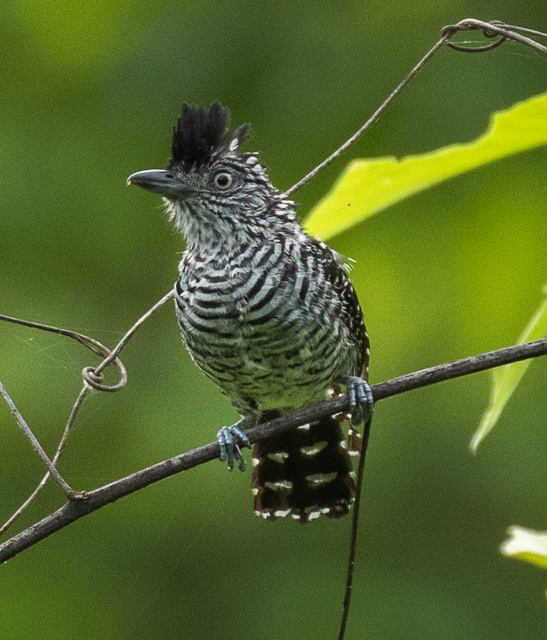 Barred AntshrikeThamnophilus doliatus
-
 Great AntshrikeTaraba major
-
 Black-crowned AntshrikeThamnophilus atrinucha
-
 Ocellated AntbirdPhaenostictus mcleannani
-
 Bicolored AntbirdGymnopithys bicolor
-
 Fasciated AntshrikeCymbilaimus lineatus
-
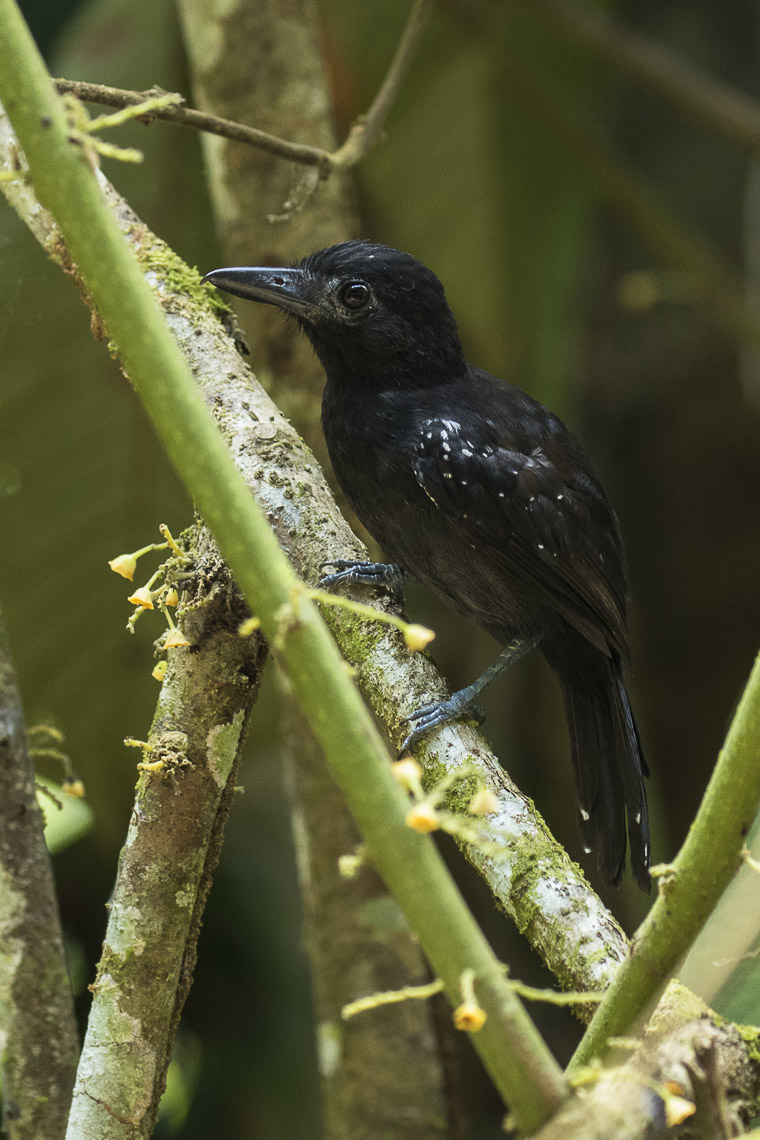 Black-hooded AntshrikeThamnophilus bridgesi
Compare
Questions and answers
What is the scientific name of the Black-crested Antshrike?
The scientific name of the Black-crested Antshrike is Sakesphorus canadensis. Written with its author, the full name is Sakesphorus canadensis (Linnaeus, 1766).
Which family does the Black-crested Antshrike belong to?
Sakesphorus canadensis belongs to the family Thamnophilidae, in the order Passeriformes and the class Aves.
Where is the Black-crested Antshrike found?
Checklists and occurrence records place Sakesphorus canadensis in 8 countries, including Colombia, Venezuela, Trinidad and Tobago, Guyana, Brazil and Suriname.
What is the conservation status of the Black-crested Antshrike?
The IUCN Red List category recorded for Sakesphorus canadensis is Least Concern (LC).
Sources
Passages the profile rests on
- Both sexes have a shaggy crest. Source passage: “but both sexes have a shaggy crest.” — English Wikipedia
- The black-crested antshrike measures 14–18 cm in length. Source passage: “The black-crested antshrike is 14 to 18 cm (5.5 to 7.1 in) long” — English Wikipedia
- The species weighs 20–28 g. Source passage: “weighs 20 to 28 g (0.71 to 0.99 oz).” — English Wikipedia
- The species inhabits deciduous woodland and savanna woodland. Source passage: “inhabits deciduous and savanna woodlands” — English Wikipedia
- Its habitats include gallery forest and bushy areas in semi-arid regions. Source passage: “gallery forest, and bushy areas in semi-arid regions.” — English Wikipedia
- The species also occurs along the edges of igapó and várzea forests. Source passage: “and also in the edges of igapó and várzea forest.” — English Wikipedia
- It occurs locally in mangroves and dune scrub near the Caribbean coast. Source passage: “It also occurs locally in mangroves and dune scrub near the Caribbean coast.” — English Wikipedia
- The species primarily occupies the forest understorey and mid-storey. Source passage: “All of the subspecies occur mostly in the understorey and mid-storey of the forest” — English Wikipedia
- The species can also be found in gardens and city parks. Source passage: “and also can be found in gardens and city parks.” — English Wikipedia
- Its recorded elevational range reaches 900 m. Source passage: “In elevation the species occurs as high as 900 m (3,000 ft)” — English Wikipedia
- The species feeds on a wide variety of insects and other arthropods. Source passage: “The black-crested antshrike feeds on a wide variety of insects and other arthropods” — English Wikipedia
- Its diet also includes small lizards and fruit. Source passage: “and also includes small lizards and fruit in its diet.” — English Wikipedia
- The species forages either alone or in pairs. Source passage: “It forages singly or in pairs” — English Wikipedia
- It sometimes joins mixed-species feeding flocks. Source passage: “and sometimes joins mixed-species feeding flocks” — English Wikipedia
- It typically feeds from ground level to approximately 15 m above the ground. Source passage: “typically feeds from the ground up to about 15 m (50 ft) above it.” — English Wikipedia
- While foraging, it hops through dense vegetation and gleans prey from leaves, stems, vines, and branches. Source passage: “It hops through dense vegetation, gleaning prey from leaves, stems, vines, and branches” — English Wikipedia
- The species has been observed dropping to the ground to capture prey. Source passage: “It has been observed dropping to the ground to capture prey.” — English Wikipedia
- The species is presumed to remain resident throughout the year across its range. Source passage: “The black-crested antshrike is presumed to be a year-round resident throughout its range.” — English Wikipedia
- The breeding season in much of Colombia and Venezuela extends from June through September. Source passage: “In much of Colombia and Venezuela it spans from June to September” — English Wikipedia
- In Guyana, the breeding season runs from March through May. Source passage: “in Guyana March to May” — English Wikipedia
- In French Guiana, the breeding season extends from December through July. Source passage: “in French Guyana December to July” — English Wikipedia
- On Trinidad, the breeding season lasts from May through July. Source passage: “on Trinidad May to July” — English Wikipedia
- The species can breed at any time of year in Suriname. Source passage: “and in Suriname at any time of year.” — English Wikipedia
- Its nest is a cup made from grass and other plant and fungal fibers. Source passage: “Its nest is a cup woven variously from grass and other plant and fungal fibers” — English Wikipedia
- The nest is typically suspended in a fork of a branch. Source passage: “and typically suspended in a branch fork.” — English Wikipedia
- The usual clutch consists of two eggs. Source passage: “The usual clutch is two eggs.” — English Wikipedia
- An incubation period of 14 days was recorded in one study in Suriname. Source passage: “In Suriname one study noted an incubation period of 14 days.” — English Wikipedia
- Both sexes incubate eggs and feed nestlings during daylight. Source passage: “Both sexes brood and feed nestlings during the day” — English Wikipedia
- Only the female incubates the nestlings at night. Source passage: “only the female broods them at night.” — English Wikipedia
- The black-crested antshrike was assessed for the IUCN Red List in 2016. Source passage: “Black-crested Antshrike Sakesphorus canadensis has most recently been assessed for The IUCN Red List of Threatened Species in 2016.” — iucnredlist.org
- The species is considered common throughout its range. Source passage: “The species is considered common throughout its range.” — English Wikipedia
- The population size is unknown and believed to be decreasing. Source passage: “both have unknown population sizes that are believed to be decreasing.” — English Wikipedia
- No immediate threats have been identified for the species. Source passage: “No immediate threats to either have been identified.” — English Wikipedia
- Some local populations restricted to dry forest may be more sensitive to potential threats. Source passage: “Some local populations, particularly those restricted to dry forest, may, however, prove more sensitive.” — English Wikipedia
Data
- Catalogue of Life, 2026-10-16 XR cc by
- Global Biodiversity Information Facility CC BY 4.0
- Wikidata CC0
- GeoNames CC BY 4.0
- Wikimedia Commons per image; credit shown with each image
- Within the Catalogue of Life, this name comes from The Integrated Taxonomic Information System cc0
References
- Gill, Frank, & and Minturn Wright. (2006). Birds of the World: Recommended English Names.
This species in other databases
Page built on 27 November 2026. See how the catalog is made and all sources and licences.
Cite this page
ScientificNames.org. (2026). Sakesphorus canadensis (Black-crested Antshrike). Retrieved November 27, 2026, from https://scientificnames.org/species/sakesphorus-canadensis
“Sakesphorus canadensis (Black-crested Antshrike).” ScientificNames.org, 2026, scientificnames.org/species/sakesphorus-canadensis. Accessed 27 Nov. 2026.
ScientificNames.org. “Sakesphorus canadensis (Black-crested Antshrike).” Accessed November 27, 2026. https://scientificnames.org/species/sakesphorus-canadensis.
@misc{scientificnames_sakesphorus_canadensis_black_crested_antshrike,
  author = {{ScientificNames.org}},
  title = {Sakesphorus canadensis (Black-crested Antshrike)},
  year = {2026},
  url = {https://scientificnames.org/species/sakesphorus-canadensis},
  note = {Accessed 2026-11-27}
}