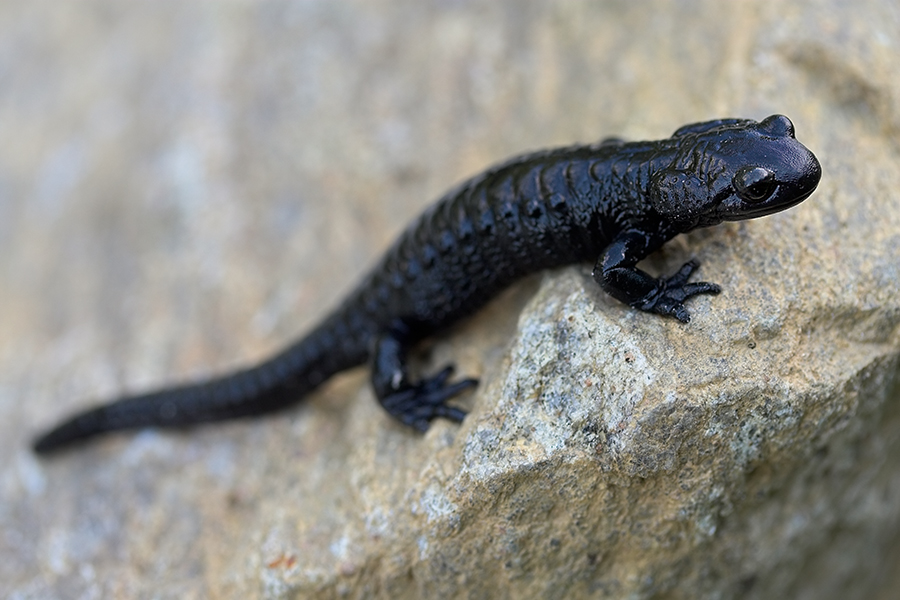
| Appearance | - The Alpine Salamander is generally black or dark brown in colour. English Wikipedia
- The subspecies Salamandra atra aurorae has bright yellow, white, or grey markings on its back and head. English Wikipedia
- Females can grow larger than males. English Wikipedia
- Males have more slender bodies and visibly swollen cloacae compared with females. English Wikipedia
- Individuals generally have 11–13 costal grooves along each side of the body. English Wikipedia
- Two rows of dorsal glands extend along the back beside the spine and continue to the tail tips. English Wikipedia
| - The fire salamander has a black body marked with yellow spots or stripes that vary in extent between individuals. English Wikipedia
- Some individuals have red or orange markings instead of, or mixed with, yellow markings. English Wikipedia
- Its conspicuous coloration serves as a warning to predators about its toxicity. English Wikipedia
- The underside is generally dark grey and has fewer spots than the upper body. animaldiversity.org
- Its body is longer than its tail, and its limbs are stout. animaldiversity.org
- The species has conspicuous parotoid glands. amphibiaweb.org
|
|---|
| Size | - Females can reach 151 mm in total length, including the tail. English Wikipedia
- Males can reach approximately 144 mm in total length, including the tail. English Wikipedia
| |
|---|
| Habitat | - The species inhabits mountainous terrestrial environments. English Wikipedia
- Individuals commonly shelter beneath stones, logs, and in rocky crevices. English Wikipedia
- The species inhabits forested environments, particularly mixed deciduous and coniferous forests. English Wikipedia
- Mountain meadows and grasslands also provide habitat for the species. English Wikipedia
- Forests containing silver fir and beech trees provide suitable habitat. English Wikipedia
- Forests dominated by Norway spruce and European larch can also support the species. English Wikipedia
- The species generally inhabits elevations above 700 metres and can occur at elevations reaching 2,000 metres. English Wikipedia
- Rainy or post-rain conditions at temperatures between 3 and 18 °C are described as ideal for the species. English Wikipedia
| - The species inhabits forests in central Europe and is particularly common in hilly areas. English Wikipedia
- It prefers deciduous forests where fallen leaves and moss-covered tree trunks provide hiding places. English Wikipedia
- Its habitat requires small brooks or ponds containing clean water for larval development. English Wikipedia
- The species prefers shaded woodland habitats with nearby ponds or streams. animaldiversity.org
- It shelters beneath rocks and logs and inside crevices to maintain protection and moisture. animaldiversity.org
|
|---|
| Diet | - The species feeds on terrestrial invertebrates including beetles, snails, millipedes, and spiders. English Wikipedia
- Coleoptera and Mollusca are particularly important components of its diet. English Wikipedia
- The species tends to select larger prey, consistent with its own relatively large body size. English Wikipedia
| - Its diet includes insects, spiders, millipedes, centipedes, earthworms and slugs. English Wikipedia
- It occasionally consumes newts and young frogs. English Wikipedia
- Its prey includes earthworms, slugs, flies, millipedes, centipedes and beetles. animaldiversity.org
- The species generally consumes the invertebrates that are most abundant in its habitat. animaldiversity.org
|
|---|
| Behaviour | - The species is primarily active during daylight hours and generally rests or sleeps at night. English Wikipedia
- Individuals may also become active at night depending on weather conditions. English Wikipedia
- The species is relatively sedentary, with a maximum observed summer movement distance of 12 metres for one individual. English Wikipedia
- Individuals frequently return to the same terrestrial refuge sites throughout their lives. English Wikipedia
- The species uses faecal pellets for scent-based territorial marking. English Wikipedia
| - Fire salamanders spend much of their time concealed beneath wood and other objects. English Wikipedia
- They are primarily active during evenings and nights but can also be active during rainy daytime conditions. English Wikipedia
- The species is shy and frequently shelters in shaded crevices and beneath logs. animaldiversity.org
- Its main activity periods occur on mild nights. animaldiversity.org
- Individuals can remain loyal to the same home range for many years. animaldiversity.org
- Some individuals have returned to the same cave for hibernation for as long as 20 years. animaldiversity.org
- When hunting in darkness, the species primarily uses smell to locate prey. animaldiversity.org
- The species can actively spray defensive chemicals at predators. animaldiversity.org
|
|---|
| Reproduction | - The species reproduces through internal fertilisation following mating on land. English Wikipedia
- The species is viviparous and gives birth to live young. English Wikipedia
- Females generally give birth to two offspring, although litters of three or four can occur. English Wikipedia
- Newborn individuals can measure up to 50 mm in length. English Wikipedia
- Pregnancy generally lasts approximately two years at elevations of 650–1,000 metres. English Wikipedia
- Pregnancy generally lasts approximately three years at elevations of 1,400–1,700 metres. English Wikipedia
| - Fertilization occurs internally after the male deposits a spermatophore. English Wikipedia
- Females deposit larvae into water when the eggs hatch. English Wikipedia
- The subspecies fastuosa and bernadezi are viviparous, whereas the other recognized subspecies are ovoviviparous. English Wikipedia
- The female may retain sperm before ovulation and fertilization occur. animaldiversity.org
- In European populations, larvae are generally born in the spring following summer mating and winter hibernation. animaldiversity.org
- In warmer Middle Eastern populations, breeding takes place from October through January. animaldiversity.org
- In warmer Middle Eastern populations, larval birth occurs in November or December of the following period. animaldiversity.org
- Some populations give birth to young that have already completed metamorphosis. animaldiversity.org
|
|---|
| Lifespan | | No checked fact yet |
|---|
| Distribution | - The species occurs from the France–Switzerland border eastward through Switzerland and Austria to the Dinaric Alps. English Wikipedia
| - The species occurs across much of southern and central Europe. English Wikipedia
- Its range includes central and southern Europe, northern Africa and the Middle East. animaldiversity.org
|
|---|
| Conservation | - The Alpine Salamander is classified as Least Concern on the IUCN Red List in the document's account. English Wikipedia
- The population of the species is reported to be decreasing. English Wikipedia
- Commercial deforestation is identified as a major threat to the species. English Wikipedia
- Forestry machinery can damage habitat by compacting soil and eliminating small prey and potential shelters. English Wikipedia
- The Golden Alpine Salamander is classified as Endangered because of its restricted distribution and declining population trend. pmc.ncbi.nlm.nih.gov
- The Golden Alpine Salamander is designated a priority taxon under the European Union Habitats Directive. pmc.ncbi.nlm.nih.gov
- The Golden Alpine Salamander is threatened by forestry practices that compact soil and remove cavities and potential refuges. pmc.ncbi.nlm.nih.gov
| - The species was classified as Vulnerable on the IUCN Red List in 2023. English Wikipedia
- Infection by the introduced fungus Batrachochytrium salamandrivorans has caused severe population declines in parts of its range. English Wikipedia
- The fungus Batrachochytrium salamandrivorans was identified as the cause of population declines in the Netherlands in 2013. English Wikipedia
- The Dutch population declined by 96% from 2010, with its largest population decreasing from 241 individuals to four in 2011. English Wikipedia
- Habitat fragmentation is identified as a potential threat because individuals are strongly attached to their home ranges and overwintering sites. animaldiversity.org
|
|---|
| Uses | No checked fact yet | |
|---|
| Similar species | - Salamandra lanzai is described as a similar species inhabiting the western Alps. English Wikipedia
| No checked fact yet |
|---|
| Name origin | No checked fact yet | - The species' common name is associated with traditional stories that salamanders could survive in fire. animaldiversity.org
|
|---|