Comparison

Common Sallow vs Goat Willow

Common Sallow (Salix cinerea) and Goat Willow (Salix caprea) both belong to the genus Salix (willow) and part ways below it. Both are recorded in 51 countries.
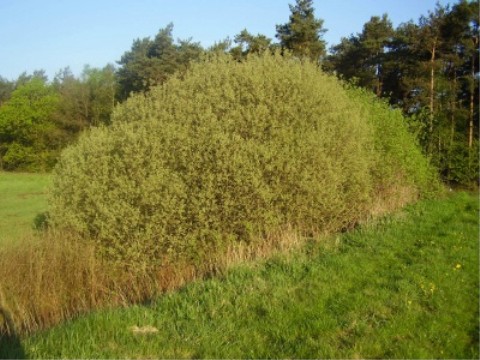
Common Sallow

Common Sallow

Salix cinerea

BCB, Public domain, via Wikimedia Commons

Goat Willow

Goat Willow

Salix caprea

Kurt Stüber [1], CC BY-SA 3.0, via Wikimedia Commons

Side by side

Common SallowGoat Willow
Scientific nameSalix cinerea L.Salix caprea L.
English nameCommon SallowGoat Willow
GroupFlowering plantsFlowering plants
ClassMagnoliopsidaMagnoliopsida
OrderMalpighialesMalpighiales
FamilySalicaceae Willow FamilySalicaceae Willow Family
GenusSalix WillowSalix Willow
Red List categoryLeast ConcernLeast Concern
Countries on record53 countries64 countries
GBIF occurrence records594,669 records764,627 records

Rows where the two agree are shown in grey.

Where each is found

Both recorded in 51 countries

Only Common Sallow (2)

Only Goat Willow (13)

From Catalogue of Life checklists and GBIF occurrence records. A country missing from a list means no record is held, which is not proof of absence.

Checked facts

Common SallowGoat Willow
Appearance
  • Salix caprea is a deciduous shrub or small tree. English Wikipedia
  • Its leaves measure 3–12 cm in length and 2.5–8 cm in width. English Wikipedia
  • The leaves are dull green and slightly hairy on their upper surfaces, with grey, woolly pubescence underneath. English Wikipedia
  • The species produces soft, silky flowers in silvery catkins measuring 3–7 cm. English Wikipedia
  • Male catkins turn yellow when releasing pollen, whereas female catkins become pale green. English Wikipedia
  • The variety sphacelata has densely silky-haired leaves on both surfaces measuring 3–7 cm in length. English Wikipedia
  • The variety caprea has leaves that are thinly hairy above and densely hairy below, measuring 5–12 cm in length. English Wikipedia
Size
  • Salix cinerea grows between 4 and 10 metres tall. English Wikipedia
  • Its leaves are typically 2–9 cm long and 1–3 cm wide, although exceptionally they reach 16 cm long and 5 cm wide. English Wikipedia
  • The species typically reaches a height of 8–10 m. English Wikipedia
  • Exceptional specimens can exceed 20 m in height, with a reported maximum of 26.2 m in Nuuksio National Park, Finland. English Wikipedia
Habitat
  • The species occurs in wet and damp habitats, including riverbanks and lake shores. English Wikipedia
  • The species also occupies drier sites where ground disturbance exposes bare soil. English Wikipedia
Diet
Behaviour
  • Salix cinerea is a pioneer species that rapidly colonizes disturbed sites. English Wikipedia
  • Phratora vulgatissima prefers female Salix cinerea plants and occurs more commonly on them than on male plants. English Wikipedia
  • Anthocoris nemorum, a natural enemy of Phratora vulgatissima, occurs more commonly on Salix cinerea. English Wikipedia
No checked fact yet
Reproduction
  • Salix cinerea produces flowers in catkins during early spring. English Wikipedia
  • Salix cinerea is dioecious, with male and female catkins occurring on separate plants. English Wikipedia
  • Female catkins mature in early summer and release numerous tiny seeds embedded in white cottony down. English Wikipedia
  • The white cottony down surrounding its seeds assists wind dispersal. English Wikipedia
  • The catkins appear in early spring before the new leaves develop. English Wikipedia
  • Male and female flowers occur on separate individual plants. English Wikipedia
  • The fruit is a capsule measuring 5–10 mm in length and containing numerous minute seeds. English Wikipedia
  • The seeds measure approximately 0.2 mm and are embedded in fine cottony hairs. English Wikipedia
  • The seeds require bare soil conditions to germinate. English Wikipedia
Distribution
Conservation
  • Salix cinerea is classified as an invasive species in New Zealand. English Wikipedia
  • Salix cinerea is listed on New Zealand's National Pest Plant Accord. English Wikipedia
  • Salix cinerea cannot be sold or distributed in New Zealand under the National Pest Plant Accord. English Wikipedia
  • Salix cinerea is highly invasive in south-eastern Australia. English Wikipedia
No checked fact yet
Uses
  • Several cultivars of the species have been selected for ornamental garden cultivation. English Wikipedia
  • The cultivar Kilmarnock is a male clone with stiffly pendulous shoots that form a mop-head shape. English Wikipedia
  • The female cultivar Weeping Sally is similar to Kilmarnock. English Wikipedia
  • The bark yields tannin and salicin. English Wikipedia
  • The species is not considered a good timber source because its wood is brittle and crackles violently when burned. English Wikipedia
  • The species is frequently cultivated for cut flowers. English Wikipedia
  • Goat willow cuttings have traditionally been used to make willow flutes in northern Europe. English Wikipedia
  • Newly opened catkins are used in Palm Sunday observances in Germany, Hungary, northern Slovakia, Poland, Ukraine and parts of Finland. English Wikipedia
  • The species was historically used as browse for goats. English Wikipedia
Similar species
  • Salix atrocinerea is a closely related species whose distribution overlaps with Salix cinerea in France, Belgium, the Netherlands, England and Ireland. English Wikipedia
  • Salix atrocinerea is taller than Salix cinerea and can reach 15 metres in height. English Wikipedia
  • Salix atrocinerea has deeply furrowed bark. English Wikipedia
  • Salix atrocinerea has dark red-brown hairs beneath its leaves. English Wikipedia
  • Salix atrocinerea becomes deciduous earlier than Salix cinerea. English Wikipedia
No checked fact yet
Other
  • The introduction of Salix cinerea has subsequently contributed to worse erosion by widening and shallowing invaded streams. English Wikipedia
  • The species commonly forms hybrids with Salix cinerea, Salix aurita, Salix viminalis and Salix purpurea. English Wikipedia
  • Salix caprea can survive in environments contaminated with heavy metals. pmc.ncbi.nlm.nih.gov
  • The species can translocate and accumulate zinc and cadmium in its leaves. pmc.ncbi.nlm.nih.gov
  • A study analysed 170 Salix caprea isolates collected from four metal-contaminated and three uncontaminated central European sites. pmc.ncbi.nlm.nih.gov
  • Northern Salix caprea populations showed more pronounced genetic differentiation than southern populations. pmc.ncbi.nlm.nih.gov
  • Northern metallicolous and non-metallicolous populations exhibited weak but statistically significant genetic differentiation. pmc.ncbi.nlm.nih.gov
  • The study found a significant difference in cadmium accumulation capacity between northern and southern populations. pmc.ncbi.nlm.nih.gov

In brief

Common Sallow

Salix cinerea is native to Europe and western Asia. It produces flowers in catkins during early spring and releases seeds surrounded by white cottony down that assists wind dispersal. Full profile

Goat Willow

Goat willow (Salix caprea L.) is a deciduous shrub or small tree in the family Salicaceae, order Malpighiales and class Magnoliopsida. It is native to Europe and western and central Asia. It produces soft, silky flowers in silvery catkins that appear in early spring before the new leaves develop. Full profile

Compare something else

Page built on 29 November 2026 from the data on the two species pages, where every source is listed.

Cite this page

ScientificNames.org. (2026). Common Sallow vs Goat Willow. Retrieved November 29, 2026, from https://scientificnames.org/compare/common-sallow-vs-goat-willow