Species · Flowering plants
Common Sallow Salix cinerea
The scientific name of the Common Sallow is Salix cinerea. It is a species of flowering plant in the family Salicaceae (willow family), order Malpighiales.
- Scientific name
- Salix cinerea L.
- Common name
- Common Sallow
- Genus
- Salix
- Family
- Salicaceae (Willow Family)
- Order
- Malpighiales
- Class
- Magnoliopsida
- Red List category
- LC Least Concern
- Recorded in
- 53 countries
- Name status
- accepted in the Catalogue of Life
Overview
Salix cinerea is native to Europe and western Asia. It produces flowers in catkins during early spring and releases seeds surrounded by white cottony down that assists wind dispersal.
Written 26 November 2026 from the sources listed below. Each statement was checked against the passage it cites; statements that could not be supported were removed.
Habitat
Common Sallow grows in wetlands, moist depressions and ditches. It occurs along embankments and the banks of stagnant or slow-moving water bodies.[1][2][3]
It occurs in low-lying damp environments with waterlogged and nutrient-poor soils.[4]
Diet
The beetle Phratora vulgatissima is a herbivore of Common Sallow.[5]
Behaviour
Common Sallow is a pioneer species that rapidly colonizes disturbed sites.[6]
Phratora vulgatissima prefers female Common Sallow plants and occurs more commonly on them than on male plants. Anthocoris nemorum, a natural enemy of Phratora vulgatissima, occurs more commonly on Common Sallow.[7][8]
Reproduction and life cycle
Common Sallow is dioecious, with male and female catkins occurring on separate plants. It produces flowers in catkins during early spring.[9][10]
Female catkins mature in early summer and release numerous tiny seeds embedded in white cottony down. The down assists wind dispersal.[11][12]
Conservation
Common Sallow is classified as an invasive species in New Zealand and is listed on New Zealand's National Pest Plant Accord. It cannot be sold or distributed in New Zealand under the Accord.[13][14][15]
Common Sallow is highly invasive in south-eastern Australia.[16]
Uses
Common Sallow was introduced to control erosion along riverbanks. Its introduction subsequently contributed to worse erosion by widening and shallowing invaded streams.[17][18]
Similar species
Salix atrocinerea is a closely related species whose distribution overlaps with Common Sallow in France, Belgium, the Netherlands, England and Ireland. It is taller and can reach 15 metres in height.[19][20]
Salix atrocinerea has deeply furrowed bark and dark red-brown hairs beneath its leaves. It becomes deciduous earlier than Common Sallow.[21][22][23]
Appearance
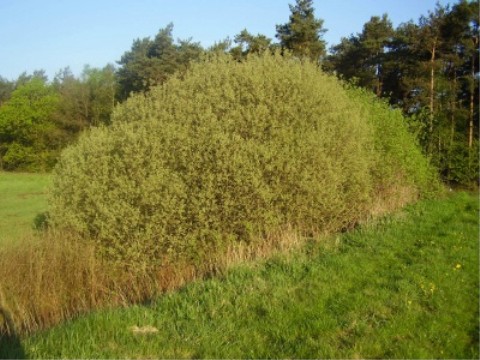
Common Sallow is a deciduous shrub or small tree that grows between 4 and 10 metres tall.[24][25]
Its leaves are spirally arranged and typically 2–9 cm long and 1–3 cm wide, although exceptionally they reach 16 cm long and 5 cm wide. Their upper surfaces are green, their undersides are hairy and their margins are crenate.[26][27][28][29]
Male catkins are initially silvery and turn yellow when pollen is released. Female catkins are greenish grey.[30][31]
Classification of the Common Sallow
| Kingdom | Plantae |
|---|---|
| Subkingdom | Pteridobiotina |
| Phylum | Tracheophyta |
| Class | Magnoliopsida |
| Order | Malpighiales |
| Family | Salicaceae (Willow Family) |
| Tribe | Saliceae |
| Genus | Salix (Willow) |
| Species | Salix cinerea L. |
Where the Common Sallow is found
Checklists and occurrence records place Salix cinerea in 53 countries across Asia, Europe, North America and Oceania. GBIF holds 594,669 georeferenced records of it.
Countries where it is native or its origin is not stated
- Aland Islands 730
- Albania 5
- Andorra 21
- Austria 4,066
- Azerbaijan
- Belarus 239
- Belgium 16,072
- Bosnia and Herzegovina 13
- Bulgaria 12
- China 87
- Croatia 18
- Czechia 1,394
- Denmark 105,168
- Estonia 2,758
- Finland 13,739
- France 108,781
- Georgia 2
- Germany 52,795
- Greece 8
- Hungary 143
- Iran 6
- Ireland 666
- Isle of Man 1,150
- Italy 332
- Kazakhstan 151
- Kosovo
- Latvia 105
- Liechtenstein 28
- Lithuania 40
- Luxembourg 833
- Moldova 4
- Montenegro 4
- North Korea 3
- North Macedonia 3
- Norway 3,080
- Poland 9,152
- Portugal 7
- Romania 51
- Russia 9,873
- Serbia 5
- Slovakia 3,188
- Slovenia 47
- Spain 359
- Sweden 13,645
- Switzerland 12,316
- The Netherlands 54,960
- Turkey 26
- Ukraine 1,797
- United Kingdom 169,503
Countries where it has been introduced
Regions and cities with the most records
- England, United Kingdom 121,553
- Central Jutland, Denmark 36,324
- Bavaria, Germany 32,472
- South Denmark, Denmark 25,258
- Auvergne-Rhône-Alpes, France 24,175
- Scotland, United Kingdom 23,667
- Zealand, Denmark 17,740
- Centre-Val de Loire, France 16,317
- Île-de-France, France 15,827
- Wales, United Kingdom 14,680
- Bourgogne-Franche-Comté, France 14,527
- Gelderland, The Netherlands 11,511
- Grand Est, France 11,228
- Hauts-de-France, France 11,082
- Capital Region, Denmark 8,962
- Drenthe, The Netherlands 7,895
- Silkeborg, Denmark 6,307
- Roskilde, Denmark 5,985
- Overijssel, The Netherlands 5,930
- Farum, Denmark 5,797
- Allerød, Denmark 5,724
- Lillerød, Denmark 5,718
- Hedehusene, Denmark 5,654
- Ballerup, Denmark 5,620
- Taastrup, Denmark 5,454
- Stenløse, Denmark 5,343
- Tilst, Denmark 5,238
- Virum, Denmark 5,236
- Birkerød, Denmark 5,165
- Albertslund, Denmark 5,138
- Karlebo, Denmark 5,067
- Ringsted, Denmark 5,053
- Glostrup, Denmark 4,976
- Hillerød, Denmark 4,941
- Eibergen, The Netherlands 4,926
- Victoria, Australia 4,916
3 more countries have a few records outside this range
These countries hold a few records of Salix cinerea but lie outside the range the checklists give for it. Such records are often zoo or garden specimens, museum material or vagrants, so the species is not counted as occurring there.
Range as the checklists state it
England (England, Wales, Isle of Man, Scotland); Ireland (Ireland, Northern Ireland); Denmark; Norway; Sweden; Finland; Netherlands; Belgium; Luxembourg; Germany (Brandenburg, Berlin, Baden-Württemberg, Bayern, Hessen, Hamburg, Mecklenburg-Vorpommern, Niedersachsen, Nordrhein-Westfalen, Rheinland-Pfalz, Schleswig-Holstein, Saarland, Sachsen, Sachsen-Anhalt, Thüringen); Switzerland; Liechtenstein; Austria; Poland; Czech Republic; Slovakia; Hungary; France; Corsica; Sardinia; Italy; Slovenia; Croatia; Bosnia & Hercegovina; Montenegro; Serbia; Kosovo; North Macedonia; Albania; Romania; Bulgaria; European Turkey; Greece (rare mountains of N- & C-Greece, N-Peloponnisos); Estonia; Latvia; Lithuania; Belarus; C-European Russia; E-European Russia; N-European Russia; W-European Russia; Moldova; Ukraine; Siberia (Altay); Kazakhstan; Northern Caucasus; Georgia [Caucasus]; Azerbaijan; Turkey (E-Anatolia, Inner Anatolia, N-Anatolia, NW-Anatolia: Bithynia, SSW-Anatolia); China (Xinjiang); Australia [I] (South Australia [I], New South Wales [I], Victoria [I], Tasmania [I]); New Zealand [I]; Chatham Isl. [I]; Canada [I] (Nova Scotia [I], Ontario [I]); USA [I] (Alabama [I], Connecticut [I], District of Columbia [I], Georgia [I], Illinois [I], Indiana [I], Kentucky [I], Louisiana [I], Massachusetts [I], Maryland [I], Maine [I], Michigan [I], North Carolina [I], New York [I], Ohio [I], Pennsylvania [I], Rhode Island [I], South Carolina [I], Tennessee [I], Utah [I], Virginia [I], Wisconsin [I], West Virginia [I])
A number beside a place is its count of GBIF occurrence records. A place without a number comes from a checklist alone. Records show where a species has been observed or collected, which can include escapes and vagrants.
Common names
English
- Common Sallow
- Ashy Willow
- Gray Sallow
- Gray Willow
- Grey Willow
- Large Grey Willow
- Pussy Willow
Names in 24 other languages
- Chinese
- hui liu, 灰柳, 灰毛柳
- Croatian
- Siva vrba
- Czech
- vrba popelavá
- Danish
- Grå-pil, graa pil
- Dutch
- Grauwe wilg, grauwe wilg en rossige wilg
- Estonian
- Tuhkur paju
- Finnish
- tuhkapaju
- French
- saule cendré, saule gris
- German
- Artengruppe Grau-Weide, Asch-Weide, Grau-Weide
- Hungarian
- Hamvas fűz
- Icelandic
- Gráselja
- Italian
- salice cerognolo
- Lithuanian
- Pilkasis karklas
- Northern Sami
- ránessieđga
- Norwegian Bokmål
- gråselje
- Polish
- wierzba szara
- Romanian
- Zălog
- Russian
- iva pepel'naja, Ива пепельная
- Slovenian
- pepelnatosiva vrba
- Swedish
- gråvide, vanligt gråvide
- Turkish
- Boz söğüt
- Ukrainian
- Верба попеляста
- Welsh
- Helyg Llwyd, Helygen Lwyd
- hsb
- Šěra wjerba
Synonyms
75 other scientific names have been used for this species and are now treated as synonyms of Salix cinerea.
- Capraea acuminata (Mill.) Opiz
- Capraea cinerea (L.) Opiz
- Salix acuminata var. oblonga Dumort.
- Salix acuminata var. obovata Ser.
- Salix acuminata var. ovalifolia Ser.
- Salix acuminata var. variegata Ser.
- Salix aquatica var. androgyna Klett & Richt.
- Salix aquatica var. fissanthera Schltdl.
- Salix aquatica var. ovata Klett & Richt.
- Salix aquatica var. vulgaris Schltdl.
- Salix aurita var. cinerea (L.) Fiori
- Salix caprea subsp. cinerea (L.) Hook.fil.
- Salix caprea var. aquatica (Sm.) J.Becker
- Salix caprea var. cinerea (L.) Hook.fil.
- Salix caprea var. variegata Weston
- Salix carinthiaca Host
- Salix cinerea
- Salix cinerea f. acuta E.L.Wolf
- Salix cinerea f. angustata E.L.Wolf
- Salix cinerea f. cinerea
- Salix cinerea f. glabrescens E.L.Wolf
- Salix cinerea f. serrata E.L.Wolf
- Salix cinerea f. subglabrifolia Zapał.
- Salix cinerea f. subintegra E.L.Wolf
- Salix cinerea f. tenuior Zapał.
- Salix cinerea f. tricolor Dippel
- Salix cinerea f. variegata (Weston) Rehder
- Salix cinerea subsp. aquatica (Sm.) Macreight
- Salix cinerea var. angustifolia Döll
- Salix cinerea var. aquatica (Sm.) Rchb.
- Salix cinerea var. arborescens Moritzi
- Salix cinerea var. brevifolia Andersson
- Salix cinerea var. cinerascens Moritzi
- Salix cinerea var. cinerea
- Salix cinerea var. crispa E.L.Wolf
- Salix cinerea var. cuneata E.L.Wolf
- Salix cinerea var. erosa E.L.Wolf
- Salix cinerea var. laeta E.L.Wolf
- Salix cinerea var. lancifolia Zapał.
- Salix cinerea var. lancifolia E.L.Wolf
Showing 40 of 75.
Subspecies and varieties
- Salix cinerea subsp. cinerea (Grey Willow) subspecies
- Salix cinerea subsp. cinerea x subsp. oleifolia subspecies
Related species
-
 Weeping WillowSalix babylonica
-
 European WillowSalix alba
-
 Goat WillowSalix caprea
-
 Black WillowSalix nigra
-
 Arctic WillowSalix arctica
-
 Common OsierSalix viminalis
-
 Snowbed WillowSalix herbacea
-
 Purple WillowSalix purpurea
Compare
Questions and answers
What is the scientific name of the Common Sallow?
The scientific name of the Common Sallow is Salix cinerea. Written with its author, the full name is Salix cinerea L..
Which family does the Common Sallow belong to?
Salix cinerea belongs to the family Salicaceae, in the order Malpighiales and the class Magnoliopsida.
Where is the Common Sallow found?
Checklists and occurrence records place Salix cinerea in 53 countries, including United Kingdom, France, Denmark, The Netherlands, Germany and Belgium.
What is the conservation status of the Common Sallow?
The IUCN Red List category recorded for Salix cinerea is Least Concern (LC).
What other names does the Common Sallow have?
Salix cinerea is also known in English as Ashy Willow, Gray Sallow, Gray Willow, Grey Willow, Large Grey Willow and Pussy Willow.
What does gray willow look like?
Common Sallow is a deciduous shrub or small tree that grows between 4 and 10 metres tall. Its spirally arranged leaves have green upper surfaces, hairy undersides and crenate margins. Male catkins are initially silvery and turn yellow when pollen is released, while female catkins are greenish grey.[24][25][26][28][29][30][31]
Sources
Passages the profile rests on
- Salix cinerea grows in wetlands. Source passage: “Grey willow grows in wetlands,” — English Wikipedia
- Salix cinerea occurs in moist depressions and ditches. Source passage: “moist depressions, ditches,” — English Wikipedia
- Salix cinerea grows along embankments and banks of stagnant or slow-moving water bodies. Source passage: “embankments, banks of stagnant or slow-moving water bodies,” — English Wikipedia
- Salix cinerea occurs in low-lying damp environments with waterlogged and nutrient-poor soils. Source passage: “where it encounters low-lying damp situations with waterlogged and nutrient-poor soils.” — English Wikipedia
- The beetle Phratora vulgatissima is a herbivore of Salix cinerea. Source passage: “A common herbivore of Salix cinerea is Phratora vulgatissima,” — English Wikipedia
- Salix cinerea is a pioneer species that rapidly colonizes disturbed sites. Source passage: “S. cinerea is a pioneer species that rapidly colonizes disturbed sites.” — English Wikipedia
- Phratora vulgatissima prefers female Salix cinerea plants and occurs more commonly on them than on male plants. Source passage: “which prefers and is more common on female plants.” — English Wikipedia
- Anthocoris nemorum, a natural enemy of Phratora vulgatissima, occurs more commonly on Salix cinerea. Source passage: “Anthocoris nemorum, a natural enemy of Phratora vulgatissima, is also more common on S. cinerea.” — English Wikipedia
- Salix cinerea produces flowers in catkins during early spring. Source passage: “The flowers are produced in early spring in catkins 2–5 cm long;” — English Wikipedia
- Salix cinerea is dioecious, with male and female catkins occurring on separate plants. Source passage: “it is dioecious with male and female catkins on separate plants.” — English Wikipedia
- Female catkins mature in early summer and release numerous tiny seeds embedded in white cottony down. Source passage: “maturing in early summer to release the numerous tiny seeds embedded in white cottony down” — English Wikipedia
- The white cottony down surrounding its seeds assists wind dispersal. Source passage: “which assists wind dispersal.” — English Wikipedia
- Salix cinerea is classified as an invasive species in New Zealand. Source passage: “Salix cinerea is an invasive species in New Zealand” — English Wikipedia
- Salix cinerea is listed on New Zealand's National Pest Plant Accord. Source passage: “and is listed on the National Pest Plant Accord,” — English Wikipedia
- Salix cinerea cannot be sold or distributed in New Zealand under the National Pest Plant Accord. Source passage: “which means it cannot be sold or distributed.” — English Wikipedia
- Salix cinerea is highly invasive in south-eastern Australia. Source passage: “S. cinerea is also highly invasive in south-eastern Australia,” — English Wikipedia
- Salix cinerea was introduced to control erosion along riverbanks. Source passage: “The species was introduced to stop erosion along riverbanks,” — English Wikipedia
- The introduction of Salix cinerea has subsequently contributed to worse erosion by widening and shallowing invaded streams. Source passage: “but has since caused worse erosion over time by widening and shallowing invaded streams.” — English Wikipedia
- Salix atrocinerea is a closely related species whose distribution overlaps with Salix cinerea in France, Belgium, the Netherlands, England and Ireland. Source passage: “The closely related species Salix atrocinerea Brot., which overlaps in distribution in France, Belgium, Netherlands, England and Ireland,” — English Wikipedia
- Salix atrocinerea is taller than Salix cinerea and can reach 15 metres in height. Source passage: “S. atrocinerea differs from S. cinerea in that it is taller (reaching up to 15 metres),” — English Wikipedia
- Salix atrocinerea has deeply furrowed bark. Source passage: “has a deeply furrowed bark,” — English Wikipedia
- Salix atrocinerea has dark red-brown hairs beneath its leaves. Source passage: “dark red-brown hairs beneath the leaves,” — English Wikipedia
- Salix atrocinerea becomes deciduous earlier than Salix cinerea. Source passage: “and is earlier deciduous.” — English Wikipedia
- Salix cinerea is a deciduous shrub or small tree. Source passage: “It is a deciduous shrub or small tree” — English Wikipedia
- Salix cinerea grows between 4 and 10 metres tall. Source passage: “growing 4–10 metres (13–30 ft) tall.” — English Wikipedia
- Its leaves are spirally arranged. Source passage: “The leaves are spirally arranged,” — English Wikipedia
- Its leaves are typically 2–9 cm long and 1–3 cm wide, although exceptionally they reach 16 cm long and 5 cm wide. Source passage: “2–9 cm (1–3+1⁄2 in) long and 1–3 cm (1⁄2–1+1⁄2 in) broad (exceptionally up to 16 cm long and 5 cm broad)” — English Wikipedia
- The upper surfaces of its leaves are green, while their undersides are hairy. Source passage: “green above, hairy below,” — English Wikipedia
- Its leaves have crenate margins. Source passage: “with a crenate margin.” — English Wikipedia
- Male catkins are initially silvery and turn yellow when pollen is released. Source passage: “The male catkins are silvery at first, turning yellow when the pollen is released;” — English Wikipedia
- Female catkins are greenish grey. Source passage: “the female catkins are greenish grey,” — English Wikipedia
Data
- Catalogue of Life, 2026-10-16 XR cc by
- Global Biodiversity Information Facility CC BY 4.0
- Wikidata CC0
- GeoNames CC BY 4.0
- Wikimedia Commons per image; credit shown with each image
- Within the Catalogue of Life, this name comes from Synonymic Checklists of the Vascular Plants of the World cc by
References
- L. (1753). Sp. Pl. [Linnaeus] 2: 1021 (1753). where the name was published
This species in other databases
Page built on 27 November 2026. See how the catalog is made and all sources and licences.
Cite this page
ScientificNames.org. (2026). Salix cinerea (Common Sallow). Retrieved November 27, 2026, from https://scientificnames.org/species/salix-cinerea
“Salix cinerea (Common Sallow).” ScientificNames.org, 2026, scientificnames.org/species/salix-cinerea. Accessed 27 Nov. 2026.
ScientificNames.org. “Salix cinerea (Common Sallow).” Accessed November 27, 2026. https://scientificnames.org/species/salix-cinerea.
@misc{scientificnames_salix_cinerea_common_sallow,
  author = {{ScientificNames.org}},
  title = {Salix cinerea (Common Sallow)},
  year = {2026},
  url = {https://scientificnames.org/species/salix-cinerea},
  note = {Accessed 2026-11-27}
}