Comparison
Californian Hummingbird Sage vs Baby Sage
Californian Hummingbird Sage (Salvia spathacea) and Baby Sage (Salvia microphylla) both belong to the genus Salvia (sage) and part ways below it. Both are recorded in 1 country.
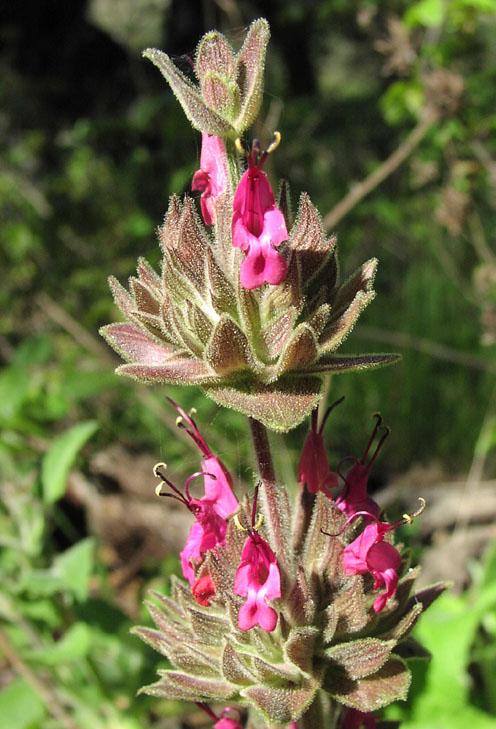
Californian Hummingbird Sage
Salvia spathacea
Taken by Antandrus, Public domain, via Wikimedia Commons


Side by side
| Californian Hummingbird Sage | Baby Sage | |
|---|---|---|
| Scientific name | Salvia spathacea Greene | Salvia microphylla Kunth |
| English name | Californian Hummingbird Sage | Baby Sage |
| Group | Flowering plants | Flowering plants |
| Class | Magnoliopsida | Magnoliopsida |
| Order | Lamiales | Lamiales |
| Family | Lamiaceae Mint Family | Lamiaceae Mint Family |
| Genus | Salvia Sage | Salvia Sage |
| Countries on record | 1 country | 17 countries |
| GBIF occurrence records | 6,114 records | 6,034 records |
Rows where the two agree are shown in grey.
Where each is found
Both recorded in 1 country
Only Baby Sage (16)
- Argentina
- Canada
- China
- Costa Rica
- Germany
- Greece
- Guatemala
- India
- Japan
- Mexico
- Morocco
- New Zealand
- Portugal
- South Korea
- Spain
- Uruguay
From Catalogue of Life checklists and GBIF occurrence records. A country missing from a list means no record is held, which is not proof of absence.
Checked facts
| Californian Hummingbird Sage | Baby Sage | |
|---|---|---|
| Appearance |
|
|
| Size |
|
|
| Habitat |
|
|
| Diet |
| No checked fact yet |
| Behaviour |
|
|
| Reproduction |
|
|
| Distribution |
|
|
| Conservation |
| No checked fact yet |
| Uses |
|
|
| Similar species | No checked fact yet |
|
| Other |
| No checked fact yet |
In brief
Californian Hummingbird Sage
Californian Hummingbird Sage (Salvia spathacea Greene) is an evergreen perennial flowering plant in the family Lamiaceae, order Lamiales and class Magnoliopsida, with a woody base. It is native to southern and central California, where it grows in moist oak woodland, chaparral and coastal sage scrub. It is distinguished by aromatic leaves, clustered flower spikes with conspicuous ruby red to dark maroon or brown bracts, and tubular flowers that attract hummingbirds. Full profile
Baby Sage
Salvia microphylla occurs naturally in southeastern Arizona and the mountains of eastern, western, and southern Mexico. Its ovate leaves have serrated margins, and its flowers grow in whorls and can be magenta, red, pink, or rose-colored. Full profile
Compare something else
Page built on 30 November 2026 from the data on the two species pages, where every source is listed.
Cite this page
ScientificNames.org. (2026). Californian Hummingbird Sage vs Baby Sage. Retrieved November 30, 2026, from https://scientificnames.org/compare/californian-hummingbird-sage-vs-baby-sage
“Californian Hummingbird Sage vs Baby Sage.” ScientificNames.org, 2026, scientificnames.org/compare/californian-hummingbird-sage-vs-baby-sage. Accessed 30 Nov. 2026.
ScientificNames.org. “Californian Hummingbird Sage vs Baby Sage.” Accessed November 30, 2026. https://scientificnames.org/compare/californian-hummingbird-sage-vs-baby-sage.
@misc{scientificnames_californian_hummingbird_sage_vs_baby_sage,
  author = {{ScientificNames.org}},
  title = {Californian Hummingbird Sage vs Baby Sage},
  year = {2026},
  url = {https://scientificnames.org/compare/californian-hummingbird-sage-vs-baby-sage},
  note = {Accessed 2026-11-30}
}