Species · Flowering plants
Californian Hummingbird Sage Salvia spathacea
The scientific name of the Californian Hummingbird Sage is Salvia spathacea. It is a species of flowering plant in the family Lamiaceae (mint family), order Lamiales.
- Scientific name
- Salvia spathacea Greene
- Common name
- Californian Hummingbird Sage
- Genus
- Salvia
- Family
- Lamiaceae (Mint Family)
- Order
- Lamiales
- Class
- Magnoliopsida
- Recorded in
- 1 country
- Name status
- accepted in the Catalogue of Life
Overview
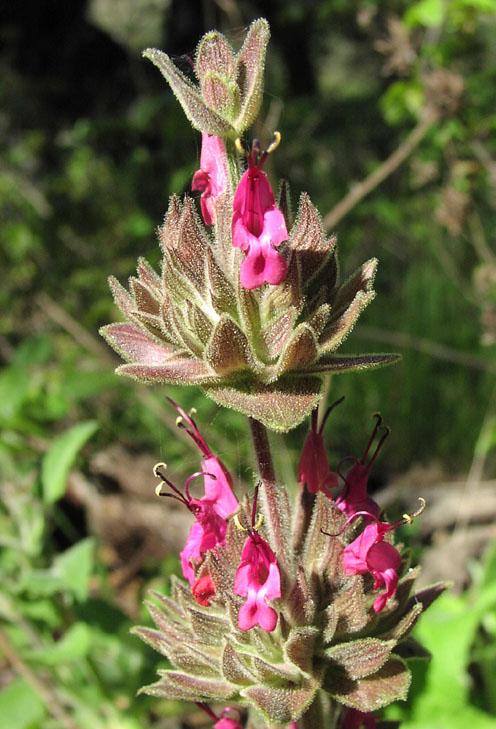
Californian Hummingbird Sage (Salvia spathacea Greene) is an evergreen perennial flowering plant in the family Lamiaceae, order Lamiales and class Magnoliopsida, with a woody base. It is native to southern and central California, where it grows in moist oak woodland, chaparral and coastal sage scrub. It is distinguished by aromatic leaves, clustered flower spikes with conspicuous ruby red to dark maroon or brown bracts, and tubular flowers that attract hummingbirds.
Written 26 November 2026 from the sources listed below. Each statement was checked against the passage it cites; statements that could not be supported were removed.
Appearance
The plant has bright green, aromatic leaves that are oblong to almost arrowhead-shaped, with rounded teeth along their edges. Their surfaces may be wrinkled, and the undersides have denser hairs than the upper surfaces.[1][2][3]
The tubular, two-lipped corollas measure 2.5–3.5 cm long, and the flowers range in color from green and light pink to magenta and purple. The fruits consist of four dark brown to black nutlets.[4][5][6]
Individual leaves measure 8–20 cm long, the calyx measures 1.5–3 cm long, and the fruit nutlets measure 3.5–6.5 mm long.[7][8][9]
Habitat
The species grows on open or shaded slopes in moist oak woodland. It also occurs in chaparral and coastal sage scrub near the Pacific Ocean.[10][11]
It is native to southern and central California. Its California distribution extends through the coast ranges from the Sacramento Valley south to the San Diego area, at elevations from sea level to 610 m.[12][13][14]
Behaviour
The species spreads through underground rhizomes and can form colonies reaching 130 cm in diameter. Each plant typically produces one flowering stem that rarely branches.[15][16][17]
The flowering stems grow 30–150 cm tall, while non-flowering plants generally remain below 50 cm. The species can reach 75 cm in height under the growing conditions described by the RHS.[18][19][20]
The plant releases a pronounced aromatic scent when its leaves are crushed or touched. It is generally avoided by deer and gophers.[21][22]
Reproduction and life cycle
The species flowers between March and May. The RHS describes it as producing flowers in summer.[23][24]
The flowers contain two fertile stamens attached to the corolla tube. The style is forked, and both the style and stamens extend beyond the corolla tube.[25][26]
The species can be propagated using seeds or rhizomes. Seeds should be collected early because insects may prey on them.[27][28]
Diet
Hummingbirds feed on the plant's flowers.[29]
Uses
The species is cultivated in gardens for its attractive flowering spikes and pleasant scent. It is also used as a groundcover in dry shade beneath oak trees.[30][31]
Planting the species in gardens can attract hummingbirds.[32]
Conservation
The species is described as common within its California distribution. It has received the Royal Horticultural Society's Award of Garden Merit.[33][34]
Classification of the Californian Hummingbird Sage
| Kingdom | Plantae |
|---|---|
| Subkingdom | Pteridobiotina |
| Phylum | Tracheophyta |
| Class | Magnoliopsida |
| Order | Lamiales |
| Family | Lamiaceae (Mint Family) |
| Subfamily | Nepetoideae |
| Tribe | Mentheae |
| Subtribe | Salviinae |
| Genus | Salvia (Sage) |
| Species | Salvia spathacea Greene |
Where the Californian Hummingbird Sage is found
Checklists and occurrence records place Salvia spathacea in 1 country across North America. GBIF holds 6,114 georeferenced records of it.
Countries
Regions and cities with the most records
- California, United States 5,658
- San Luis Obispo, United States 1,053
- Bayview-Hunters Point, United States 848
- San Francisco, United States 840
- South San Francisco, United States 836
- Daly City, United States 833
- San Bruno, United States 831
- Pacifica, United States 821
- Alameda, United States 796
- Millbrae, United States 765
- Agoura Hills, United States 744
- Agoura, United States 735
- Oakland, United States 714
- Burlingame, United States 708
- Goleta, United States 670
- Santa Barbara, United States 659
- San Mateo, United States 642
- Isla Vista, United States 622
- Thousand Oaks, United States 614
- Los Angeles, United States 425
- Santa Monica, United States 415
- Glendale, United States 402
- Burbank, United States 397
- Arroyo Grande, United States 375
- Foster City, United States 331
- Atascadero, United States 321
- South Pasadena, United States 311
- Alhambra, United States 305
- Monterey Park, United States 303
- Pasadena, United States 300
- East Los Angeles, United States 299
- San Gabriel, United States 298
- La Crescenta-Montrose, United States 294
- Altadena, United States 279
- La Cañada Flintridge, United States 275
- Huntington Park, United States 264
1 more country has a few records outside this range
These countries hold a few records of Salvia spathacea but lie outside the range the checklists give for it. Such records are often zoo or garden specimens, museum material or vagrants, so the species is not counted as occurring there.
Range as the checklists state it
USA (California)
A number beside a place is its count of GBIF occurrence records. A place without a number comes from a checklist alone. Records show where a species has been observed or collected, which can include escapes and vagrants.
Common names
English
- Californian Hummingbird Sage
- Crimson Pitcher Sage
- California Hummingbird Sage
Names in 2 other languages
- Chinese
- 加州蜂鳥鼠尾草
- Russian
- Шалфей покрывальцевый
Synonyms
3 other scientific names have been used for this species and are now treated as synonyms of Salvia spathacea.
- Audibertia grandiflora Benth.
- Audibertiella grandiflora (Benth.) Briq.
- Ramona grandiflora (Benth.) Briq.
Related species
-
 Diviner's SageSalvia divinorum
- Common SageSalvia officinalis
-
 Californian White SageSalvia apiana
-
 Baby SageSalvia microphylla
-
 Mealy Blue SageSalvia farinacea
-
 Mexican Bush SageSalvia leucantha
-
 Russian SageSalvia yangii
-
 Clary SageSalvia sclarea
Compare
Questions and answers
What is the scientific name of the Californian Hummingbird Sage?
The scientific name of the Californian Hummingbird Sage is Salvia spathacea. Written with its author, the full name is Salvia spathacea Greene.
Which family does the Californian Hummingbird Sage belong to?
Salvia spathacea belongs to the family Lamiaceae, in the order Lamiales and the class Magnoliopsida.
Where is the Californian Hummingbird Sage found?
Checklists and occurrence records place Salvia spathacea in 1 country: United States.
What other names does the Californian Hummingbird Sage have?
Salvia spathacea is also known in English as Crimson Pitcher Sage and California Hummingbird Sage.
How big does pitcher sage get?
Flowering stems grow 30–150 cm tall, while non-flowering plants generally remain below 50 cm. The plant can form spreading colonies reaching 130 cm in diameter.[18][19][15]
Where to plant pitcher sage?
It grows on open or shaded slopes in moist oak woodland and also occurs in chaparral and coastal sage scrub near the Pacific Ocean. In gardens, it is used as a groundcover in dry shade beneath oak trees.[10][11][31]
Sources
Passages the profile rests on
- The plant has bright green, aromatic leaves that are oblong to almost arrowhead-shaped. Source passage: “Its bright green leaves are 8–20 cm. long, and highly aromatic when crushed or touched. They are oblong to almost arrowhead-shaped at the base” — English Wikipedia
- The leaves have rounded teeth along their edges and may have wrinkled surfaces. Source passage: “and can be puckered with wrinkles, and have rounded teeth at the leaf edges.” — English Wikipedia
- The undersides of the leaves have denser hairs than their upper surfaces. Source passage: “The hairs tend to be denser on the bottom surface of the leaves.” — English Wikipedia
- The corollas are tubular, two-lipped structures measuring 2.5–3.5 cm long. Source passage: “Each corolla is tubular and 2.5-3.5 cm. long, with 2 lips.” — English Wikipedia
- The flowers can range in color from green and light pink to magenta and purple. Source passage: “Flowers vary in color from green through light pink and magenta to purple.” — English Wikipedia
- The fruits consist of four dark brown to black nutlets. Source passage: “The fruits are 4 nutlets, dark brown to black in color.” — English Wikipedia
- Individual leaves measure 8–20 cm long. Source passage: “Its bright green leaves are 8–20 cm. long” — English Wikipedia
- The calyx measures 1.5–3 cm long. Source passage: “The calyx is 1.5 to 3 cm. long.” — English Wikipedia
- The fruit nutlets measure 3.5–6.5 mm long. Source passage: “They are round to ovate, with a length of 3.5 to 6.5 mm.” — English Wikipedia
- The species grows on open or shaded slopes in moist oak woodland. Source passage: “grows on open or shady slopes in moist oak woodland” — English Wikipedia
- The species occurs in chaparral and coastal sage scrub near the Pacific Ocean. Source passage: “chaparral, and coastal sage scrub not far from the Pacific Ocean.” — English Wikipedia
- The species is native to southern and central California. Source passage: “native to southern and central California” — English Wikipedia
- Its California distribution extends through the coast ranges from the Sacramento Valley south to the San Diego area. Source passage: “found in the California coast ranges from the Sacramento Valley south to the San Diego area.” — English Wikipedia
- The species occurs at elevations from sea level to 610 m. Source passage: “growing from sea level to 610 m (2,001 ft).” — English Wikipedia
- The plant can form spreading colonies reaching 130 cm in diameter. Source passage: “It spreads by rhizomes and can form colonies up to 130 cm (51 in) in diameter.” — English Wikipedia
- The species spreads through underground rhizomes and can form colonies. Source passage: “It spreads by rhizomes and can form colonies up to 130 cm (51 in) in diameter.” — English Wikipedia
- Each plant typically produces one flowering stem that rarely branches. Source passage: “Each plant produces a single flowering stem which rarely branches.” — English Wikipedia
- The flowering stems grow 30–150 cm tall. Source passage: “flowering stems growing from a woody base, 30–150 cm (12–59 in) tall.” — English Wikipedia
- Non-flowering plants generally remain below 50 cm tall. Source passage: “When not flowering plants grow less than 50 cm (20 in) tall” — English Wikipedia
- The species can reach 75 cm in height under the growing conditions described by the RHS. Source passage: “A vigorous spreading perennial to 75cm in height” — rhs.org.uk
- The plant releases a pronounced aromatic scent when its leaves are crushed or touched. Source passage: “highly aromatic when crushed or touched.” — English Wikipedia
- The species is generally avoided by deer and gophers. Source passage: “Deer and gophers generally leave this strongly aromatic plant alone.” — English Wikipedia
- The species flowers between March and May. Source passage: “blooms in March to May” — English Wikipedia
- The RHS describes the species as producing flowers in summer. Source passage: “stout stems bearing long purplish-red flowers emerge from maroon calyces, with large maroon bracts, in summer” — rhs.org.uk
- The flowers contain two fertile stamens attached to the corolla tube. Source passage: “The two fertile stamens are attached to the corolla tube.” — English Wikipedia
- The style is forked, and both it and the stamens extend beyond the corolla tube. Source passage: “The style is forked. Both the style and the stamens protrude outside the corolla tube.” — English Wikipedia
- The species can be propagated using either seeds or rhizomes. Source passage: “It easily propagates by seeds or rhizomes.” — English Wikipedia
- Seeds should be collected early because insects may prey on them. Source passage: “Seeds should be collected as early as possible, or they can be predated by insects.” — English Wikipedia
- Hummingbirds feed on the plant's flowers. Source passage: “As the alternative common name suggests, it is used by feeding hummingbirds” — English Wikipedia
- The species is cultivated in gardens for its attractive flowering spikes and pleasant scent. Source passage: “It is cultivated in gardens for its attractive flowering spikes and pleasant scent.” — English Wikipedia
- The plant is used as a groundcover in dry shade beneath oak trees. Source passage: “a very useful groundcover for dry shade under oaks.” — English Wikipedia
- Planting the species in gardens can attract hummingbirds. Source passage: “it is used by feeding hummingbirds and will attract them to the garden.” — English Wikipedia
- The species is described as common within its California distribution. Source passage: “It is a common species” — English Wikipedia
- The species has received the Royal Horticultural Society's Award of Garden Merit. Source passage: “Salvia spathacea has gained the Royal Horticultural Society's Award of Garden Merit.” — English Wikipedia
Data
- Catalogue of Life, 2026-10-16 XR cc by
- Global Biodiversity Information Facility CC BY 4.0
- Wikidata CC0
- GeoNames CC BY 4.0
- Wikimedia Commons per image; credit shown with each image
- Within the Catalogue of Life, this name comes from Synonymic Checklists of the Vascular Plants of the World cc by
References
- Greene. (1892). Pittonia 2: 236 (1892), et Man. Bot. San Francisco 291 (1894). where the name was published
This species in other databases
Page built on 26 November 2026. See how the catalog is made and all sources and licences.
Cite this page
ScientificNames.org. (2026). Salvia spathacea (Californian Hummingbird Sage). Retrieved November 26, 2026, from https://scientificnames.org/species/salvia-spathacea
“Salvia spathacea (Californian Hummingbird Sage).” ScientificNames.org, 2026, scientificnames.org/species/salvia-spathacea. Accessed 26 Nov. 2026.
ScientificNames.org. “Salvia spathacea (Californian Hummingbird Sage).” Accessed November 26, 2026. https://scientificnames.org/species/salvia-spathacea.
@misc{scientificnames_salvia_spathacea_californian_hummingbird_sage,
  author = {{ScientificNames.org}},
  title = {Salvia spathacea (Californian Hummingbird Sage)},
  year = {2026},
  url = {https://scientificnames.org/species/salvia-spathacea},
  note = {Accessed 2026-11-26}
}