Comparison
Blue Elderberry vs Dwarf Elder
Blue Elderberry (Sambucus cerulea) and Dwarf Elder (Sambucus ebulus) both belong to the genus Sambucus (elder) and part ways below it. Both are recorded in 3 countries.
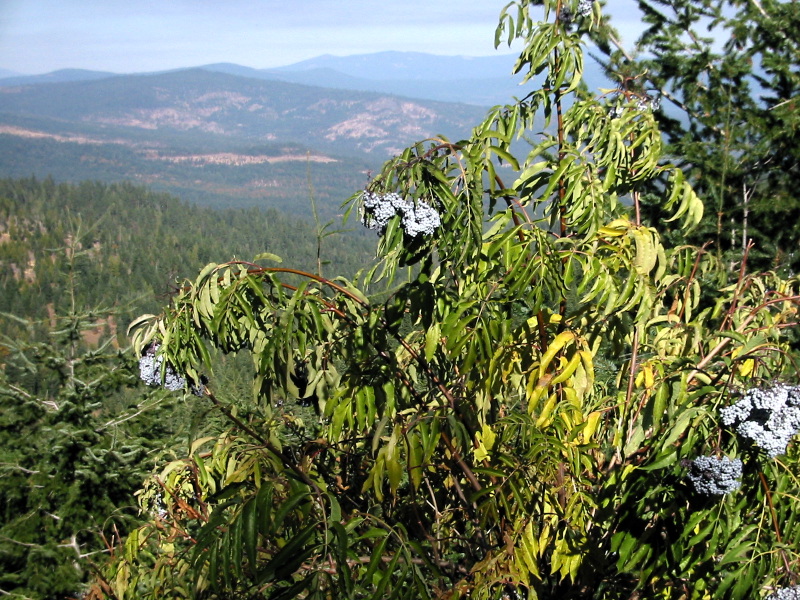
Blue Elderberry
Sambucus cerulea
No machine-readable author provided. Wsiegmund assumed (based on copyright claims)., CC BY 2.5, via Wikimedia Commons


Side by side
| Blue Elderberry | Dwarf Elder | |
|---|---|---|
| Scientific name | Sambucus cerulea Raf. | Sambucus ebulus L. |
| English name | Blue Elderberry | Dwarf Elder |
| Group | Flowering plants | Flowering plants |
| Class | Magnoliopsida | Magnoliopsida |
| Order | Dipsacales | Dipsacales |
| Family | Viburnaceae Elder Family | Viburnaceae Elder Family |
| Genus | Sambucus Elder | Sambucus Elder |
| Countries on record | 4 countries | 59 countries |
| GBIF occurrence records | 28,554 records | 155,386 records |
Rows where the two agree are shown in grey.
Where each is found
Both recorded in 3 countries
Only Blue Elderberry (1)
Only Dwarf Elder (56)
- Albania
- Algeria
- Andorra
- Armenia
- Austria
- Azerbaijan
- Belarus
- Belgium
- Bosnia and Herzegovina
- Bulgaria
- China
- Croatia
- Cyprus
- Czechia
- Denmark
- Estonia
- Finland
- France
- Georgia
- Greece
- Hungary
- India
- Iran
- Iraq
- Ireland
- Israel
- Italy
- Kenya
- Kosovo
- Lebanon
- Liechtenstein
- Lithuania
- Luxembourg
- Moldova
- Montenegro
- Morocco
- North Macedonia
- Norway
- Poland
- Portugal
- Romania
- Russia
- San Marino
- Serbia
- Slovakia
- Slovenia
- Spain
- Sweden
- Switzerland
- Syria
- The Netherlands
- Tunisia
- Turkey
- Turkmenistan
- Ukraine
- United Kingdom
From Catalogue of Life checklists and GBIF occurrence records. A country missing from a list means no record is held, which is not proof of absence.
Checked facts
| Blue Elderberry | Dwarf Elder | |
|---|---|---|
| Appearance |
|
|
| Size |
|
|
| Habitat |
|
|
| Diet |
|
|
| Behaviour |
| No checked fact yet |
| Reproduction |
|
|
| Distribution |
|
|
| Conservation |
| No checked fact yet |
| Uses |
|
|
| Other |
|
|
In brief
Blue Elderberry
Sambucus cerulea occurs in mountain and hill habitats, valleys, riparian zones, open woodland, and forest habitats. It is distinguished by its white or creamy flowers and bluish-black fruits with a glaucous coating that gives them a light blue appearance. Full profile
Dwarf Elder
The species is native to southern and central Europe, southwest Asia and Northwest Africa, including Northern Iran. It has erect stems, pinnate leaves, clusters of white or occasionally pink flowers and dark-coloured berries. Full profile
Compare something else
Page built on 26 November 2026 from the data on the two species pages, where every source is listed.
Cite this page
ScientificNames.org. (2026). Blue Elderberry vs Dwarf Elder. Retrieved November 26, 2026, from https://scientificnames.org/compare/blue-elderberry-vs-dwarf-elder
“Blue Elderberry vs Dwarf Elder.” ScientificNames.org, 2026, scientificnames.org/compare/blue-elderberry-vs-dwarf-elder. Accessed 26 Nov. 2026.
ScientificNames.org. “Blue Elderberry vs Dwarf Elder.” Accessed November 26, 2026. https://scientificnames.org/compare/blue-elderberry-vs-dwarf-elder.
@misc{scientificnames_blue_elderberry_vs_dwarf_elder,
  author = {{ScientificNames.org}},
  title = {Blue Elderberry vs Dwarf Elder},
  year = {2026},
  url = {https://scientificnames.org/compare/blue-elderberry-vs-dwarf-elder},
  note = {Accessed 2026-11-26}
}