Species · Flowering plants
Blue Elderberry Sambucus cerulea
The scientific name of the Blue Elderberry is Sambucus cerulea. It is a species of flowering plant in the family Viburnaceae (elder family), order Dipsacales.
- Scientific name
- Sambucus cerulea Raf.
- Common name
- Blue Elderberry
- Genus
- Sambucus
- Family
- Viburnaceae (Elder Family)
- Order
- Dipsacales
- Class
- Magnoliopsida
- Recorded in
- 4 countries
- Name status
- accepted in the Catalogue of Life
Overview
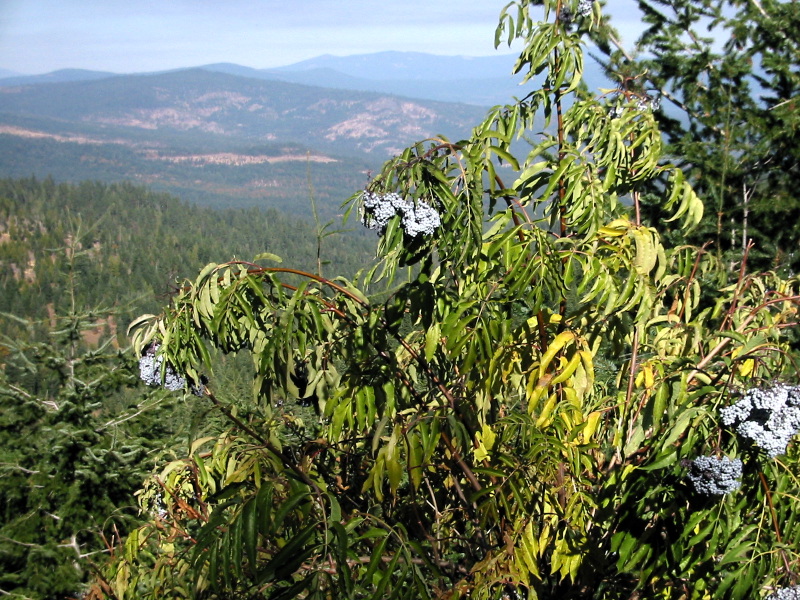
Sambucus cerulea occurs in mountain and hill habitats, valleys, riparian zones, open woodland, and forest habitats. It is distinguished by its white or creamy flowers and bluish-black fruits with a glaucous coating that gives them a light blue appearance.
Written 26 November 2026 from the sources listed below. Each statement was checked against the passage it cites; statements that could not be supported were removed.
Appearance
Its leaves are pinnately divided into five to nine elliptical to lanceolate leaflets. The leaflets are sharply toothed, hairless, and commonly measure three to fifteen centimetres long and two to six centimetres wide.[1][2][3]
Its white or creamy flowers have a strong, unpleasant odour and form numerous flat-topped, umbel-shaped clusters, normally with four to five rays. The clusters are usually five to twenty centimetres wide, and individual flowers measure four to seven millimetres across.[4][5][6][7][8][9]
Habitat
Blue elderberry occurs in mountain and hill habitats, valleys, riparian zones, open woodland, and forest habitats. It also grows on exposed slopes where moisture is accessible.[10][11][12][13]
The species occurs at elevations below 3,000 metres.[14]
It is native to the western United States, northwestern Mexico, and British Columbia. Its range extends from the Pacific coasts through California and the Great Basin to Montana, Wyoming, Texas, and Oklahoma.[15][16]
Diet
The berries provide food for bird species and chipmunks. Indigenous peoples use the fresh, dried, and cooked berries as food.[17][18]
The fruits can be eaten raw, dried, or prepared as jelly. Raw berries contain a toxin that may cause nausea in some people.[19][20]
Behaviour
Blue elderberry can be heavily pruned or cut to the ground during winter dormancy.[21]
Reproduction and life cycle
Blue elderberry flowers between May and June. Its flowers form numerous flat-topped, umbel-shaped clusters.[22][6][7]
Its fruits contain three to five seed-like stones, each enclosing a single seed.[23]
Conservation
Blue elderberry provides nesting habitat for a number of bird species. Its flowers attract pollinators, butterflies, and hummingbirds.[24][25]
Uses
The flowers can be used to prepare tea, and the fruits can be eaten raw, dried, or prepared as jelly. Indigenous peoples use the fresh, dried, and cooked berries as food.[26][19][18]
Indigenous peoples of North America use the leaves, blossoms, bark, roots, and wood to prepare traditional medicinal remedies. These preparations are taken internally or applied externally.[27][28]
The bark has been used to prepare a traditional fever remedy. The stems and berries have also been used as dyes for basket-weaving materials.[29][30]
Some Indigenous tribes use the wood to make flutes, clappers, and small whistles. The soft wood is also used as a spindle stick for making fire through friction.[31][32]
Blue elderberry is cultivated as an ornamental plant for traditional, native plant, and habitat gardens. It is also used in natural landscaping and habitat restoration projects.[33][34]
Classification of the Blue Elderberry
| Kingdom | Plantae |
|---|---|
| Subkingdom | Pteridobiotina |
| Phylum | Tracheophyta |
| Class | Magnoliopsida |
| Order | Dipsacales |
| Family | Viburnaceae (Elder Family) |
| Subfamily | Adoxoideae |
| Tribe | Sambuceae |
| Genus | Sambucus (Elder) |
| Species | Sambucus cerulea Raf. |
Where the Blue Elderberry is found
Checklists and occurrence records place Sambucus cerulea in 4 countries across Europe and North America. GBIF holds 28,554 georeferenced records of it.
Countries where it is native or its origin is not stated
Countries where it has been introduced
Regions and cities with the most records
- California, United States 19,218
- Burbank, United States 1,981
- Glendale, United States 1,882
- South Pasadena, United States 1,838
- Pasadena, United States 1,827
- Altadena, United States 1,796
- Alhambra, United States 1,776
- La Crescenta-Montrose, United States 1,761
- San Gabriel, United States 1,756
- La Cañada Flintridge, United States 1,755
- Los Angeles, United States 1,735
- Monterey Park, United States 1,676
- Temple City, United States 1,509
- Rosemead, United States 1,488
- Arcadia, United States 1,458
- Campbell, United States 1,450
- East Los Angeles, United States 1,447
- San Jose, United States 1,427
- Santa Clara, United States 1,372
- Monrovia, United States 1,327
- South El Monte, United States 1,310
- El Monte, United States 1,302
- Duarte, United States 1,239
- Cupertino, United States 1,233
- Sunnyvale, United States 1,158
- Saratoga, United States 1,156
- Oregon, United States 1,151
- Los Gatos, United States 1,125
- Montebello, United States 1,087
- Lafayette, United States 1,034
- Mountain View, United States 1,023
- Los Altos, United States 1,012
- Huntington Park, United States 1,010
- Maywood, United States 979
- Moraga, United States 977
- Washington, United States 969
1 more country has a few records outside this range
These countries hold a few records of Sambucus cerulea but lie outside the range the checklists give for it. Such records are often zoo or garden specimens, museum material or vagrants, so the species is not counted as occurring there.
Range as the checklists state it
Germany [I]; Canada (British Columbia); USA (Arizona, California, Colorado, Idaho, Montana, Nevada, Oregon, Texas, Utah, Washington State, Wyoming); Mexico (Sonora, Coahuila)
A number beside a place is its count of GBIF occurrence records. A place without a number comes from a checklist alone. Records show where a species has been observed or collected, which can include escapes and vagrants.
Common names
English
- Blue Elderberry
- Blue Elder
- Blueberry Elder
Names in 16 other languages
- Arabic
- خمان أزرق
- Chinese
- 藍果接骨木
- Estonian
- sinine leeder
- Finnish
- siniselja
- French
- sureau bleu
- German
- Bereifter Holunder, Blauer Holunder
- Lithuanian
- mėlynuogis šeivamedis
- Russian
- Бузина голубая
- Slovak
- baza belasá
- Spanish
- Saúco azul, Tilo
- Swedish
- blåfläder
- Ukrainian
- Бузина сиза
- mte
- hubuxia, pagubuxia
- nav
- Atsiniltłʼish yiltʼąąʼí
- nok
- ts’i7kwékw
- xgf
- hukaat, ku'ut
Synonyms
27 other scientific names have been used for this species and are now treated as synonyms of Sambucus cerulea.
- Sambucus caerulea Raf.
- Sambucus californica K.Koch
- Sambucus cerulea f. fimbriata Schwer.
- Sambucus cerulea f. glauca (Nutt.) Schwer.
- Sambucus cerulea f. semperflorens Schwer.
- Sambucus cerulea f. trifida Schwer.
- Sambucus cerulea var. cerulea
- Sambucus cerulea var. glabra Schwer.
- Sambucus cerulea var. glauca (Nutt.) Schwer.
- Sambucus cerulea var. velutina (Durand & Hilg.) Schwer.
- Sambucus coriacea Greene
- Sambucus decipiens M.E.Jones
- Sambucus ferax A.Nelson
- Sambucus fimbriata Greene
- Sambucus glauca Nutt. ex Torr. & A.Gray
- Sambucus glauca var. velutina (Durand & Hilg.) I.M.Johnst.
- Sambucus maritima Greene
- Sambucus mexicana subsp. cerulea (Raf.) A.E.Murray
- Sambucus mexicana subsp. velutina (Durand & Hilg.) A.E.Murray
- Sambucus mexicana var. cerulea (Raf.) A.E.Murray
- Sambucus mexicana var. velutina (Durand & Hilg.) A.E.Murray
- Sambucus nigra subsp. cerulea (Raf.) Bolli
- Sambucus nigra var. caerulea (Raf.) B.L.Turner
- Sambucus nigra var. cerulea (Raf.) B.L.Turner
- Sambucus racemosa var. maritima (Greene) Jeps.
- Sambucus trifida A.Heller ex Schwer.
- Sambucus velutina Durand & Hilg. ambiguous synonym
Subspecies and varieties
Related species
-
 ElderSambucus nigra
-
 American ElderberrySambucus canadensis
-
 Red ElderberrySambucus racemosa
-
 Dwarf ElderSambucus ebulus
-
 Blue ElderberrySambucus mexicana
-
 Chinese ElderSambucus javanica
-
 Native ElderSambucus australasica
-
 White ElderberrySambucus gaudichaudiana
Compare
Questions and answers
What is the scientific name of the Blue Elderberry?
The scientific name of the Blue Elderberry is Sambucus cerulea. Written with its author, the full name is Sambucus cerulea Raf..
Which family does the Blue Elderberry belong to?
Sambucus cerulea belongs to the family Viburnaceae, in the order Dipsacales and the class Magnoliopsida.
Where is the Blue Elderberry found?
Checklists and occurrence records place Sambucus cerulea in 4 countries, including United States, Canada and Mexico.
What other names does the Blue Elderberry have?
Sambucus cerulea is also known in English as Blue Elder and Blueberry Elder.
What are the benefits of Blue Elderberry?
Blue elderberry provides food for bird species and chipmunks and nesting habitat for a number of bird species. Its flowers attract pollinators, butterflies, and hummingbirds. Its flowers, fruits, and other plant parts are also used for food, traditional medicinal remedies, and other purposes.[17][24][26][19][27][18][25]
How big does Blue Elderberry grow?
Blue elderberry can reach six metres in both height and width.[35]
Sources
Passages the profile rests on
- Its leaves are pinnately divided into five to nine leaflets. Source passage: “The leaves are pinnately divided into 5–9 leaflets.” — English Wikipedia
- Its leaflets are elliptical to lanceolate, sharply toothed, and hairless. Source passage: “They are elliptical to lanceolate, sharp-toothed and hairless.” — English Wikipedia
- Its leaflets commonly measure three to fifteen centimetres long and two to six centimetres wide. Source passage: “These are commonly 3–15 centimetres (1–6 inches) long and 2–6 cm (1–2+1⁄2 in) wide.” — English Wikipedia
- Its flowers are white or creamy in colour. Source passage: “The white or creamy coloured flowers” — English Wikipedia
- Its flowers have a strong, unpleasant odour. Source passage: “The flowers have a strong, unpleasant odor.” — English Wikipedia
- Its flowers form numerous flat-topped clusters. Source passage: “are numerous and form a flat-topped cluster” — English Wikipedia
- Its flowers are arranged in umbel-shaped clusters, normally with four to five rays. Source passage: “They are umbel-shaped, normally with 4 to 5 rays extending from the base.” — English Wikipedia
- Its flower clusters are usually five to twenty centimetres wide. Source passage: “usually about 5–20 cm (2–8 in) wide.” — English Wikipedia
- Individual flowers measure four to seven millimetres across. Source passage: “Individual flowers are 4–7 millimetres (1⁄8–1⁄4 in) wide.” — English Wikipedia
- The species occurs in mountain and hill habitats. Source passage: “in diverse habitats of mountains and hills,” — English Wikipedia
- The species grows in valleys and riparian zones. Source passage: “valleys, riparian zones,” — English Wikipedia
- The species occurs in open woodland and forest habitats. Source passage: “open places in woodlands and forests,” — English Wikipedia
- The species grows on exposed slopes where moisture is accessible. Source passage: “exposed slopes where moisture is reachable.” — English Wikipedia
- The species occurs at elevations below 3,000 metres. Source passage: “This species grows at elevations below 3,000 m (9,800 ft),” — English Wikipedia
- The species is native to the western United States, northwestern Mexico, and British Columbia. Source passage: “S. cerulea is native to the Western United States, northwestern Mexico, and British Columbia.” — English Wikipedia
- Its range extends from the Pacific coasts through California and the Great Basin to Montana, Wyoming, Texas, and Oklahoma. Source passage: “It is found from the Pacific coasts, through California and the Great Basin, to Montana, Wyoming, Texas and Oklahoma.” — English Wikipedia
- The berries provide food for bird species and chipmunks. Source passage: “its berries feed other bird species and chipmunks.” — English Wikipedia
- Indigenous peoples use the fresh, dried, and cooked berries as food. Source passage: “The fresh, dried, and cooked berries are used for food.” — English Wikipedia
- The fruits can be eaten raw, dried, or prepared as jelly. Source passage: “The fruits can be eaten raw (despite containing a toxin), dried, or as jelly.” — English Wikipedia
- The raw berries contain a toxin that may cause nausea in some people. Source passage: “The raw berries contain a toxin which, if eaten raw, may induce nausea in some people.” — English Wikipedia
- The shrub can be heavily pruned or cut to the ground during winter dormancy. Source passage: “which can be heavily pruned (or even cut to the ground) during winter dormancy.” — English Wikipedia
- The species flowers between May and June. Source passage: “The white or creamy coloured flowers, occurring May to June,” — English Wikipedia
- Its fruits contain three to five seed-like stones, each enclosing a single seed. Source passage: “The fruit contains 3 to 5 small seed-like stones, each enclosing a single seed.” — English Wikipedia
- Blue elderberry provides nesting habitat for a number of bird species. Source passage: “Blue elderberry provides nesting habitat for a number of bird ...” — fs.usda.gov
- The flowers attract pollinators, butterflies, and hummingbirds. Source passage: “its flowers attract pollinators, butterflies and hummingbirds,” — English Wikipedia
- The flowers can be used to prepare tea. Source passage: “The flower blossoms can be used to make tea.” — English Wikipedia
- Indigenous peoples of North America use the leaves, blossoms, bark, roots, and wood to prepare traditional medicinal remedies. Source passage: “The indigenous peoples of North America with the plant in their homelands use the leaves, blossoms, bark, roots, and wood for preparing traditional medicinal remedies” — English Wikipedia
- Traditional medicinal preparations made from the species are taken internally or applied externally. Source passage: “taken internally or applied externally.” — English Wikipedia
- The bark has been used to prepare a traditional fever remedy. Source passage: “The bark was used to produce a remedy for fever.” — English Wikipedia
- The stems and berries have been used as dyes for basket-weaving materials. Source passage: “Stems and berries were used as a dye for basket weaving materials.” — English Wikipedia
- Some Indigenous tribes use the wood to make flutes, clappers, and small whistles. Source passage: “Some tribes used the wood to make musical instruments, such as flutes, clappers, and small whistles;” — English Wikipedia
- The soft wood is used as a spindle stick for making fire through friction. Source passage: “Soft wood was used as a spindle "twirling stick" to make fire by friction.” — English Wikipedia
- The species is cultivated as an ornamental plant for traditional, native plant, and habitat gardens. Source passage: “is cultivated as an ornamental plant by plant nurseries, for planting in traditional, native plant, and habitat gardens.” — English Wikipedia
- The species is used in natural landscaping and habitat restoration projects. Source passage: “It is also used for natural landscaping and habitat restoration projects.” — English Wikipedia
- The shrub can reach six metres in both height and width. Source passage: “grow to 6 metres (20 ft) in height and width.” — English Wikipedia
Data
- Catalogue of Life, 2026-10-16 XR cc by
- Global Biodiversity Information Facility CC BY 4.0
- Wikidata CC0
- GeoNames CC BY 4.0
- Wikimedia Commons per image; credit shown with each image
- Within the Catalogue of Life, this name comes from Synonymic Checklists of the Vascular Plants of the World cc by
References
- Raf. Alsogr. Amer. 48 (1838). where the name was published
This species in other databases
- Catalogue of Life B42HN
- Wikidata Q353892
- iNaturalist 143799
- World Flora Online wfo-0001290659
- GRIN 32985
Page built on 26 November 2026. See how the catalog is made and all sources and licences.
Cite this page
ScientificNames.org. (2026). Sambucus cerulea (Blue Elderberry). Retrieved November 26, 2026, from https://scientificnames.org/species/sambucus-cerulea
“Sambucus cerulea (Blue Elderberry).” ScientificNames.org, 2026, scientificnames.org/species/sambucus-cerulea. Accessed 26 Nov. 2026.
ScientificNames.org. “Sambucus cerulea (Blue Elderberry).” Accessed November 26, 2026. https://scientificnames.org/species/sambucus-cerulea.
@misc{scientificnames_sambucus_cerulea_blue_elderberry,
  author = {{ScientificNames.org}},
  title = {Sambucus cerulea (Blue Elderberry)},
  year = {2026},
  url = {https://scientificnames.org/species/sambucus-cerulea},
  note = {Accessed 2026-11-26}
}