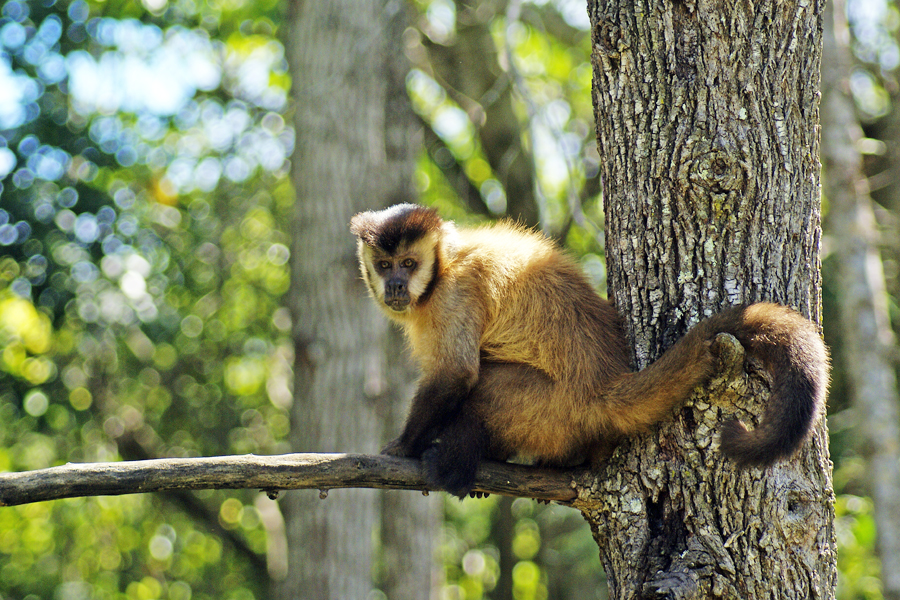
| Appearance | - The species has medium-length fur with varying shades of brown across its body. English Wikipedia
- Its limbs and head tuft are generally darker than the rest of its body. English Wikipedia
- Individuals have a dark hair stripe at the front of their ears that resembles sideburns. English Wikipedia
- The head tuft develops fully only after an individual reaches adulthood. English Wikipedia
- Males are larger in body size than females. English Wikipedia
- The species exhibits morphological variation between and within populations, between sexes, and across different ages. English Wikipedia
| |
|---|
| Size | | No checked fact yet |
|---|
| Habitat | - The species inhabits subtropical, humid, semi-deciduous forests and gallery forests. English Wikipedia
- The species also inhabits forested regions of the Pantanal. birdnet.cornell.edu
- The species occurs in the humid semi-deciduous Alto Parana Atlantic Forest in Paraguay. English Wikipedia
- The species can occupy bushlands and savannas. English Wikipedia
| |
|---|
| Diet | - The species is described as a frugivore-insectivore whose diet includes fruits, seeds, arthropods, frogs, and small mammals. birdnet.cornell.edu
- Fruits constitute the largest part of the species' diet, followed by seeds. English Wikipedia
- Plant parts and invertebrates make up the remainder of the diet after fruits and seeds. English Wikipedia
- Large males have been observed eating small vertebrates. English Wikipedia
- Males tend to consume larger food items than females. English Wikipedia
| - The species is omnivorous and consumes insects, bird eggs, small vertebrates, leaves, bulbs, seeds, and fruits. English Wikipedia
- Fruit can constitute as much as 60–80% of the species' diet. English Wikipedia
- The species adjusts its food choices according to seasonal availability. English Wikipedia
- One observed group consumed 61 of the 145 fruit types available in its environment. English Wikipedia
|
|---|
| Behaviour | - The species is diurnal and opportunistically omnivorous. English Wikipedia
- Individuals live in social communities and travel through their territory while searching for food. English Wikipedia
- Individuals spend most of their time resting, travelling, and foraging. English Wikipedia
- Females spend more time browsing and eating in the canopy of sleeping trees than males. English Wikipedia
- Males spend more time resting and surveying the area on or near the ground. English Wikipedia
- Group sizes range from fewer than twelve individuals to as many as 44. English Wikipedia
- Groups consist of multiple males and multiple females. English Wikipedia
- The alpha male is generally the largest and most ferocious group member. English Wikipedia
- The alpha male protects the group, controls access to food, and has priority in mating with females. English Wikipedia
- Groups normally remain within their home-range boundaries while travelling. English Wikipedia
- Individuals may rub leaves from certain citrus trees against their fur. English Wikipedia
- Individuals use tree branches as anvils to smash hard-shelled fruits and seeds held in both hands. English Wikipedia
| - The alpha female is subordinate to the alpha male. English Wikipedia
- Group size and cohesion increase when food is readily available. English Wikipedia
- When food is scarce, groups divide into smaller units to cover more ground per individual. English Wikipedia
- Females generally remain in their natal groups, while dispersal is predominantly undertaken by males. English Wikipedia
- Females that leave their natal groups gradually move toward the group's periphery before departing. English Wikipedia
- Males may kill the offspring of competing males, particularly during struggles for dominance. English Wikipedia
- Females participate in food-related conflicts, with one study reporting their involvement in 19% of such fights. English Wikipedia
- Females were the aggressors in 93% of the conflicts in which they participated in the cited study. English Wikipedia
|
|---|
| Reproduction | - Females are estimated to reach sexual maturity at four to five years of age. English Wikipedia
- Males are estimated to reach sexual maturity at approximately eight years of age. English Wikipedia
| - Females strongly prefer the alpha male as a sexual partner. English Wikipedia
- One study found that the alpha male received three-quarters of female sexual advances. English Wikipedia
- Females use auditory and visual signals at different stages of mating. English Wikipedia
- The frequency of visual mating signals increases as ovulation approaches. English Wikipedia
- At least seven distinct vocalizations are used during mating. English Wikipedia
|
|---|
| Distribution | - The species occurs in eastern Paraguay, southeastern Bolivia, northern Argentina, and the Brazilian states of Mato Grosso and Mato Grosso do Sul. birdnet.cornell.edu
- In Brazil, the species also occurs in the southeast of Goiás state. English Wikipedia
| - The species occurs in the Atlantic Forest region of southeastern Brazil and far northeastern Argentina. English Wikipedia
|
|---|
| Conservation | - The species is protected in Argentina's El Rey National Park. English Wikipedia
- The species is protected in Bolivia's Kaa-Iya National Park. English Wikipedia
- The species is protected in Brazil's Pantanal Matogrossense National Park. English Wikipedia
- Forest loss from human activities and natural disasters is identified as a threat to the species in Paraguay. English Wikipedia
- Agricultural habitat conversion and illegal hunting threaten populations in Argentina. English Wikipedia
- Deforestation, fires, agriculture, livestock keeping, urban expansion, hunting, and pet capture are among the threats reported in Brazil. English Wikipedia
| - The species' total population size is unknown and is thought to be declining. English Wikipedia
- Habitat loss, hunting, and the pet trade are identified as major threats to the species. English Wikipedia
- The species has demonstrated an ability to survive in fragmented habitats with sparse canopy. English Wikipedia
- The two southern subspecies are relatively widespread and classified as Near Threatened by the IUCN. English Wikipedia
- The northern subspecies has a more restricted distribution and is classified as Endangered. English Wikipedia
|
|---|
| Uses | | No checked fact yet |
|---|
| Similar species | No checked fact yet | - The species historically included the crested or robust tufted capuchin as a subspecies, but that taxon is now recognized as a distinct species. English Wikipedia
|
|---|
| Other | No checked fact yet | - The species was historically classified as a subspecies of the tufted capuchin. English Wikipedia
- The species was originally named Cebus nigritus or Cebus apella nigritus. English Wikipedia
|
|---|