Species · Mammals
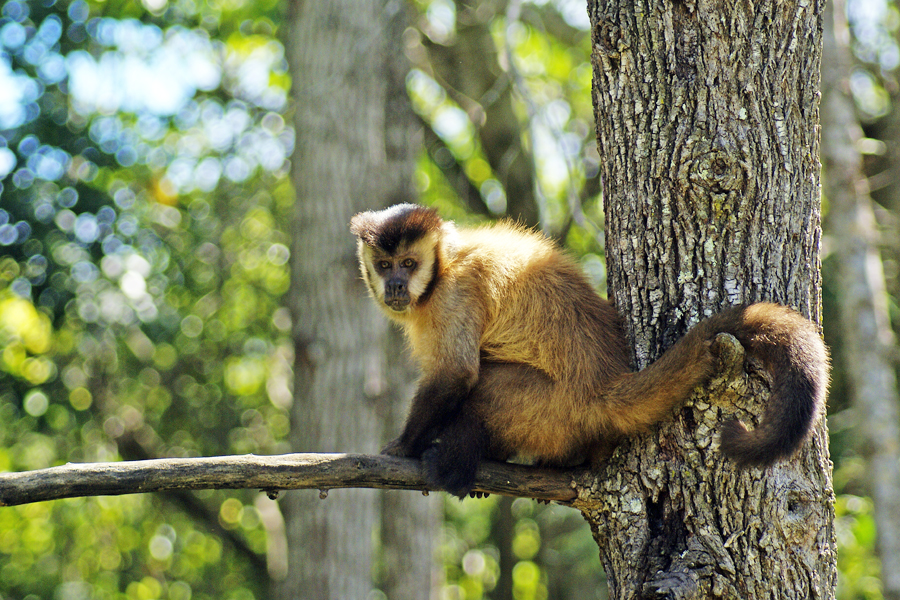
Black Capuchin Sapajus nigritus
The scientific name of the Black Capuchin is Sapajus nigritus. It is a species of mammal in the family Cebidae (new world monkeys), order Primates. The name dates from 1809.
- Scientific name
- Sapajus nigritus (Goldfuss, 1809)
- Common name
- Black Capuchin
- Genus
- Sapajus
- Family
- Cebidae (New World Monkeys)
- Order
- Primates
- Class
- Mammalia
- Red List category
- NT Near Threatened
- Recorded in
- 2 countries
- Name status
- accepted in the Catalogue of Life

Overview
Sapajus nigritus occurs in the Atlantic Forest region of southeastern Brazil and far northeastern Argentina. It has a distinctive pair of tufts on its crown.
Written 26 November 2026 from the sources listed below. Each statement was checked against the passage it cites; statements that could not be supported were removed.
Habitat
The Black Capuchin primarily inhabits the tree canopy. It also descends to the forest floor to forage for insects and nuts.[1][2]
Diet
The Black Capuchin is omnivorous and consumes insects, bird eggs, small vertebrates, leaves, bulbs, seeds, and fruits. Fruit can constitute as much as 60–80% of its diet.[3][4]
The species adjusts its food choices according to seasonal availability. One observed group consumed 61 of the 145 fruit types available in its environment.[5][6]
Behaviour
The alpha female is subordinate to the alpha male. Group size and cohesion increase when food is readily available, while food scarcity causes groups to divide into smaller units to cover more ground per individual.[7][8][9]
Females generally remain in their natal groups, while dispersal is predominantly undertaken by males. Females that leave their natal groups gradually move toward the group's periphery before departing.[10][11]
Males may kill the offspring of competing males, particularly during struggles for dominance.[12]
Females participate in food-related conflicts, with one study reporting their involvement in 19% of such fights. Females were the aggressors in 93% of the conflicts in which they participated in that study.[13][14]
Reproduction and life cycle
Females strongly prefer the alpha male as a sexual partner. One study found that the alpha male received three-quarters of female sexual advances.[15][16]
Females use auditory and visual signals at different stages of mating. The frequency of visual mating signals increases as ovulation approaches, and at least seven distinct vocalizations are used during mating.[17][18][19]
Conservation
The total population size of the Black Capuchin is unknown and is thought to be declining. Habitat loss, hunting, and the pet trade are identified as major threats.[20][21]
The species has demonstrated an ability to survive in fragmented habitats with sparse canopy.[22]
The two southern subspecies are relatively widespread and classified as Near Threatened by the IUCN. The northern subspecies has a more restricted distribution and is classified as Endangered.[23][24]
Similar species
The Black Capuchin historically included the crested or robust tufted capuchin as a subspecies, but that taxon is now recognized as a distinct species.[25]
The species was historically classified as a subspecies of the tufted capuchin and was originally named Cebus nigritus or Cebus apella nigritus.[26][27]
Classification of the Black Capuchin
| Kingdom | Animalia |
|---|---|
| Phylum | Chordata |
| Subphylum | Vertebrata |
| Infraphylum | Gnathostomata |
| Parvphylum | Osteichthyes |
| Megaclass | Tetrapoda |
| Class | Mammalia (Mammal) |
| Subclass | Theria |
| Infraclass | Eutheria |
| Order | Primates (Primate) |
| Suborder | Haplorrhini |
| Infraorder | Simiiformes |
| Family | Cebidae (New World Monkeys) |
| Subfamily | Cebinae (Capuchin Monkeys) |
| Genus | Sapajus (Robust Capuchin Monkey) |
| Species | Sapajus nigritus (Goldfuss, 1809) |
Where the Black Capuchin is found
Checklists and occurrence records place Sapajus nigritus in 2 countries across South America. GBIF holds 4,465 georeferenced records of it.
Countries
Regions and cities with the most records
- São Paulo, Brazil 1,060
- Rio de Janeiro, Brazil 976
- Cordovil, Brazil 776
- Estácio, Brazil 755
- Acari, Brazil 743
- Puerto Iguazú, Argentina 732
- Misiones, Argentina 719
- Rocinha, Brazil 698
- Santa Teresa, Brazil 692
- Leblon, Brazil 684
- Rio de Janeiro, Brazil 678
- Vidigal, Brazil 662
- Catete, Brazil 659
- Botafogo, Brazil 641
- Ipanema, Brazil 639
- Barra da Tijuca, Brazil 633
- São João de Meriti, Brazil 615
- Duque de Caxias, Brazil 607
- Paraná, Brazil 520
- Nilópolis, Brazil 506
- Foz do Iguaçu, Brazil 479
- Presidente Franco, Paraguay 468
- Freguesia, Brazil 426
- Belford Roxo, Brazil 391
- Niterói, Brazil 371
- Espírito Santo, Brazil 350
- Campinas, Brazil 296
- Hortolândia, Brazil 286
- Souzas, Brazil 286
- Paulínia, Brazil 281
- Sumaré, Brazil 273
- Jaguariúna, Brazil 272
- Minas Gerais, Brazil 268
- Valinhos, Brazil 252
- Nova Iguaçu, Brazil 246
- Santa Catarina, Brazil 218
Range as the checklists state it
South America
A number beside a place is its count of GBIF occurrence records. A place without a number comes from a checklist alone. Records show where a species has been observed or collected, which can include escapes and vagrants.
Common names
English
- Black Capuchin
- Black-capped Capuchin
- Black-horned Capuchin
- Mono Cai
Names in 14 other languages
- Arabic
- كبوشي أسود
- Czech
- malpa černá
- Danish
- Sort kapucinerabe
- Dutch
- Zwarte Kapucijnaap
- French
- Sajou, Sapajou, Sapajou noir
- German
- Schwarzer Kapuziner, Schwarzer Kapuzineraffe
- Greek
- Μαύρος Καπουτσίνος
- Italian
- Cebo nero, Scimmie cappucine
- Japanese
- クロオマキザル
- Polish
- kapucynka czarna
- Portuguese
- Macaco-prego, Macaco-prego-preto
- Russian
- Бурый капуцин
- Spanish
- Capuchino, Capuchino negro, Mono caí negro, Mono-capuchino
- Ukrainian
- Капуцин бурий
Synonyms
7 other scientific names have been used for this species and are now treated as synonyms of Sapajus nigritus.
- Cebus apella nigritus (Goldfuss, 1809)
- Cebus caliginosus Elliot, 1910
- Cebus nigritus (Goldfuss, 1809)
- Cebus vellerosus I. Geoffroy, 1851
- Cebus vellerosus I. Geoffroy Saint-Hilaire, 1851
- Cebus xanthocephalus Spix, 1823
- Cercopithecus nigritus Goldfuss, 1809
Related species
-
 Tufted CapuchinSapajus apella
-
 Golden-bellied CapuchinSapajus xanthosternos
-
 Black-striped CapuchinSapajus libidinosus
-
 Blond CapuchinSapajus flavius
-
 Crested CapuchinSapajus robustus
-
 Azaras's CapuchinSapajus cay
- Sapajus cucullatus
-
 Panamanian White-faced CapuchinCebus imitator
Compare
Questions and answers
What is the scientific name of the Black Capuchin?
The scientific name of the Black Capuchin is Sapajus nigritus. Written with its author, the full name is Sapajus nigritus (Goldfuss, 1809).
Which family does the Black Capuchin belong to?
Sapajus nigritus belongs to the family Cebidae, in the order Primates and the class Mammalia.
Where is the Black Capuchin found?
Checklists and occurrence records place Sapajus nigritus in 2 countries: Brazil and Argentina.
What is the conservation status of the Black Capuchin?
The IUCN Red List category recorded for Sapajus nigritus is Near Threatened (NT).
What other names does the Black Capuchin have?
Sapajus nigritus is also known in English as Black-capped Capuchin, Black-horned Capuchin and Mono Cai.
Sources
Passages the profile rests on
- The species primarily inhabits the tree canopy. Source passage: “They are considered arboreal, mainly dwelling in the tree canopy” — English Wikipedia
- The species also descends to the forest floor to forage for insects and nuts. Source passage: “they will also drop to the forest floor to forage, where insects and nuts are most abundant.” — English Wikipedia
- The species is omnivorous and consumes insects, bird eggs, small vertebrates, leaves, bulbs, seeds, and fruits. Source passage: “They eat a wide variety of foods, including insects, bird eggs, small vertebrates, leaves, bulbs, seeds, and fruits.” — English Wikipedia
- Fruit can constitute as much as 60–80% of the species' diet. Source passage: “fruit can make up as much as three or four-fifths of their diet.” — English Wikipedia
- The species adjusts its food choices according to seasonal availability. Source passage: “Their choice among these depends primarily on seasonal availability.” — English Wikipedia
- One observed group consumed 61 of the 145 fruit types available in its environment. Source passage: “One group of black capuchins, for example, ate 61 of 145 fruits available to them in their environment.” — English Wikipedia
- The alpha female is subordinate to the alpha male. Source passage: “the alpha female of the group is submissive to the alpha male.” — English Wikipedia
- Group size and cohesion increase when food is readily available. Source passage: “size and cohesiveness are highest when food is readily available.” — English Wikipedia
- When food is scarce, groups divide into smaller units to cover more ground per individual. Source passage: “When food is scarce, black capuchins split up into smaller groups to cover more ground per capita.” — English Wikipedia
- Females generally remain in their natal groups, while dispersal is predominantly undertaken by males. Source passage: “Females are, for the most part, philopatric. Although rare, females leaving their natal group can be observed, as dispersal is largely a male phenomenon.” — English Wikipedia
- Females that leave their natal groups gradually move toward the group's periphery before departing. Source passage: “When females do leave, they do so gradually, retreating to the group's periphery before breaking away entirely.” — English Wikipedia
- Males may kill the offspring of competing males, particularly during struggles for dominance. Source passage: “Males are apt to kill the offspring of competing males, especially during power struggles.” — English Wikipedia
- Females participate in food-related conflicts, with one study reporting their involvement in 19% of such fights. Source passage: “one study finding that females participated in only 19% of such fights.” — English Wikipedia
- Females were the aggressors in 93% of the conflicts in which they participated in the cited study. Source passage: “they are almost always the aggressor (93% of the time in the same study)” — English Wikipedia
- Females strongly prefer the alpha male as a sexual partner. Source passage: “Females strongly favor the alpha male in choosing a sexual partner” — English Wikipedia
- One study found that the alpha male received three-quarters of female sexual advances. Source passage: “he is the target mate in three-quarters of female sexual advances” — English Wikipedia
- Females use auditory and visual signals at different stages of mating. Source passage: “females possess a wide variety of signals, both auditory and ocular, which they employ at different stages of the process.” — English Wikipedia
- The frequency of visual mating signals increases as ovulation approaches. Source passage: “the increasing frequency with which visual signals occur as ovulation approaches.” — English Wikipedia
- At least seven distinct vocalizations are used during mating. Source passage: “At least seven distinct calls exist for this purpose alone” — English Wikipedia
- The species' total population size is unknown and is thought to be declining. Source passage: “The black capuchin's population number is unknown but thought to be declining.” — English Wikipedia
- Habitat loss, hunting, and the pet trade are identified as major threats to the species. Source passage: “This is due mostly to habitat loss, hunting, and the pet trade” — English Wikipedia
- The species has demonstrated an ability to survive in fragmented habitats with sparse canopy. Source passage: “the species has been observed to be able to survive in fragmented and sparse areas of canopy.” — English Wikipedia
- The two southern subspecies are relatively widespread and classified as Near Threatened by the IUCN. Source passage: “The two southern subspecies remain relatively widespread and are rated as Near Threatened by the IUCN.” — English Wikipedia
- The northern subspecies has a more restricted distribution and is classified as Endangered. Source passage: “The distinctive northern subspecies has a far more restricted distribution and it is considered Endangered.” — English Wikipedia
- The species historically included the crested or robust tufted capuchin as a subspecies, but that taxon is now recognized as a distinct species. Source passage: “The crested or robust tufted capuchin (S. robustus) was once considered a subspecies of S. nigritus, but has since been reevaluated as a distinct species.” — English Wikipedia
- The species was historically classified as a subspecies of the tufted capuchin. Source passage: “Historically, it was included as a subspecies of the tufted capuchin.” — English Wikipedia
- The species was originally named Cebus nigritus or Cebus apella nigritus. Source passage: “The black capuchin was originally named Cebus nigritus or Cebus apella nigritus.” — English Wikipedia
Data
- Catalogue of Life, 2026-10-16 XR cc by
- Global Biodiversity Information Facility CC BY 4.0
- Wikidata CC0
- GeoNames CC BY 4.0
- Wikimedia Commons per image; credit shown with each image
- Within the Catalogue of Life, this name comes from The Integrated Taxonomic Information System cc0
References
- Ruiz-García, Manuel, Maria Ignacia Castillo, Nicolás Lichilín-Ortiz, & and Myreya Pinedo-Castro. (2012). Molecular Relationships and Classification of Several Tufted Capuchin Lineages (Cebus apella, Cebus xanthosternos and Cebus nigritus, Cebidae), by Means of Mitochondrial Cytochrome Oxidase II Gene Sequences. Folia Primatologica, Vol. 83, No. 2.
- Mittermeier, Rusell A., Anthony B. Rylands, and Don E. Wilson, eds. (2013). Handbook of the Mammals of the World. Volume 3. Primates.
- Lima, Marcela G. M., José de Sousa E. Silva-Júnior, David Cerny, Janet C. Buckner, et al. (2018). A phylogenomic perspective on the robust capuchin monkey (Sapajus) radiation: First evidence for extensive population admixture across South America. Molecular Phylogenetics and Evolution, Vol. 124.
This species in other databases
Page built on 28 November 2026. See how the catalog is made and all sources and licences.
Cite this page
ScientificNames.org. (2026). Sapajus nigritus (Black Capuchin). Retrieved November 28, 2026, from https://scientificnames.org/species/sapajus-nigritus
“Sapajus nigritus (Black Capuchin).” ScientificNames.org, 2026, scientificnames.org/species/sapajus-nigritus. Accessed 28 Nov. 2026.
ScientificNames.org. “Sapajus nigritus (Black Capuchin).” Accessed November 28, 2026. https://scientificnames.org/species/sapajus-nigritus.
@misc{scientificnames_sapajus_nigritus_black_capuchin,
  author = {{ScientificNames.org}},
  title = {Sapajus nigritus (Black Capuchin)},
  year = {2026},
  url = {https://scientificnames.org/species/sapajus-nigritus},
  note = {Accessed 2026-11-28}
}