Comparison

Azaras's Capuchin vs Black-striped Capuchin

Azaras's Capuchin (Sapajus cay) and Black-striped Capuchin (Sapajus libidinosus) both belong to the genus Sapajus (robust capuchin monkey) and part ways below it. Both are recorded in 2 countries.
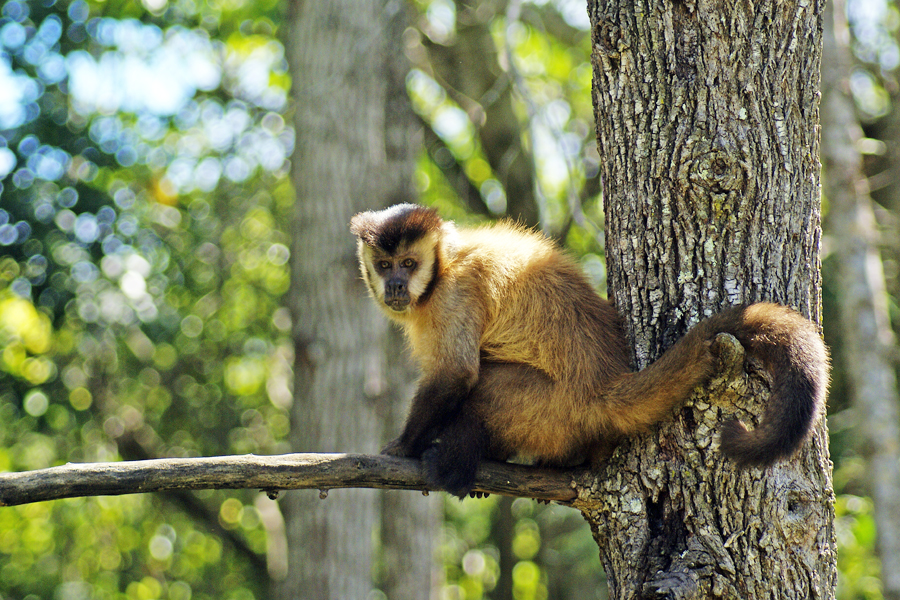
Azaras's Capuchin

Azaras's Capuchin

Sapajus cay

Alexandre Pereira, CC BY-SA 2.0, via Wikimedia Commons

Black-striped Capuchin

Black-striped Capuchin

Sapajus libidinosus

Tiago Falótico, CC BY-SA 3.0, via Wikimedia Commons

Side by side

Azaras's CapuchinBlack-striped Capuchin
Scientific nameSapajus cay (Illiger, 1815)Sapajus libidinosus (Spix, 1823)
English nameAzaras's CapuchinBlack-striped Capuchin
GroupMammalsMammals
ClassMammalia MammalMammalia Mammal
OrderPrimates PrimatePrimates Primate
FamilyCebidae New World MonkeysCebidae New World Monkeys
GenusSapajus Robust Capuchin MonkeySapajus Robust Capuchin Monkey
Named in18151823
Red List categoryVulnerableNear Threatened
Countries on record4 countries2 countries
GBIF occurrence records1,099 records857 records

Rows where the two agree are shown in grey.

Where each is found

Both recorded in 2 countries

Only Azaras's Capuchin (2)

From Catalogue of Life checklists and GBIF occurrence records. A country missing from a list means no record is held, which is not proof of absence.

Checked facts

Azaras's CapuchinBlack-striped Capuchin
Appearance
  • The species has medium-length fur with varying shades of brown across its body. English Wikipedia
  • Its limbs and head tuft are generally darker than the rest of its body. English Wikipedia
  • Individuals have a dark hair stripe at the front of their ears that resembles sideburns. English Wikipedia
  • The head tuft develops fully only after an individual reaches adulthood. English Wikipedia
  • Males are larger in body size than females. English Wikipedia
  • The species exhibits morphological variation between and within populations, between sexes, and across different ages. English Wikipedia
  • The species has light to dark brown body fur and darker black fur on its tail, arms, legs, and head. English Wikipedia
  • The species has orange fur on its neck and yellow-tinted fur on its dorsal side. English Wikipedia
  • Mature individuals develop dark spots on their heads and sideburns on their faces. English Wikipedia
  • The species has a relatively thick and strong tail. English Wikipedia
Size
Habitat
  • The species inhabits subtropical, humid, semi-deciduous forests and gallery forests. English Wikipedia
  • The species also inhabits forested regions of the Pantanal. birdnet.cornell.edu
  • The species occurs in the humid semi-deciduous Alto Parana Atlantic Forest in Paraguay. English Wikipedia
  • The species can occupy bushlands and savannas. English Wikipedia
  • The species primarily inhabits dry forests and savannah landscapes. English Wikipedia
Diet
  • The species is described as a frugivore-insectivore whose diet includes fruits, seeds, arthropods, frogs, and small mammals. birdnet.cornell.edu
  • Fruits constitute the largest part of the species' diet, followed by seeds. English Wikipedia
  • Plant parts and invertebrates make up the remainder of the diet after fruits and seeds. English Wikipedia
  • Large males have been observed eating small vertebrates. English Wikipedia
  • Males tend to consume larger food items than females. English Wikipedia
Behaviour
  • The species is diurnal and opportunistically omnivorous. English Wikipedia
  • Individuals live in social communities and travel through their territory while searching for food. English Wikipedia
  • Individuals spend most of their time resting, travelling, and foraging. English Wikipedia
  • Females spend more time browsing and eating in the canopy of sleeping trees than males. English Wikipedia
  • Males spend more time resting and surveying the area on or near the ground. English Wikipedia
  • Group sizes range from fewer than twelve individuals to as many as 44. English Wikipedia
  • Groups consist of multiple males and multiple females. English Wikipedia
  • The alpha male is generally the largest and most ferocious group member. English Wikipedia
  • The alpha male protects the group, controls access to food, and has priority in mating with females. English Wikipedia
  • Groups normally remain within their home-range boundaries while travelling. English Wikipedia
  • Individuals may rub leaves from certain citrus trees against their fur. English Wikipedia
  • Individuals use tree branches as anvils to smash hard-shelled fruits and seeds held in both hands. English Wikipedia
Reproduction
  • Females are estimated to reach sexual maturity at four to five years of age. English Wikipedia
  • Males are estimated to reach sexual maturity at approximately eight years of age. English Wikipedia
Distribution
  • The species occurs in eastern Paraguay, southeastern Bolivia, northern Argentina, and the Brazilian states of Mato Grosso and Mato Grosso do Sul. birdnet.cornell.edu
  • In Brazil, the species also occurs in the southeast of Goiás state. English Wikipedia
  • The species is native to northern and central Brazil. English Wikipedia
  • The species occurs in Brazil's Cerrado, Caatinga, and Pantanal regions. English Wikipedia
  • The species' described range includes the landscapes between the Rio Araguaia and Rio Grande. English Wikipedia
Conservation
  • The species is protected in Argentina's El Rey National Park. English Wikipedia
  • The species is protected in Bolivia's Kaa-Iya National Park. English Wikipedia
  • The species is protected in Brazil's Pantanal Matogrossense National Park. English Wikipedia
  • Forest loss from human activities and natural disasters is identified as a threat to the species in Paraguay. English Wikipedia
  • Agricultural habitat conversion and illegal hunting threaten populations in Argentina. English Wikipedia
  • Deforestation, fires, agriculture, livestock keeping, urban expansion, hunting, and pet capture are among the threats reported in Brazil. English Wikipedia
No checked fact yet
UsesNo checked fact yet
Similar speciesNo checked fact yet
  • The species was formerly classified as a subspecies of the tufted capuchin. English Wikipedia
  • The southern population is sometimes treated as a separate species called Azaras's capuchin. English Wikipedia
  • In Rondônia, the species associates with the bare-eared squirrel monkey. English Wikipedia
  • Further south, the species associates with the black-capped squirrel monkey. English Wikipedia
  • The species is also found alongside the white-nosed saki. English Wikipedia
  • The black-striped capuchin has been classified separately from the tufted capuchin. fog.ccsf.edu

In brief

Azaras's Capuchin

The species occurs in eastern Paraguay, southeastern Bolivia, northern Argentina, and the Brazilian states of Mato Grosso and Mato Grosso do Sul, as well as the southeast of Goiás state. It has medium-length brown fur, generally darker limbs and head tuft, and a dark hair stripe resembling sideburns at the front of its ears. Full profile

Black-striped Capuchin

The species is native to northern and central Brazil, where it occurs in the Cerrado, Caatinga, and Pantanal regions. It is distinguished by its use of stones to crack nuts, dig in the ground, and produce loud noises that intimidate potential predators. Full profile

Compare something else

Page built on 28 November 2026 from the data on the two species pages, where every source is listed.

Cite this page

ScientificNames.org. (2026). Azaras's Capuchin vs Black-striped Capuchin. Retrieved November 28, 2026, from https://scientificnames.org/compare/sapajus-cay-vs-black-striped-capuchin