Species · Mammals
Black-striped Capuchin Sapajus libidinosus
The scientific name of the Black-striped Capuchin is Sapajus libidinosus. It is a species of mammal in the family Cebidae (new world monkeys), order Primates. The name dates from 1823.
- Scientific name
- Sapajus libidinosus (Spix, 1823)
- Common name
- Black-striped Capuchin
- Genus
- Sapajus
- Family
- Cebidae (New World Monkeys)
- Order
- Primates
- Class
- Mammalia
- Red List category
- NT Near Threatened
- Recorded in
- 2 countries
- Name status
- accepted in the Catalogue of Life

Overview
The species is native to northern and central Brazil, where it occurs in the Cerrado, Caatinga, and Pantanal regions. It is distinguished by its use of stones to crack nuts, dig in the ground, and produce loud noises that intimidate potential predators.
Written 26 November 2026 from the sources listed below. Each statement was checked against the passage it cites; statements that could not be supported were removed.
Appearance
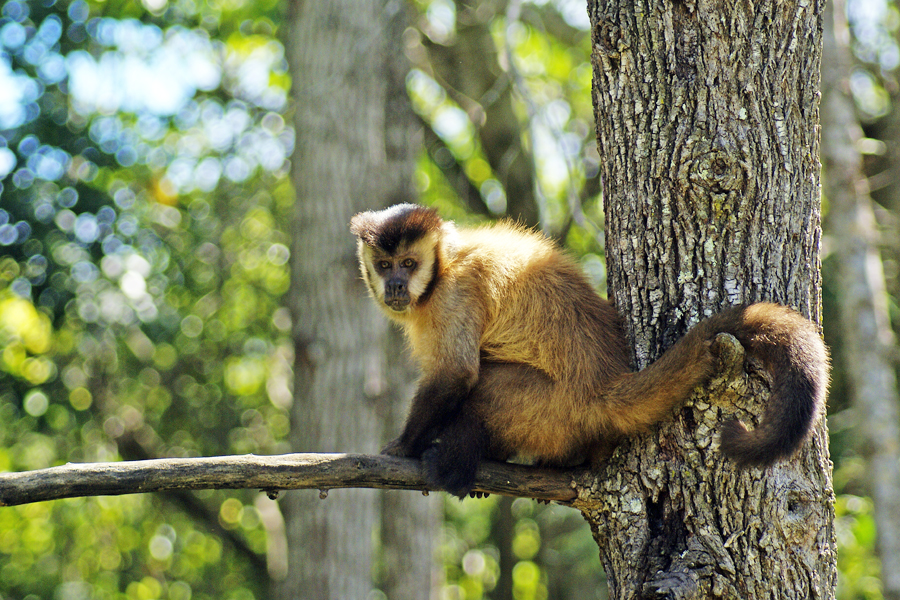
The Black-striped Capuchin has light to dark brown body fur and darker black fur on its tail, arms, legs, and head. Its neck has orange fur, while its dorsal side has yellow-tinted fur.[1][2]
Mature individuals develop dark spots on their heads and sideburns on their faces. The species has a relatively thick and strong tail.[3][4]
Males and females have a similar average height of approximately 37 cm. Adult males weigh approximately 3.5 kg, while adult females weigh approximately 2.1 kg.[5][6][7]
Habitat
The Black-striped Capuchin primarily inhabits dry forests and savannah landscapes.[8]
Its native distribution includes northern and central Brazil, with occurrences in the Cerrado, Caatinga, and Pantanal regions. Its described range includes the landscapes between the Rio Araguaia and Rio Grande.[9][10][11]
Diet
The Black-striped Capuchin eats fruits, nuts, insects, small vertebrates, flowers, and leaves. Fruits are a particularly important component of its diet.[12][13]
The species uses digging tools to locate roots and tubers. It also uses sticks to probe for and collect honey in the wild.[14][15]
Behaviour
The Black-striped Capuchin is active during daylight hours and spends much of the day travelling in search of food. It primarily travels terrestrially using quadrupedal locomotion.[16][17][18]
The species uses stones to crack open nuts placed on stone anvils and tools to dig in the ground. It also uses stones to produce loud noises that intimidate potential predators.[19][20][21]
The species often lives in social groups containing 6–20 individuals. Females remain in their natal groups and exhibit coalition formation and a linear dominance hierarchy.[22][23][24]
Males use sticks and other tools more frequently than females. Females and males use tools at similar rates during the first ten months.[25][26]
The species' documented tool use extends back more than three thousand years.[27]
Reproduction and life cycle
Females reach sexual maturity at approximately five years of age and give birth approximately every two years. They may attract potential mates by throwing rocks and sticks.[28][29][30]
Females initially carry their infants on their bellies before transferring them to their backs. Infants are weaned gradually, and young individuals begin foraging independently at approximately two years of age.[31][32][33]
Similar species
The Black-striped Capuchin was formerly classified as a subspecies of the tufted capuchin. It has been classified separately from the tufted capuchin, although the southern population is sometimes treated as a separate species called Azaras's capuchin.[34][35][36]
In Rondônia, the species associates with the bare-eared squirrel monkey. Further south, it associates with the black-capped squirrel monkey and is also found alongside the white-nosed saki.[37][38][39]
Classification of the Black-striped Capuchin
| Kingdom | Animalia |
|---|---|
| Phylum | Chordata |
| Subphylum | Vertebrata |
| Infraphylum | Gnathostomata |
| Parvphylum | Osteichthyes |
| Megaclass | Tetrapoda |
| Class | Mammalia (Mammal) |
| Subclass | Theria |
| Infraclass | Eutheria |
| Order | Primates (Primate) |
| Suborder | Haplorrhini |
| Infraorder | Simiiformes |
| Family | Cebidae (New World Monkeys) |
| Subfamily | Cebinae (Capuchin Monkeys) |
| Genus | Sapajus (Robust Capuchin Monkey) |
| Species | Sapajus libidinosus (Spix, 1823) |
Where the Black-striped Capuchin is found
Checklists and occurrence records place Sapajus libidinosus in 2 countries across South America. GBIF holds 857 georeferenced records of it.
Countries
Regions and cities with the most records
- Goiás, Brazil 170
- Brasília, Brazil 147
- Plano Piloto, Brazil 147
- Cruzeiro, Brazil 146
- Guará, Brazil 143
- Lago Norte, Brazil 139
- Lago Sul, Brazil 139
- Setor Complementar de Indústria e Abastecimento, Brazil 138
- Park Way, Brazil 134
- Águas Claras, Brazil 133
- Jardim Botânico, Brazil 131
- Núcleo Bandeirante, Brazil 127
- Paranoá, Brazil 127
- Riacho Fundo, Brazil 122
- Itapoã, Brazil 95
- Sobradinho II, Brazil 95
- Sobradinho, Brazil 85
- Piauí, Brazil 84
- Ceará, Brazil 74
- Maranhão, Brazil 59
- Minas Gerais, Brazil 59
- São Sebastião, Brazil 54
- Goiânia, Brazil 50
- Riacho Fundo II, Brazil 48
- Recanto das Emas, Brazil 46
- Samambaia, Brazil 46
- São Paulo, Brazil 35
- Barreirinhas, Brazil 34
- Paulino Neves, Brazil 34
- Tianguá, Brazil 32
- Ubajara, Brazil 30
- Senador Canedo, Brazil 29
- Tocantins, Brazil 29
- Pernambuco, Brazil 28
- Aparecida de Goiânia, Brazil 27
- Ibiapina, Brazil 27
Range as the checklists state it
South America
A number beside a place is its count of GBIF occurrence records. A place without a number comes from a checklist alone. Records show where a species has been observed or collected, which can include escapes and vagrants.
Common names
English
- Black-striped Capuchin
- Bearded Capuchin
Names in 12 other languages
- Arabic
- كبوشي أسود الخطوط
- Czech
- malpa pruhohřbetá
- Danish
- Sortstribet kapucinerabe
- Dutch
- Baardkapucijnaap
- French
- Sajou lascif, Sapajou à barbe
- German
- Rückenstreifen-Kapuzineraffe, Rückenstreifenkapuziner
- Greek
- Γενειοφόρος Καπουτσίνος
- Italian
- Cebo barbuto, Cebo striato
- Japanese
- ホオヒゲオマキザル
- Polish
- kapucynka brodata
- Portuguese
- Macaco-prego, Macaco-prego-amarelo
- Spanish
- Capuchino barbado
Synonyms
3 other scientific names have been used for this species and are now treated as synonyms of Sapajus libidinosus.
- Cebus elegans I. Geoffroy Saint-Hilaire, 1850
- Cebus elegans I. Geoffroy, 1850
- Cebus libidinosus Spix, 1823
Related species
-
 Tufted CapuchinSapajus apella
-
 Golden-bellied CapuchinSapajus xanthosternos
-
 Black CapuchinSapajus nigritus
-
 Blond CapuchinSapajus flavius
-
 Crested CapuchinSapajus robustus
-
 Azaras's CapuchinSapajus cay
- Sapajus cucullatus
-
 Panamanian White-faced CapuchinCebus imitator
Compare
Questions and answers
What is the scientific name of the Black-striped Capuchin?
The scientific name of the Black-striped Capuchin is Sapajus libidinosus. Written with its author, the full name is Sapajus libidinosus (Spix, 1823).
Which family does the Black-striped Capuchin belong to?
Sapajus libidinosus belongs to the family Cebidae, in the order Primates and the class Mammalia.
Where is the Black-striped Capuchin found?
Checklists and occurrence records place Sapajus libidinosus in 2 countries: Brazil and Paraguay.
What is the conservation status of the Black-striped Capuchin?
The IUCN Red List category recorded for Sapajus libidinosus is Near Threatened (NT).
What other names does the Black-striped Capuchin have?
Sapajus libidinosus is also known in English as Bearded Capuchin.
What is the diet of a capuchin monkey?
The Black-striped Capuchin eats fruits, nuts, insects, small vertebrates, flowers, and leaves. Fruits are a particularly important component of its diet.[12][13]
What habitat do capuchin monkeys live in?
The Black-striped Capuchin primarily inhabits dry forests and savannah landscapes.[8]
Sources
Passages the profile rests on
- The species has light to dark brown body fur and darker black fur on its tail, arms, legs, and head. Source passage: “It has fur colored light to dark brown on its body, with darker black fur on its tail, arms, legs, and head.” — English Wikipedia
- The species has orange fur on its neck and yellow-tinted fur on its dorsal side. Source passage: “include orange fur on its neck as well as the yellow tinted fur on its dorsal side.” — English Wikipedia
- Mature individuals develop dark spots on their heads and sideburns on their faces. Source passage: “As it reaches sexual maturity, it gets dark spots on its head as well as sideburns on its face.” — English Wikipedia
- The species has a relatively thick and strong tail. Source passage: “Similarly, to other tufted capuchins it has a thick and strong tail.” — English Wikipedia
- Males and females have a similar average height of approximately 37 cm. Source passage: “Males and females often have a similar height of around 37 cm (15 in)” — English Wikipedia
- Adult males weigh approximately 3.5 kg. Source passage: “with males around 3.5 kg (7.7 lb)” — English Wikipedia
- Adult females weigh approximately 2.1 kg. Source passage: “and females around 2.1 kg (4.6 lb).” — English Wikipedia
- The species primarily inhabits dry forests and savannah landscapes. Source passage: “These capuchins mostly live in dry forests, and savannah landscapes between the Rio Araguaia and the Rio Grande.” — English Wikipedia
- The species is native to northern and central Brazil. Source passage: “They are native to northern and central Brazil.” — English Wikipedia
- The species occurs in Brazil's Cerrado, Caatinga, and Pantanal regions. Source passage: “Specifically, in the Cerrados, Caatingas, and Pantanal of Brazil.” — English Wikipedia
- The species' described range includes the landscapes between the Rio Araguaia and Rio Grande. Source passage: “between the Rio Araguaia and the Rio Grande.” — English Wikipedia
- The species eats fruits, nuts, insects, small vertebrates, flowers, and leaves. Source passage: “Fruits, nuts, insects, small vertebrates, flowers, and leaves.” — English Wikipedia
- Fruits are a particularly important component of its diet. Source passage: “From this variety they especially eat fruits.” — English Wikipedia
- The species uses digging tools to locate roots and tubers. Source passage: “Using tools to dig, they can find foods like roots, tubers, as well as scare prey out of hiding spots.” — English Wikipedia
- The species uses sticks to probe for and collect honey in the wild. Source passage: “Sticks also seem to be used to probe as well as dip for honey in the wild.” — English Wikipedia
- The species is active during daylight hours. Source passage: “black-striped capuchins are diurnal” — English Wikipedia
- The species spends much of the day travelling in search of food. Source passage: “spend much of their day travelling in search of food” — English Wikipedia
- The species primarily travels terrestrially using quadrupedal locomotion. Source passage: “primarily quadrupedally and rarely walking bipedally to use tools.” — English Wikipedia
- The species uses stones to crack open nuts placed on stone anvils. Source passage: “They have been known to take nuts, place them on a stone anvil, and use another stone to crack them open.” — English Wikipedia
- The species uses tools to dig in the ground. Source passage: “Aside from that, they have also been seen using tools to dig in the ground.” — English Wikipedia
- The species uses stones to produce loud noises that intimidate potential predators. Source passage: “It has been shown that they also use stones to make loud noises in order to intimidate potential predators.” — English Wikipedia
- The species often lives in social groups containing 6–20 individuals. Source passage: “They often live in highly social groups ranging from 6-20 individuals.” — English Wikipedia
- Females remain in their natal groups. Source passage: “Females are philopatric” — English Wikipedia
- Females exhibit coalition formation and a linear dominance hierarchy. Source passage: “show coalition, and linear dominance hierarchy.” — English Wikipedia
- Males use sticks and other tools more frequently than females. Source passage: “Males have been seen to use sticks and tools more often than females.” — English Wikipedia
- Females and males use tools at similar rates during the first ten months. Source passage: “females use tools at the same rate as males for the first 10 months” — English Wikipedia
- The species' documented tool use extends back more than three thousand years. Source passage: “This use of tools is a well-defined trait in black-striped capuchins and has been traced back over three thousand years.” — English Wikipedia
- Females reach sexual maturity at approximately five years of age. Source passage: “Females reach sexual maturity around 5 years of age” — English Wikipedia
- Females give birth approximately every two years. Source passage: “Females have offspring on average once every two years to a single infant.” — English Wikipedia
- Females may attract potential mates by throwing rocks and sticks. Source passage: “including throwing rocks and sticks.” — English Wikipedia
- Females carry their infants initially on their bellies before transferring them to their backs. Source passage: “This infant will be initially carried on the mothers belly, but will transition to her back.” — English Wikipedia
- Young individuals begin foraging independently at approximately two years of age. Source passage: “They forage independently at two years of age” — English Wikipedia
- Infants are weaned gradually. Source passage: “and are weaned slowly.” — English Wikipedia
- The species was formerly classified as a subspecies of the tufted capuchin. Source passage: “Until the past few decades, the black-striped capuchin was considered a subspecies of the tufted capuchin” — English Wikipedia
- The southern population is sometimes treated as a separate species called Azaras's capuchin. Source passage: “the southern population is sometimes considered a species of its own as well, called Azaras's capuchin.” — English Wikipedia
- The black-striped capuchin has been classified separately from the tufted capuchin. Source passage: “This species has been split from the Tufted Capuchin (S. apella)” — fog.ccsf.edu
- In Rondônia, the species associates with the bare-eared squirrel monkey. Source passage: “In Rondônia, it associates with the Bare-eared Squirrel Monkey (Saimiri ustus)” — English Wikipedia
- Further south, the species associates with the black-capped squirrel monkey. Source passage: “and further south with the Black-capped Squirrel Monkey (Saimiri Boliviensis).” — English Wikipedia
- The species is also found alongside the white-nosed saki. Source passage: “It is also found with the White-nosed Saki (Chiropotes albinasus).” — English Wikipedia
Data
- Catalogue of Life, 2026-10-16 XR cc by
- Global Biodiversity Information Facility CC BY 4.0
- Wikidata CC0
- GeoNames CC BY 4.0
- Wikimedia Commons per image; credit shown with each image
- Within the Catalogue of Life, this name comes from The Integrated Taxonomic Information System cc0
References
- Mittermeier, Rusell A., Anthony B. Rylands, and Don E. Wilson, eds. (2013). Handbook of the Mammals of the World. Volume 3. Primates.
- Lima, Marcela G. M., José de Sousa E. Silva-Júnior, David Cerny, Janet C. Buckner, et al. (2018). A phylogenomic perspective on the robust capuchin monkey (Sapajus) radiation: First evidence for extensive population admixture across South America. Molecular Phylogenetics and Evolution, Vol. 124.
This species in other databases
Page built on 26 November 2026. See how the catalog is made and all sources and licences.
Cite this page
ScientificNames.org. (2026). Sapajus libidinosus (Black-striped Capuchin). Retrieved November 26, 2026, from https://scientificnames.org/species/sapajus-libidinosus
“Sapajus libidinosus (Black-striped Capuchin).” ScientificNames.org, 2026, scientificnames.org/species/sapajus-libidinosus. Accessed 26 Nov. 2026.
ScientificNames.org. “Sapajus libidinosus (Black-striped Capuchin).” Accessed November 26, 2026. https://scientificnames.org/species/sapajus-libidinosus.
@misc{scientificnames_sapajus_libidinosus_black_striped_capuchin,
  author = {{ScientificNames.org}},
  title = {Sapajus libidinosus (Black-striped Capuchin)},
  year = {2026},
  url = {https://scientificnames.org/species/sapajus-libidinosus},
  note = {Accessed 2026-11-26}
}