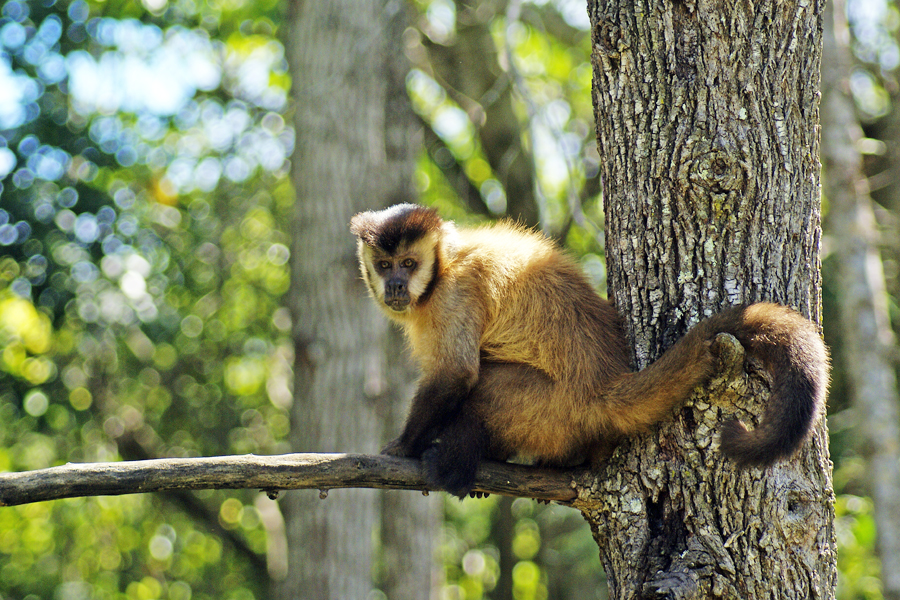
| Appearance | - The species has medium-length fur with varying shades of brown across its body. English Wikipedia
- Its limbs and head tuft are generally darker than the rest of its body. English Wikipedia
- Individuals have a dark hair stripe at the front of their ears that resembles sideburns. English Wikipedia
- The head tuft develops fully only after an individual reaches adulthood. English Wikipedia
- Males are larger in body size than females. English Wikipedia
- The species exhibits morphological variation between and within populations, between sexes, and across different ages. English Wikipedia
| - The tufted capuchin has a more robust build, rougher fur, and a longer, thicker tail than other capuchins. English Wikipedia
- The species has a tuft of long, hardened hair on its forehead that can be raised. English Wikipedia
- Its fur is brownish gray, with a lighter-colored belly and black hands and feet. English Wikipedia
- Its tail is prehensile and can grasp objects like an additional limb. English Wikipedia
|
|---|
| Size | | |
|---|
| Habitat | - The species inhabits subtropical, humid, semi-deciduous forests and gallery forests. English Wikipedia
- The species also inhabits forested regions of the Pantanal. birdnet.cornell.edu
- The species occurs in the humid semi-deciduous Alto Parana Atlantic Forest in Paraguay. English Wikipedia
- The species can occupy bushlands and savannas. English Wikipedia
| - The species inhabits moist tropical and subtropical forests, dry forests, and disturbed or secondary forests. English Wikipedia
- It occurs mainly in tropical rainforests but also inhabits more open forests. English Wikipedia
- The species has been recorded in tropical rainforest habitats at elevations reaching 2,700 metres. English Wikipedia
|
|---|
| Diet | - The species is described as a frugivore-insectivore whose diet includes fruits, seeds, arthropods, frogs, and small mammals. birdnet.cornell.edu
- Fruits constitute the largest part of the species' diet, followed by seeds. English Wikipedia
- Plant parts and invertebrates make up the remainder of the diet after fruits and seeds. English Wikipedia
- Large males have been observed eating small vertebrates. English Wikipedia
- Males tend to consume larger food items than females. English Wikipedia
| - The tufted capuchin is omnivorous and primarily consumes fruits and invertebrates. English Wikipedia
- It sometimes eats small vertebrates, including lizards and bird chicks, as well as other plant parts. English Wikipedia
- Its documented foods include leaves, seeds, pith, insects, larvae, eggs, frogs, reptiles, rodents, mouse opossums, and bats. English Wikipedia
- It consumes nuts from palm species belonging to the genera Attalea and Astrocaryum. English Wikipedia
- It has been observed eating jatobá fruits. English Wikipedia
|
|---|
| Behaviour | - The species is diurnal and opportunistically omnivorous. English Wikipedia
- Individuals live in social communities and travel through their territory while searching for food. English Wikipedia
- Individuals spend most of their time resting, travelling, and foraging. English Wikipedia
- Females spend more time browsing and eating in the canopy of sleeping trees than males. English Wikipedia
- Males spend more time resting and surveying the area on or near the ground. English Wikipedia
- Group sizes range from fewer than twelve individuals to as many as 44. English Wikipedia
- Groups consist of multiple males and multiple females. English Wikipedia
- The alpha male is generally the largest and most ferocious group member. English Wikipedia
- The alpha male protects the group, controls access to food, and has priority in mating with females. English Wikipedia
- Groups normally remain within their home-range boundaries while travelling. English Wikipedia
- Individuals may rub leaves from certain citrus trees against their fur. English Wikipedia
- Individuals use tree branches as anvils to smash hard-shelled fruits and seeds held in both hands. English Wikipedia
| - The tufted capuchin is diurnal and arboreal but also forages on the ground. English Wikipedia
- It walks longer distances between trees that are too far apart for it to jump between. English Wikipedia
- It lives in social groups that can contain between two and twenty or more individuals. English Wikipedia
- Its groups usually contain at least one adult male. English Wikipedia
- Groups containing multiple males generally have one dominant male. English Wikipedia
- Dominant males and nearby group members have priority access to food when supplies are scarce. English Wikipedia
- Group members may produce loud whistles to communicate the discovery of edible food. English Wikipedia
- The species has been observed using sticks to obtain food, including catching ants and reaching otherwise inaccessible items. English Wikipedia
- It has been observed using containers to hold water and sponges to absorb juice. English Wikipedia
- Some individuals manufacture probing sticks to access containers holding syrup. English Wikipedia
- Young individuals tend to observe experienced tool users when learning nut-cracking behaviour. English Wikipedia
|
|---|
| Reproduction | - Females are estimated to reach sexual maturity at four to five years of age. English Wikipedia
- Males are estimated to reach sexual maturity at approximately eight years of age. English Wikipedia
| |
|---|
| Distribution | - The species occurs in eastern Paraguay, southeastern Bolivia, northern Argentina, and the Brazilian states of Mato Grosso and Mato Grosso do Sul. birdnet.cornell.edu
- In Brazil, the species also occurs in the southeast of Goiás state. English Wikipedia
| - The species occurs in South America and on the Caribbean islands of Trinidad and Margarita. English Wikipedia
|
|---|
| Conservation | - The species is protected in Argentina's El Rey National Park. English Wikipedia
- The species is protected in Bolivia's Kaa-Iya National Park. English Wikipedia
- The species is protected in Brazil's Pantanal Matogrossense National Park. English Wikipedia
- Forest loss from human activities and natural disasters is identified as a threat to the species in Paraguay. English Wikipedia
- Agricultural habitat conversion and illegal hunting threaten populations in Argentina. English Wikipedia
- Deforestation, fires, agriculture, livestock keeping, urban expansion, hunting, and pet capture are among the threats reported in Brazil. English Wikipedia
| - The Margarita Island population, identified as S. a. margaritae, is classified as Critically Endangered by the IUCN Red List. English Wikipedia
|
|---|
| Uses | | No checked fact yet |
|---|
| Similar species | No checked fact yet | - The tufted capuchin's distribution overlaps with that of the white-fronted capuchin (Cebus albifrons). English Wikipedia
|
|---|