Species · Mammals
Tufted Capuchin Sapajus apella
The scientific name of the Tufted Capuchin is Sapajus apella. It is a species of mammal in the family Cebidae (new world monkeys), order Primates. The name dates from 1758.
- Scientific name
- Sapajus apella (Linnaeus, 1758)
- Common name
- Tufted Capuchin
- Genus
- Sapajus
- Family
- Cebidae (New World Monkeys)
- Order
- Primates
- Class
- Mammalia
- Red List category
- LC Least Concern
- Recorded in
- 11 countries
- Name status
- accepted in the Catalogue of Life

Overview
Sapajus apella occurs in South America and on the Caribbean islands of Trinidad and Margarita. It has a tuft of long, hardened hair on its forehead that can be raised and a prehensile tail that can grasp objects like an additional limb.
Written 26 November 2026 from the sources listed below. Each statement was checked against the passage it cites; statements that could not be supported were removed.
Appearance
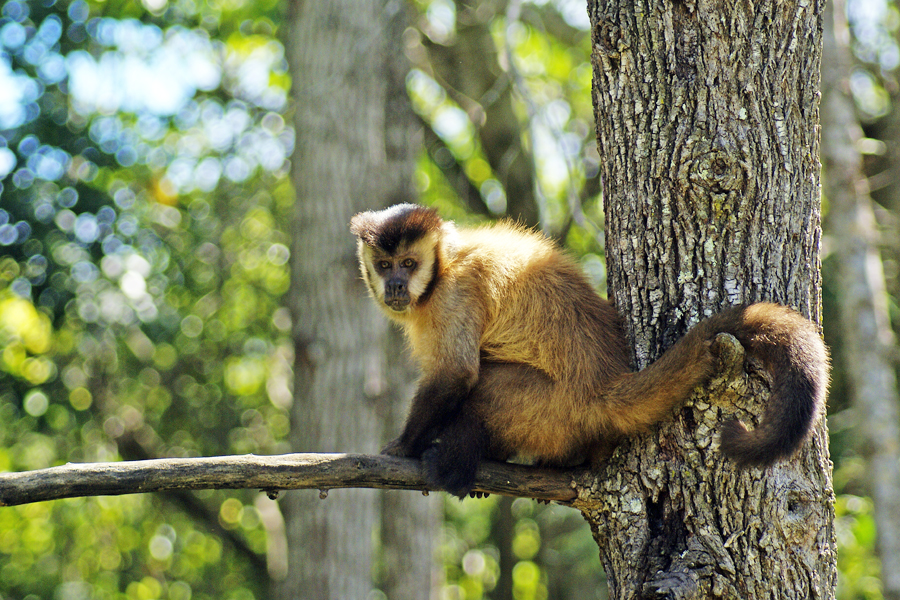
The Tufted Capuchin has a more robust build, rougher fur, and a longer, thicker tail than other capuchins. Its forehead has a tuft of long, hardened hair that can be raised.[1][2]
Its fur is brownish gray, with a lighter-colored belly and black hands and feet. Its prehensile tail can grasp objects like an additional limb.[3][4]
Its head-and-body length ranges from 32 to 57 centimetres, and its tail measures between 38 and 56 centimetres long. Its body weight ranges from 1.9 to 4.8 kilograms, with males generally larger and heavier than females.[5][6][7][8]
Habitat
The Tufted Capuchin inhabits moist tropical and subtropical forests, dry forests, and disturbed or secondary forests. It occurs mainly in tropical rainforests but also inhabits more open forests.[9][10]
It has been recorded in tropical rainforest habitats at elevations reaching 2,700 metres.[11]
Diet
The Tufted Capuchin is omnivorous and primarily consumes fruits and invertebrates. It sometimes eats small vertebrates, including lizards and bird chicks, as well as other plant parts.[12][13]
Its documented foods include leaves, seeds, pith, insects, larvae, eggs, frogs, reptiles, rodents, mouse opossums, and bats. It also consumes nuts from palm species belonging to the genera Attalea and Astrocaryum and has been observed eating jatobá fruits.[14][15][16]
Behaviour
The Tufted Capuchin is diurnal and arboreal but also forages on the ground. It walks longer distances between trees that are too far apart for it to jump between.[17][18]
It lives in social groups containing between two and twenty or more individuals. Groups usually contain at least one adult male, and groups with multiple males generally have one dominant male.[19][20][21]
Dominant males and nearby group members have priority access to food when supplies are scarce. Group members may produce loud whistles to communicate the discovery of edible food.[22][23]
It has been observed using sticks to obtain food, including catching ants and reaching otherwise inaccessible items. It also uses containers to hold water and sponges to absorb juice.[24][25]
Some individuals manufacture probing sticks to access containers holding syrup. Young individuals tend to observe experienced tool users when learning nut-cracking behaviour.[26][27]
Reproduction and life cycle
The gestation period lasts approximately 180 days. Females usually give birth to one offspring, although twins occasionally occur.[28][29]
Newborn offspring weigh approximately 200 to 250 grams. Mothers carry their offspring on their backs and nurse them for approximately nine months.[30][31][32]
Individuals reach sexual maturity at approximately seven years of age.[33]
Conservation
The Margarita Island population, identified as S. a. margaritae, is classified as Critically Endangered by the IUCN Red List.[34]
Similar species
The Tufted Capuchin's distribution overlaps with that of the white-fronted capuchin (Cebus albifrons).[35]
Classification of the Tufted Capuchin
| Kingdom | Animalia |
|---|---|
| Phylum | Chordata |
| Subphylum | Vertebrata |
| Infraphylum | Gnathostomata |
| Parvphylum | Osteichthyes |
| Megaclass | Tetrapoda |
| Class | Mammalia (Mammal) |
| Subclass | Theria |
| Infraclass | Eutheria |
| Order | Primates (Primate) |
| Suborder | Haplorrhini |
| Infraorder | Simiiformes |
| Family | Cebidae (New World Monkeys) |
| Subfamily | Cebinae (Capuchin Monkeys) |
| Genus | Sapajus (Robust Capuchin Monkey) |
| Species | Sapajus apella (Linnaeus, 1758) |
Where the Tufted Capuchin is found
Checklists and occurrence records place Sapajus apella in 11 countries across South America. GBIF holds 10,204 georeferenced records of it.
Countries
- Argentina 256
- Bolivia 285
- Brazil 2,624
- Colombia 2,636
- Ecuador 14
- French Guiana 2,666
- Guyana 70
- Paraguay 103
- Peru 984
- Suriname 550
- Venezuela 16
Regions and cities with the most records
- Meta Department, Colombia 1,224
- Casanare Department, Colombia 944
- Yopal, Colombia 549
- Madre de Dios, Peru 479
- Amapá, Brazil 312
- Mato Grosso, Brazil 280
- Pará, Brazil 258
- Paramaribo, Suriname 254
- Lelydorp, Suriname 250
- Commewijne District, Suriname 230
- Villavicencio, Colombia 230
- Amazonas, Brazil 229
- Sipaliwini District, Suriname 210
- Acacías, Colombia 206
- Cuzco Department, Peru 183
- Loreto, Peru 144
- Kourou, French Guiana 118
- Rondônia, Brazil 111
- Misiones, Argentina 106
- Paraná, Brazil 104
- Cundinamarca, Colombia 102
- Aguazul, Colombia 98
- Puerto Iguazú, Argentina 96
- Puerto Maldonado, Peru 96
- Tauramena, Colombia 89
- Putumayo Department, Colombia 80
- San Martín, Colombia 78
- Beni Department, Bolivia 74
- São Paulo, Brazil 63
- Granada, Colombia 61
- Brokopondo District, Suriname 60
- Foz do Iguaçu, Brazil 60
- Presidente Franco, Paraguay 58
- Huila Department, Colombia 51
- Cayenne, French Guiana 48
- La Paz Department, Bolivia 47
9 more countries have a few records outside this range
These countries hold a few records of Sapajus apella but lie outside the range the checklists give for it. Such records are often zoo or garden specimens, museum material or vagrants, so the species is not counted as occurring there.
Range as the checklists state it
South America
A number beside a place is its count of GBIF occurrence records. A place without a number comes from a checklist alone. Records show where a species has been observed or collected, which can include escapes and vagrants.
Common names
English
- Tufted Capuchin
- Black-capped Capuchin
- Brown Capuchin
- Guianan Brown Capuchin
- Large-headed Capuchin
- Margarita Island Capuchin
Names in 28 other languages
- Arabic
- كبوشي ذو الخصل
- Bulgarian
- Кафяв капуцин
- Catalan
- Caputxí bru
- Czech
- malpa hnědá, malpa velkohlavá
- Danish
- Brunhovedet kapucinerabe
- Dutch
- Bruine Kapucijnaap, Grootkopkapucijnaap
- Finnish
- Töyhtökapusiiniapina, töyhtökapusiini
- French
- Capucin brun, Sapajou apelle
- Galician
- Capuchino pardo
- Georgian
- მურა კაპუცინი
- German
- Apella, Faunaffe, Gehaubter Kapuziner, Großkopfkapuzineraffe, Haubenkapuziner
- Greek
- Μαυροφόρος Καπουτσίνος, Μεγαλοκέφαλος Καπουτσίνος
- Hungarian
- Apella csuklyásmajom
- Italian
- Cebo bruno, Cebo dai cornetti, Cebo dal cappuccio nero, Cebus apella, Scimmia pin
- Japanese
- フサオマキザル
- Korean
- 검은머리카푸친
- Lithuanian
- Juodagalvis kapucinas
- Norwegian Bokmål
- Luekapusiner
- Polish
- kapucynka czubata
- Portuguese
- Macaco-prego-castanho
- Russian
- Капуцин бурый, Капуцин-фавн
- Spanish
- Macaco Prego, Macao prego, Mach, Maicero negro, Mico cachón, Mono Capuchin Pardo, Mono maicero
- mbr
- Wuaáp
- myy
- Gaqué-gaqué
- que
- Yana machin
- srm
- Maka-kou
- tnc
- Tankiya
- ycn
- Calapichi
Synonyms
29 other scientific names have been used for this species and are now treated as synonyms of Sapajus apella.
- Cebus apella (Linnaeus, 1758)
- Cebus apella avus von Pusch, 1942
- Cebus apella chacoensis Pusch, 1941
- Cebus apella macrocephalus Spix, 1823
- Cebus apella magnus Pusch, 1941
- Cebus apella maranonis Pusch, 1941
- Cebus apella morrulus Pusch, 1941
- Cebus apella peruanus Thomas, 1901
- Cebus apella tocantinus Lönnberg, 1939
- Cebus azarae Rengger, 1830
- Cebus capillatus Gray, 1865
- Cebus cirrifer É. Geoffroy Saint-Hilaire, 1812
- Cebus crassiceps Pucheran, 1857
- Cebus cristatus G. Cuvier, 1829
- Cebus frontatus Kuhl, 1820
- Cebus leucogenys Gray, 1866
- Cebus libidinosus juruanus Lönnberg, 1939
- Cebus libidinosus pallidus Gray, 1866
- Cebus libidinosus paraguayanus Fischer, 1829
- Cebus libidinosus sagitta Pusch, 1941
- Cebus lunatus Kuhl, 1820
- Cebus macrocephalus Spix, 1823
- Cebus monachus F. Cuvier, 1820
- Cebus niger É. Geoffroy Saint-Hilaire, 1812
- Cebus subcristatus Gray, 1865
- Cebus versuta Elliot, 1910
- Sapajus macrocephalus (Spix, 1823)
- Simia apella Linnaeus, 1758
- Simia variegata Humboldt, 1812 ambiguous synonym
Subspecies and varieties
- Sapajus apella apella (Guianan Brown Capuchin) subspecies
- Sapajus apella margaritae (Margarita Island Capuchin) subspecies
Related species
-
 Golden-bellied CapuchinSapajus xanthosternos
-
 Black-striped CapuchinSapajus libidinosus
-
 Black CapuchinSapajus nigritus
-
 Blond CapuchinSapajus flavius
-
 Crested CapuchinSapajus robustus
-
 Azaras's CapuchinSapajus cay
- Sapajus cucullatus
-
 Panamanian White-faced CapuchinCebus imitator
Compare
Questions and answers
What is the scientific name of the Tufted Capuchin?
The scientific name of the Tufted Capuchin is Sapajus apella. Written with its author, the full name is Sapajus apella (Linnaeus, 1758).
Which family does the Tufted Capuchin belong to?
Sapajus apella belongs to the family Cebidae, in the order Primates and the class Mammalia.
Where is the Tufted Capuchin found?
Checklists and occurrence records place Sapajus apella in 11 countries, including French Guiana, Colombia, Brazil, Peru, Suriname and Bolivia.
What is the conservation status of the Tufted Capuchin?
The IUCN Red List category recorded for Sapajus apella is Least Concern (LC).
What other names does the Tufted Capuchin have?
Sapajus apella is also known in English as Black-capped Capuchin, Brown Capuchin, Guianan Brown Capuchin, Large-headed Capuchin and Margarita Island Capuchin.
What do tufted capuchins eat?
Tufted Capuchins are omnivorous and primarily consume fruits and invertebrates. Their documented foods include leaves, seeds, pith, insects, larvae, eggs, frogs, reptiles, rodents, mouse opossums, and bats. They also eat palm nuts and jatobá fruits.[12][14][15][16]
Sources
Passages the profile rests on
- The tufted capuchin has a more robust build, rougher fur, and a longer, thicker tail than other capuchins. Source passage: “The tufted capuchin is more powerfully built than the other capuchins, with rougher fur and a long, thick tail.” — English Wikipedia
- The species has a tuft of long, hardened hair on its forehead that can be raised. Source passage: “It has a bundle of long, hardened hair on the forehead that can be raised as a sort of "wig".” — English Wikipedia
- Its fur is brownish gray, with a lighter-colored belly and black hands and feet. Source passage: “The fur is brownish gray, with the belly being somewhat lighter-colored than the rest of the body. The hands and feet are black.” — English Wikipedia
- Its tail is prehensile and can grasp objects like an additional limb. Source passage: “The tail is prehensile: strong and can be used for grasping, as an extra limb.” — English Wikipedia
- Its head-and-body length ranges from 32 to 57 centimetres. Source passage: “The tufted capuchin has a head-body length of 32 to 57 centimetres” — English Wikipedia
- Its tail measures between 38 and 56 centimetres long. Source passage: “a tail length of 38 to 56 centimetres (15 to 22 in)” — English Wikipedia
- Its body weight ranges from 1.9 to 4.8 kilograms. Source passage: “a weight of 1.9 to 4.8 kilograms (4.2 to 10.6 lb)” — English Wikipedia
- Males are generally larger and heavier than females. Source passage: “with the males generally being larger and heavier than the females.” — English Wikipedia
- The species inhabits moist tropical and subtropical forests, dry forests, and disturbed or secondary forests. Source passage: “including moist tropical and subtropical forest, dry forest, and disturbed or secondary forest.” — English Wikipedia
- It occurs mainly in tropical rainforests but also inhabits more open forests. Source passage: “mainly in tropical rainforests (up till a height of 2700 m), but also in more open forests.” — English Wikipedia
- The species has been recorded in tropical rainforest habitats at elevations reaching 2,700 metres. Source passage: “mainly in tropical rainforests (up till a height of 2700 m)” — English Wikipedia
- The tufted capuchin is omnivorous and primarily consumes fruits and invertebrates. Source passage: “The tufted capuchin is omnivorous, mostly feeding on fruits and invertebrates” — English Wikipedia
- It sometimes eats small vertebrates, including lizards and bird chicks, as well as other plant parts. Source passage: “although it sometimes feeds on small vertebrates (e.g. lizards and bird chicks) and other plant parts.” — English Wikipedia
- Its documented foods include leaves, seeds, pith, insects, larvae, eggs, frogs, reptiles, rodents, mouse opossums, and bats. Source passage: “Besides nuts, the capuchin also eats fruit, leaves, seeds, pith, insects and larvae, eggs and young birds, frogs, lizards, other reptiles, rodents, mouse opossums, and even bats.” — English Wikipedia
- It consumes nuts from palm species belonging to the genera Attalea and Astrocaryum. Source passage: “It has been observed cracking various nuts and fruits such as palm nuts (Attalea and Astrocaryum spp.)” — English Wikipedia
- It has been observed eating jatobá fruits. Source passage: “and jatobá fruits (Hymenaea courbaril).” — English Wikipedia
- The tufted capuchin is diurnal and arboreal but also forages on the ground. Source passage: “The tufted capuchin is a diurnal, arboreal primate species, but it often forages on the ground” — English Wikipedia
- It walks longer distances between trees that are too far apart for it to jump between. Source passage: “and walks longer distances between trees that are too far apart to jump.” — English Wikipedia
- It lives in social groups that can contain between two and twenty or more individuals. Source passage: “The tufted capuchin lives in groups of two to twenty or more animals.” — English Wikipedia
- Its groups usually contain at least one adult male. Source passage: “A single group usually contains at least one adult male” — English Wikipedia
- Groups containing multiple males generally have one dominant male. Source passage: “Where multiple males are present, one of the males is dominant.” — English Wikipedia
- Dominant males and nearby group members have priority access to food when supplies are scarce. Source passage: “The dominant male and the group members that are close to him have the privilege to eat first in case of food scarcity” — English Wikipedia
- Group members may produce loud whistles to communicate the discovery of edible food. Source passage: “As soon as one of the group members has found something edible, he or she may make a large whistling sound” — English Wikipedia
- The species has been observed using sticks to obtain food, including catching ants and reaching otherwise inaccessible items. Source passage: “using sticks (to dig nuts, to dip for syrup, to catch ants, to reach food)” — English Wikipedia
- It has been observed using containers to hold water and sponges to absorb juice. Source passage: “using containers to hold water, using sticks (to dig nuts, to dip for syrup, to catch ants, to reach food), using sponges to absorb juice” — English Wikipedia
- Some individuals manufacture probing sticks to access containers holding syrup. Source passage: “In captivity, it has been reported as making probing sticks to reach normally inaccessible containers with syrup.” — English Wikipedia
- Young individuals tend to observe experienced tool users when learning nut-cracking behaviour. Source passage: “young capuchins tended to observe the best tool users when cracking nuts.” — English Wikipedia
- The gestation period lasts approximately 180 days. Source passage: “After a gestation period of 180 days” — English Wikipedia
- Females usually give birth to one offspring, although twins occasionally occur. Source passage: “one young is born, or incidentally a twin.” — English Wikipedia
- Newborn offspring weigh approximately 200 to 250 grams. Source passage: “This young, which weighs only 200 to 250 grams (7.1 to 8.8 oz)” — English Wikipedia
- Mothers carry their offspring on their backs. Source passage: “is carried on the back of its mother.” — English Wikipedia
- Mothers nurse their offspring for approximately nine months. Source passage: “The mother feeds her child for 9 months” — English Wikipedia
- Individuals reach sexual maturity at approximately seven years of age. Source passage: “the young are sexually immature until its seventh year” — English Wikipedia
- The Margarita Island population, identified as S. a. margaritae, is classified as Critically Endangered by the IUCN Red List. Source passage: “The subspecies/population on Margarita Island in Venezuela, S. a. margaritae, is considered Critically Endangered by the IUCN Red List.” — English Wikipedia
- The tufted capuchin's distribution overlaps with that of the white-fronted capuchin (Cebus albifrons). Source passage: “The distribution overlaps with that of other species of capuchins, such as the white-fronted capuchin (Cebus albifrons).” — English Wikipedia
Data
- Catalogue of Life, 2026-10-16 XR cc by
- Global Biodiversity Information Facility CC BY 4.0
- Wikidata CC0
- GeoNames CC BY 4.0
- Wikimedia Commons per image; credit shown with each image
- Within the Catalogue of Life, this name comes from The Integrated Taxonomic Information System cc0
References
- Mittermeier, Rusell A., Anthony B. Rylands, and Don E. Wilson, eds. (2013). Handbook of the Mammals of the World. Volume 3. Primates.
- Lima, Marcela G. M., José de Sousa E. Silva-Júnior, David Cerny, Janet C. Buckner, et al. (2018). A phylogenomic perspective on the robust capuchin monkey (Sapajus) radiation: First evidence for extensive population admixture across South America. Molecular Phylogenetics and Evolution, Vol. 124.
This species in other databases
Page built on 27 November 2026. See how the catalog is made and all sources and licences.
Cite this page
ScientificNames.org. (2026). Sapajus apella (Tufted Capuchin). Retrieved November 27, 2026, from https://scientificnames.org/species/sapajus-apella
“Sapajus apella (Tufted Capuchin).” ScientificNames.org, 2026, scientificnames.org/species/sapajus-apella. Accessed 27 Nov. 2026.
ScientificNames.org. “Sapajus apella (Tufted Capuchin).” Accessed November 27, 2026. https://scientificnames.org/species/sapajus-apella.
@misc{scientificnames_sapajus_apella_tufted_capuchin,
  author = {{ScientificNames.org}},
  title = {Sapajus apella (Tufted Capuchin)},
  year = {2026},
  url = {https://scientificnames.org/species/sapajus-apella},
  note = {Accessed 2026-11-27}
}