Comparison
Striped Parrotfish vs Midnight Parrotfish
Striped Parrotfish (Scarus iseri) and Midnight Parrotfish (Scarus coelestinus) both belong to the genus Scarus (parrotfishes) and part ways below it. Both are recorded in 16 countries.
Striped Parrotfish
Scarus iseri
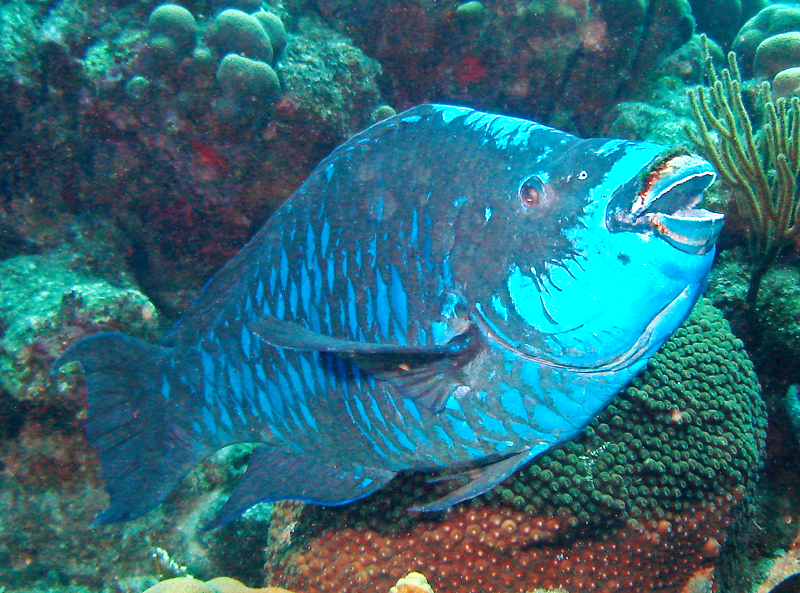
Midnight Parrotfish
Scarus coelestinus
The original uploader was Adona9 at English Wikipedia., CC BY-SA 3.0, via Wikimedia Commons

Side by side
| Striped Parrotfish | Midnight Parrotfish | |
|---|---|---|
| Scientific name | Scarus iseri (Bloch, 1789) | Scarus coelestinus Valenciennes, 1840 |
| English name | Striped Parrotfish | Midnight Parrotfish |
| Group | Fishes | Fishes |
| Class | Teleostei Teleost | Teleostei Teleost |
| Order | Perciformes | Perciformes |
| Family | Labridae Wrasse | Labridae Wrasse |
| Genus | Scarus Parrotfishes | Scarus Parrotfishes |
| Named in | 1789 | 1840 |
| Red List category | Least Concern | Data Deficient |
| Environment | marine | marine |
| Countries on record | 38 countries | 16 countries |
| GBIF occurrence records | 106,950 records | 3,488 records |
Rows where the two agree are shown in grey.
Where each is found
Both recorded in 16 countries
- Bahamas
- Belize
- Bermuda
- Bonaire, Saint Eustatius and Saba
- British Virgin Islands
- Cayman Islands
- Guadeloupe
- Honduras
- Jamaica
- Martinique
- Mexico
- Panama
- Puerto Rico
- Saint Barthelemy
- U.S. Virgin Islands
- United States
Only Striped Parrotfish (22)
- Antigua and Barbuda
- Aruba
- Barbados
- Brazil
- Colombia
- Costa Rica
- Cuba
- Curacao
- Dominica
- Dominican Republic
- French Guiana
- Grenada
- Haiti
- Nicaragua
- Saint Kitts and Nevis
- Saint Lucia
- Saint Martin
- Saint Vincent and the Grenadines
- Sint Maarten
- Trinidad and Tobago
- Turks and Caicos Islands
- Venezuela
From Catalogue of Life checklists and GBIF occurrence records. A country missing from a list means no record is held, which is not proof of absence.
Checked facts
| Striped Parrotfish | Midnight Parrotfish | |
|---|---|---|
| Appearance |
|
|
| Habitat |
|
|
| Diet | No checked fact yet |
|
| Behaviour | No checked fact yet |
|
| Distribution |
|
|
| Conservation | No checked fact yet |
|
| Other |
|
|
In brief
Striped Parrotfish
Scarus iseri (Bloch, 1789), known as the striped parrotfish, is a fish in the family Labridae, order Perciformes, and class Teleostei. It is associated with reefs and soft-bottom habitats in the Greater Caribbean and western Atlantic. It has fused jaw teeth forming broad plates, large crushing molar plates in the throat, and distinct coloration patterns during its initial and terminal phases. Full profile
Midnight Parrotfish
Scarus coelestinus inhabits coral reefs and nearby sandy areas, occurring from Maryland to Brazil and at depths between 5 and 75 meters. It has a deep blue body with light blue patches, including a distinctive patch beneath its beak. Full profile
Compare something else
Page built on 29 November 2026 from the data on the two species pages, where every source is listed.
Cite this page
ScientificNames.org. (2026). Striped Parrotfish vs Midnight Parrotfish. Retrieved November 29, 2026, from https://scientificnames.org/compare/striped-parrotfish-vs-midnight-parrotfish
“Striped Parrotfish vs Midnight Parrotfish.” ScientificNames.org, 2026, scientificnames.org/compare/striped-parrotfish-vs-midnight-parrotfish. Accessed 29 Nov. 2026.
ScientificNames.org. “Striped Parrotfish vs Midnight Parrotfish.” Accessed November 29, 2026. https://scientificnames.org/compare/striped-parrotfish-vs-midnight-parrotfish.
@misc{scientificnames_striped_parrotfish_vs_midnight_parrotfish,
  author = {{ScientificNames.org}},
  title = {Striped Parrotfish vs Midnight Parrotfish},
  year = {2026},
  url = {https://scientificnames.org/compare/striped-parrotfish-vs-midnight-parrotfish},
  note = {Accessed 2026-11-29}
}