Species · Fishes
Midnight Parrotfish Scarus coelestinus
The scientific name of the Midnight Parrotfish is Scarus coelestinus. It is a species of fish in the family Labridae (wrasse), order Perciformes. The name dates from 1840.
- Scientific name
- Scarus coelestinus Valenciennes, 1840
- Common name
- Midnight Parrotfish
- Genus
- Scarus
- Family
- Labridae (Wrasse)
- Order
- Perciformes
- Class
- Teleostei
- Red List category
- DD Data Deficient
- Environment
- marine
- Recorded in
- 16 countries
- Name status
- accepted in the Catalogue of Life
Overview
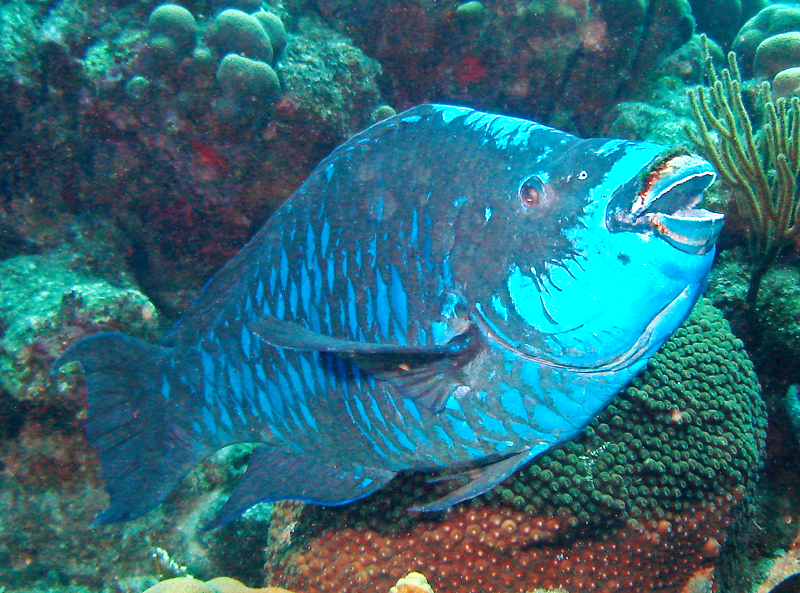
Scarus coelestinus inhabits coral reefs and nearby sandy areas, occurring from Maryland to Brazil and at depths between 5 and 75 meters. It has a deep blue body with light blue patches, including a distinctive patch beneath its beak.
Written 26 November 2026 from the sources listed below. Each statement was checked against the passage it cites; statements that could not be supported were removed.
Appearance
The Midnight Parrotfish has a deep blue body with light blue patches along its sides and head. Every individual has a light blue patch on the underside of its beak, although the positions of other patches vary between fish.[1][2][3]
Males and females retain the same coloration throughout their juvenile and adult stages.[4]
Habitat
The species inhabits coral reefs, particularly in the Caribbean, southern Florida, and the southern Gulf of Mexico. It swims over coral reefs and sandy areas at depths between 5 and 75 meters.[5][6][7]
Its documented distribution extends from Maryland in the north to Brazil in the south, including the Caribbean, Bahamas, and Florida. The species has also been documented at the Miskito Cays in Nicaragua, where it has been photographed swimming above a seagrass bed near a coral reef.[8][9][10][11]
Diet
The Midnight Parrotfish is primarily herbivorous. Its main food source is algae scraped from coral and other hard substrates, although it has also been observed consuming sergeant major damselfish eggs.[12][13][14]
The species consumes carbonate sediments while scraping algae from hard substrates. Adult individuals can take up to 16,000 bites per day, while juveniles can take up to 28,000 bites per day.[15][16][17]
The species has not been shown to consume sponges.[18]
Behaviour
Midnight Parrotfish can form feeding schools containing more than 30 individuals. These schools can raid algae farms and egg nests defended by territorial damselfish.[19][20]
The species frequently forms mixed feeding schools with blue tangs. These schools typically contain 50 to 400 blue tangs and between one and seven midnight parrotfish, which feed together on algae.[21][22][23]
Midnight Parrotfish are relatively rare across their geographical range but can be locally abundant in areas where they are not fished.[24][25]
Conservation
The Midnight Parrotfish is classified as Least Concern on the IUCN Red List. It is protected in United States waters and in several marine protected areas in the Caribbean.[26][27]
Cuban spearfishers target the species, contributing to a slight population decline.[28]
Similar species
The Midnight Parrotfish is closely related to Scarus guacamaia and Scarus trispinosus.[29]
Classification of the Midnight Parrotfish
| Kingdom | Animalia |
|---|---|
| Phylum | Chordata |
| Subphylum | Vertebrata |
| Infraphylum | Gnathostomata |
| Parvphylum | Osteichthyes |
| Gigaclass | Actinopterygii |
| Superclass | Actinopteri |
| Class | Teleostei (Teleost) |
| Order | Perciformes |
| Family | Labridae (Wrasse) |
| Subfamily | Scarinae |
| Tribe | Scarini |
| Genus | Scarus (Parrotfishes) |
| Species | Scarus coelestinus Valenciennes, 1840 |
Where the Midnight Parrotfish is found
Checklists and occurrence records place Scarus coelestinus in 16 countries. GBIF holds 3,488 georeferenced records of it.
Countries
- Bahamas 18
- Belize 19
- Bermuda 14
- Bonaire, Saint Eustatius and Saba 10
- British Virgin Islands 4
- Cayman Islands 17
- Guadeloupe 3
- Honduras 31
- Jamaica 3
- Martinique 3
- Mexico 49
- Panama 7
- Puerto Rico 16
- Saint Barthelemy 4
- U.S. Virgin Islands 6
- United States 3,284
Regions and cities with the most records
- Key West, United States 540
- Florida, United States 43
- Coconut Grove, United States 24
- Coral Gables, United States 23
- Miami, United States 23
- Miami Beach, United States 23
- Allapattah, United States 22
- Brownsville, United States 22
- Little Havana, United States 21
- Greenacres City, United States 20
- Lake Worth Beach, United States 20
- Lake Worth Corridor, United States 20
- Palm Beach Gardens, United States 20
- Palm Springs, United States 20
- Riviera Beach, United States 20
- West Palm Beach, United States 20
- Cozumel, Mexico 18
- Jupiter, United States 18
- George Town, Cayman Islands 15
- West Bay, Cayman Islands 15
- Coral Terrace, United States 13
- Flagami, United States 13
- Hamilton, Bermuda 13
- Pinecrest, United States 13
- Kendall, United States 12
- Quintana Roo, Mexico 11
- Glenvar Heights, United States 10
- Hialeah, United States 10
- North Miami, United States 10
- Pinewood, United States 10
- West Little River, United States 10
- Westchester, United States 10
- Cutler, United States 9
- Golden Glades, United States 9
- North Miami Beach, United States 9
- Oakland Park, United States 8
4 more countries have a few records outside this range
These countries hold a few records of Scarus coelestinus but lie outside the range the checklists give for it. Such records are often zoo or garden specimens, museum material or vagrants, so the species is not counted as occurring there.
A number beside a place is its count of GBIF occurrence records. A place without a number comes from a checklist alone. Records show where a species has been observed or collected, which can include escapes and vagrants.
Common names
English
- Midnight Parrotfish
- Nightowl Parrot
- Scarld
- Plum Parrotfish
Names in 10 other languages
- Catalan
- Peix lloro blau fosc
- Czech
- ploskozubec půlnoční
- Estonian
- Öösinine papagoikala
- French
- Perroquet noir
- German
- Mitternachts-Papageifisch
- Italian
- Pesce pappagallo blu
- Mandarin Chinese
- 紫鸚嘴魚
- Papiamento
- Gutu pretu
- Portuguese
- Budião-Roxo, Peixe-Papagaio
- Spanish
- Guacamaya Negra, Judio, Loro Negro, Loro medianoche, loro de medianoche
Synonyms
5 other scientific names have been used for this species and are now treated as synonyms of Scarus coelestinus.
- Pseudoscarus coelestinus (Valenciennes, 1840)
- Pseudoscarus plumbeus Bean, 1912
- Pseudoscarus simplex Poey, 1865
- Scarus coelastinus Valenciennes, 1840
- Scarus rostratus Poey, 1860
Related species
-
 Blue ParrotfishScarus coeruleus
- Black ParrotfishScarus niger
-
 Rainbow ParrotfishScarus guacamaia
-
 Queen ParrotfishScarus vetula
-
 Blue-barred ParrotfishScarus ghobban
-
 Princess ParrotfishScarus taeniopterus
-
 Common ParrotfishScarus psittacus
-
 Rusty ParrotfishScarus ferrugineus
Compare
Questions and answers
What is the scientific name of the Midnight Parrotfish?
The scientific name of the Midnight Parrotfish is Scarus coelestinus. Written with its author, the full name is Scarus coelestinus Valenciennes, 1840.
Which family does the Midnight Parrotfish belong to?
Scarus coelestinus belongs to the family Labridae, in the order Perciformes and the class Teleostei.
Where is the Midnight Parrotfish found?
Checklists and occurrence records place Scarus coelestinus in 16 countries, including United States, Mexico, Honduras, Belize, Bahamas and Cayman Islands.
What is the conservation status of the Midnight Parrotfish?
The IUCN Red List category recorded for Scarus coelestinus is Data Deficient (DD).
What other names does the Midnight Parrotfish have?
Scarus coelestinus is also known in English as Nightowl Parrot, Scarld and Plum Parrotfish.
Are midnight parrotfish rare?
Midnight Parrotfish are relatively rare across their geographical range. They can be locally abundant in areas where they are not fished.[24][25]
What is the diet of a parrotfish?
The Midnight Parrotfish is primarily herbivorous. It mainly eats algae scraped from coral and other hard substrates, but it has also been observed consuming sergeant major damselfish eggs.[12][13][14]
Sources
Passages the profile rests on
- The midnight parrotfish has a deep blue body with light blue patches along its sides and head. Source passage: “The midnight parrotfish has a deep blue body with light blue patches along its sides and head.” — English Wikipedia
- Every midnight parrotfish has a light blue patch on the underside of its beak. Source passage: “all midnight parrotfish have a light blue patch on the underside of the beak.” — English Wikipedia
- The positions of the light blue patches vary between individual fish. Source passage: “The exact location of light blue patches differs between each fish” — English Wikipedia
- Both male and female midnight parrotfish retain the same coloration throughout their juvenile and adult stages. Source passage: “Unlike most other parrotfish species, the midnight parrotfish retains its coloration through its juvenile and adult stages of life. Both male and female midnight parrotfish exhibit this coloration.” — English Wikipedia
- The species inhabits coral reefs, particularly in the Caribbean, southern Florida, and the southern Gulf of Mexico. Source passage: “The midnight parrotfish inhabits coral reefs mainly in the Caribbean, southern Florida, and the southern Gulf of Mexico” — English Wikipedia
- The species occurs at depths between 5 and 75 meters. Source passage: “Midnight parrotfish have been found at depths between 5 and 75 meters.” — English Wikipedia
- The species swims over coral reefs and sandy areas. Source passage: “it swims over reefs and sandy areas” — English Wikipedia
- The species has been photographed swimming above a seagrass bed near a coral reef at the Miskito Cays in Nicaragua. Source passage: “Photograph of a midnight parrotfish (Scarus coelestinus) swimming above a seagrass bed near a coral reef at Research Station HK-2 at the Miskito Cays, Nicaragua.” — digitalcommons.usf.edu
- The species occurs from Maryland in the north to Brazil in the south. Source passage: “It has been observed as far north as Maryland and as far south as Brazil.” — English Wikipedia
- The species occurs in the Caribbean, Bahamas, and Florida. Source passage: “inhabits coral reefs mainly in the Caribbean, Bahamas, and Florida.” — English Wikipedia
- The species has been documented at the Miskito Cays in Nicaragua. Source passage: “at Research Station HK-2 at the Miskito Cays, Nicaragua.” — digitalcommons.usf.edu
- The midnight parrotfish is primarily herbivorous. Source passage: “The midnight parrotfish, along with other parrotfishes, is primarily a herbivore.” — English Wikipedia
- Algae scraped from coral and other hard substrates constitute its main food source. Source passage: “Their main source of food is algae, which they scrape from coral and other hard substrates using their beak.” — English Wikipedia
- The species has also been observed consuming sergeant major damselfish eggs. Source passage: “midnight parrotfish have also been observed consuming sergeant major damselfish eggs.” — English Wikipedia
- The species consumes carbonate sediments while scraping algae from hard substrates. Source passage: “Through this process, the parrotfish also consumes carbonate sediments” — English Wikipedia
- Adult midnight parrotfish can take up to 16,000 bites per day. Source passage: “The midnight parrotfish can take up to 16,000 bites a day as an adult” — English Wikipedia
- Juvenile midnight parrotfish can take up to 28,000 bites per day. Source passage: “28,000 a day as a juvenile.” — English Wikipedia
- The species has not been shown to consume sponges. Source passage: “the midnight parrotfish has not been shown to consume sponges.” — English Wikipedia
- Midnight parrotfish can form feeding schools containing more than 30 individuals. Source passage: “feeding midnight parrotfish may form schools of over 30 individuals” — English Wikipedia
- Feeding schools can raid algae farms and egg nests defended by territorial damselfish. Source passage: “in order to raid food from the algae "farms" and egg nests of territorial damselfish” — English Wikipedia
- The species frequently forms mixed feeding schools with blue tangs. Source passage: “Midnight parrotfish are often found schooling with large numbers of blue tang for extended period of time when feeding.” — English Wikipedia
- Mixed schools typically contain 50 to 400 blue tangs and between one and seven midnight parrotfish. Source passage: “typically composed of 50 to 400 blue tang with 1-7 midnight parrotfish” — English Wikipedia
- Mixed schools of midnight parrotfish and blue tangs feed together on algae. Source passage: “These mixed schools feed together on algae” — English Wikipedia
- Midnight parrotfish are relatively rare across their geographical range. Source passage: “midnight parrotfish are relatively rare throughout their range.” — English Wikipedia
- The species can be locally abundant in areas where it is not fished. Source passage: “in areas where they are not fished for, they can be locally abundant” — English Wikipedia
- The midnight parrotfish is classified as Least Concern on the IUCN Red List. Source passage: “Midnight parrotfish are cited as 'Least Concern' on the IUCN Red List.” — English Wikipedia
- The species is protected in United States waters and in several marine protected areas in the Caribbean. Source passage: “Midnight parrotfish are protected species in United States waters, as well as a number of marine protected areas in the Caribbean.” — English Wikipedia
- Cuban spearfishers target midnight parrotfish, contributing to a slight population decline. Source passage: “Cuban spear-fishers often target the midnight parrotfish along with other parrotfish species, which has led to a slight decline in population.” — English Wikipedia
- The species is closely related to Scarus guacamaia and Scarus trispinosus. Source passage: “The midnight parrotfish is most closely related to two other large-bodied parrotfish species, S. guacamaia and S. trispinosus.” — English Wikipedia
Data
- Catalogue of Life, 2026-10-16 XR cc by
- Global Biodiversity Information Facility CC BY 4.0
- Wikidata CC0
- GeoNames CC BY 4.0
- Wikimedia Commons per image; credit shown with each image
- Within the Catalogue of Life, this name comes from World Register of Marine Species cc by
References
- Cuvier, G.; Valenciennes A. (1840). Histoire naturelle des poissons. Tome Quatorzième. Suite Du Livre Seizième. Labroïdes. Livre Dix-Septième. Des Malacoptérygiens. Pitois-Levrault, Paris., v. 14: i–xxii + 2 pp. + 1–464 + 4 pp., Pls. 389–420. where the name was published
This species in other databases
- Catalogue of Life 4V3H9
- Wikidata Q2394774
- iNaturalist 112135
- WoRMS urn:lsid:marinespecies.org:taxname:276042
- ITIS 170812
Page built on 28 November 2026. See how the catalog is made and all sources and licences.
Cite this page
ScientificNames.org. (2026). Scarus coelestinus (Midnight Parrotfish). Retrieved November 28, 2026, from https://scientificnames.org/species/scarus-coelestinus
“Scarus coelestinus (Midnight Parrotfish).” ScientificNames.org, 2026, scientificnames.org/species/scarus-coelestinus. Accessed 28 Nov. 2026.
ScientificNames.org. “Scarus coelestinus (Midnight Parrotfish).” Accessed November 28, 2026. https://scientificnames.org/species/scarus-coelestinus.
@misc{scientificnames_scarus_coelestinus_midnight_parrotfish,
  author = {{ScientificNames.org}},
  title = {Scarus coelestinus (Midnight Parrotfish)},
  year = {2026},
  url = {https://scientificnames.org/species/scarus-coelestinus},
  note = {Accessed 2026-11-28}
}