Comparison
Gulf Parrotfish vs Midnight Parrotfish
Gulf Parrotfish (Scarus persicus) and Midnight Parrotfish (Scarus coelestinus) both belong to the genus Scarus (parrotfishes) and part ways below it.
Gulf Parrotfish
Scarus persicus
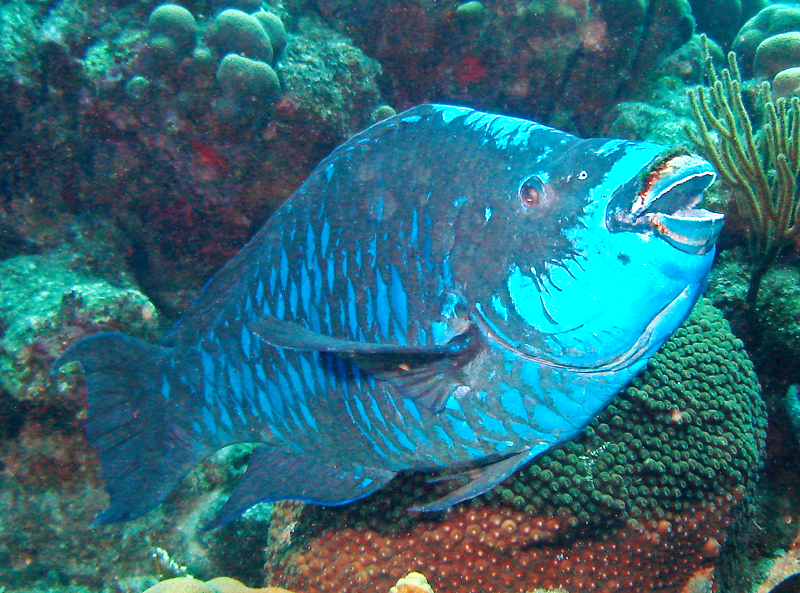
Midnight Parrotfish
Scarus coelestinus
The original uploader was Adona9 at English Wikipedia., CC BY-SA 3.0, via Wikimedia Commons

Side by side
| Gulf Parrotfish | Midnight Parrotfish | |
|---|---|---|
| Scientific name | Scarus persicus Randall & Bruce, 1983 | Scarus coelestinus Valenciennes, 1840 |
| English name | Gulf Parrotfish | Midnight Parrotfish |
| Group | Fishes | Fishes |
| Class | Teleostei Teleost | Teleostei Teleost |
| Order | Perciformes | Perciformes |
| Family | Labridae Wrasse | Labridae Wrasse |
| Genus | Scarus Parrotfishes | Scarus Parrotfishes |
| Named in | 1983 | 1840 |
| Red List category | Least Concern | Data Deficient |
| Environment | marine | marine |
| Countries on record | 4 countries | 16 countries |
| GBIF occurrence records | 68 records | 3,488 records |
Rows where the two agree are shown in grey.
Where each is found
Only Gulf Parrotfish (4)
Only Midnight Parrotfish (16)
- Bahamas
- Belize
- Bermuda
- Bonaire, Saint Eustatius and Saba
- British Virgin Islands
- Cayman Islands
- Guadeloupe
- Honduras
- Jamaica
- Martinique
- Mexico
- Panama
- Puerto Rico
- Saint Barthelemy
- U.S. Virgin Islands
- United States
From Catalogue of Life checklists and GBIF occurrence records. A country missing from a list means no record is held, which is not proof of absence.
Checked facts
| Gulf Parrotfish | Midnight Parrotfish | |
|---|---|---|
| Appearance | No checked fact yet |
|
| Habitat | No checked fact yet |
|
| Diet | No checked fact yet |
|
| Behaviour | No checked fact yet |
|
| Distribution | No checked fact yet |
|
| Conservation | No checked fact yet |
|
| Other | No checked fact yet |
|
In brief
Midnight Parrotfish
Scarus coelestinus inhabits coral reefs and nearby sandy areas, occurring from Maryland to Brazil and at depths between 5 and 75 meters. It has a deep blue body with light blue patches, including a distinctive patch beneath its beak. Full profile
Compare something else
Page built on 28 November 2026 from the data on the two species pages, where every source is listed.
Cite this page
ScientificNames.org. (2026). Gulf Parrotfish vs Midnight Parrotfish. Retrieved November 28, 2026, from https://scientificnames.org/compare/gulf-parrotfish-vs-midnight-parrotfish
“Gulf Parrotfish vs Midnight Parrotfish.” ScientificNames.org, 2026, scientificnames.org/compare/gulf-parrotfish-vs-midnight-parrotfish. Accessed 28 Nov. 2026.
ScientificNames.org. “Gulf Parrotfish vs Midnight Parrotfish.” Accessed November 28, 2026. https://scientificnames.org/compare/gulf-parrotfish-vs-midnight-parrotfish.
@misc{scientificnames_gulf_parrotfish_vs_midnight_parrotfish,
  author = {{ScientificNames.org}},
  title = {Gulf Parrotfish vs Midnight Parrotfish},
  year = {2026},
  url = {https://scientificnames.org/compare/gulf-parrotfish-vs-midnight-parrotfish},
  note = {Accessed 2026-11-28}
}