Comparison

Brazilian Striped Parrotfish vs Midnight Parrotfish

Brazilian Striped Parrotfish (Scarus zelindae) and Midnight Parrotfish (Scarus coelestinus) both belong to the genus Scarus (parrotfishes) and part ways below it.

Brazilian Striped Parrotfish

Brazilian Striped Parrotfish

Scarus zelindae

Igor Cristino Silva Cruz, CC BY-SA 4.0, via Wikimedia Commons

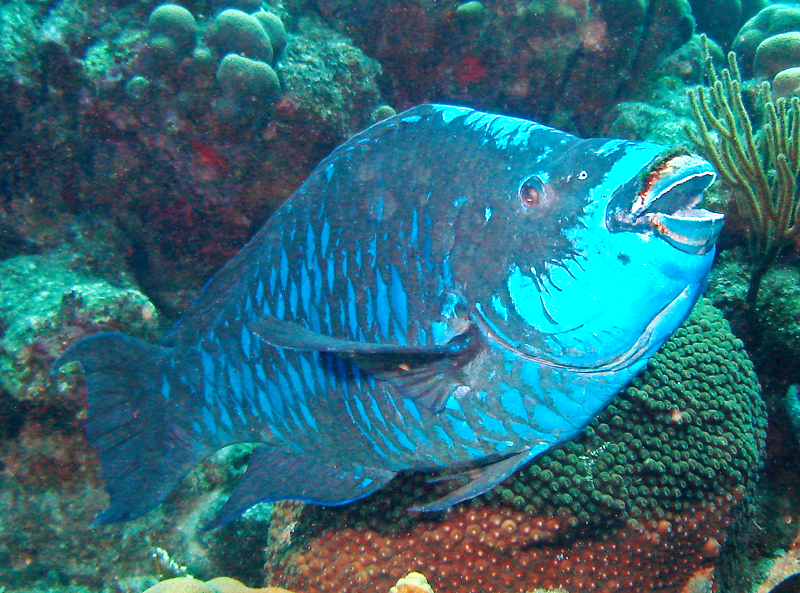
Midnight Parrotfish

Midnight Parrotfish

Scarus coelestinus

The original uploader was Adona9 at English Wikipedia., CC BY-SA 3.0, via Wikimedia Commons

Side by side

Brazilian Striped ParrotfishMidnight Parrotfish
Scientific nameScarus zelindae Moura, Figueiredo & Sazima, 2001Scarus coelestinus Valenciennes, 1840
English nameBrazilian Striped ParrotfishMidnight Parrotfish
GroupFishesFishes
ClassTeleostei TeleostTeleostei Teleost
OrderPerciformesPerciformes
FamilyLabridae WrasseLabridae Wrasse
GenusScarus ParrotfishesScarus Parrotfishes
Named in20011840
Red List categoryData DeficientData Deficient
Environmentmarinemarine
Countries on record1 country16 countries
GBIF occurrence records1,666 records3,488 records

Rows where the two agree are shown in grey.

Where each is found

Only Brazilian Striped Parrotfish (1)

Only Midnight Parrotfish (16)

From Catalogue of Life checklists and GBIF occurrence records. A country missing from a list means no record is held, which is not proof of absence.

Checked facts

Brazilian Striped ParrotfishMidnight Parrotfish
Appearance
  • Juvenile individuals have brown bodies, white stripes, and white bellies. English Wikipedia
  • Individuals in the initial phase have brown coloration and three to four lateral white spots. English Wikipedia
  • Terminal-phase individuals develop orange-yellow coloration around their mouths or lower heads. English Wikipedia
  • Secondary males have bluish-green bodies and yellow bands on their caudal fins. English Wikipedia
  • Females and primary males have dusky purple coloration and four white markings. English Wikipedia
  • The species has nine dorsal spines, three anal spines, and seven predorsal scales. English Wikipedia
  • The species has an inferior mouth. English Wikipedia
  • The midnight parrotfish has a deep blue body with light blue patches along its sides and head. English Wikipedia
  • Every midnight parrotfish has a light blue patch on the underside of its beak. English Wikipedia
  • The positions of the light blue patches vary between individual fish. English Wikipedia
  • Both male and female midnight parrotfish retain the same coloration throughout their juvenile and adult stages. English Wikipedia
Size
  • The species can reach a maximum reported length of 33.2 cm. English Wikipedia
  • Individuals have three recognized life stages: juvenile, initial, and terminal. English Wikipedia
No checked fact yet
Habitat
  • The species occurs at depths between 1 and 60 m. English Wikipedia
  • The species is associated with water temperatures of 24–28 °C. English Wikipedia
  • Terminal-phase individuals commonly inhabit deeper coral and rocky reefs farther from the coast. English Wikipedia
  • Juveniles use shallow coastal reefs as nursery habitats. English Wikipedia
  • The Abrolhos Bank and Davies Bank contain fire coral colonies with high biomass of this species. English Wikipedia
  • The species inhabits coral reefs, particularly in the Caribbean, southern Florida, and the southern Gulf of Mexico. English Wikipedia
  • The species occurs at depths between 5 and 75 meters. English Wikipedia
  • The species swims over coral reefs and sandy areas. English Wikipedia
  • The species has been photographed swimming above a seagrass bed near a coral reef at the Miskito Cays in Nicaragua. digitalcommons.usf.edu
Diet
Behaviour
  • The species swims using a rowing movement generated by its pectoral fins. English Wikipedia
  • Individuals defend feeding territories when they find productive feeding locations. English Wikipedia
  • The species scrapes algae from coral reefs during daylight. English Wikipedia
  • At night, individuals sleep in coral while enclosed in a mucus cocoon. English Wikipedia
  • Mucus used to form the sleeping cocoon is secreted by glands near the gills. English Wikipedia
  • Producing the mucus sleeping cocoon can take up to an hour. English Wikipedia
  • The species contributes to bioerosion by removing algae from rocks with its beak. English Wikipedia
  • Midnight parrotfish can form feeding schools containing more than 30 individuals. English Wikipedia
  • Feeding schools can raid algae farms and egg nests defended by territorial damselfish. English Wikipedia
  • The species frequently forms mixed feeding schools with blue tangs. English Wikipedia
  • Mixed schools typically contain 50 to 400 blue tangs and between one and seven midnight parrotfish. English Wikipedia
  • Mixed schools of midnight parrotfish and blue tangs feed together on algae. English Wikipedia
  • Midnight parrotfish are relatively rare across their geographical range. English Wikipedia
  • The species can be locally abundant in areas where it is not fished. English Wikipedia
ReproductionNo checked fact yet
Distribution
  • The species is endemic to the southwestern Atlantic Ocean, particularly Brazilian waters. English Wikipedia
Conservation
  • The species has experienced a reduction of up to 50% in total abundance in recent decades. English Wikipedia
  • The species is classified as vulnerable on the Brazilian Red List. English Wikipedia
  • Coastal fisheries in Brazil are identified as a major threat to the species. English Wikipedia
  • Recreational spearfishing targets adults in the terminal phase. English Wikipedia
  • Mangrove deforestation and seagrass removal negatively affect the species' life cycle. English Wikipedia
  • The midnight parrotfish is classified as Least Concern on the IUCN Red List. English Wikipedia
  • The species is protected in United States waters and in several marine protected areas in the Caribbean. English Wikipedia
  • Cuban spearfishers target midnight parrotfish, contributing to a slight population decline. English Wikipedia
Uses
  • The species contributes to coral recruitment by producing sediment that provides attachment surfaces for young corals. English Wikipedia
No checked fact yet
Other
  • The species is classified as a scraper but can also act as an excavator. English Wikipedia
  • The species and Scarus trispinosus are the only parrotfish species endemic to the southwestern Atlantic according to the document. English Wikipedia
  • The species is closely related to Scarus guacamaia and Scarus trispinosus. English Wikipedia

In brief

Brazilian Striped Parrotfish

Scarus zelindae Moura, Figueiredo & Sazima, 2001 is a parrotfish species in the family Labridae, order Perciformes, and class Teleostei. The species is endemic to the southwestern Atlantic Ocean, particularly Brazilian waters. The species is classified as a scraper but can also act as an excavator. Full profile

Midnight Parrotfish

Scarus coelestinus inhabits coral reefs and nearby sandy areas, occurring from Maryland to Brazil and at depths between 5 and 75 meters. It has a deep blue body with light blue patches, including a distinctive patch beneath its beak. Full profile

Compare something else

Page built on 29 November 2026 from the data on the two species pages, where every source is listed.

Cite this page

ScientificNames.org. (2026). Brazilian Striped Parrotfish vs Midnight Parrotfish. Retrieved November 29, 2026, from https://scientificnames.org/compare/brazilian-striped-parrotfish-vs-midnight-parrotfish