Comparison
Kirk's Caecilian vs Uluguru Black Caecilian
Kirk's Caecilian (Scolecomorphus kirkii) and Uluguru Black Caecilian (Scolecomorphus uluguruensis) both belong to the genus Scolecomorphus (tropical caecilians) and part ways below it. Both are recorded in 1 country.
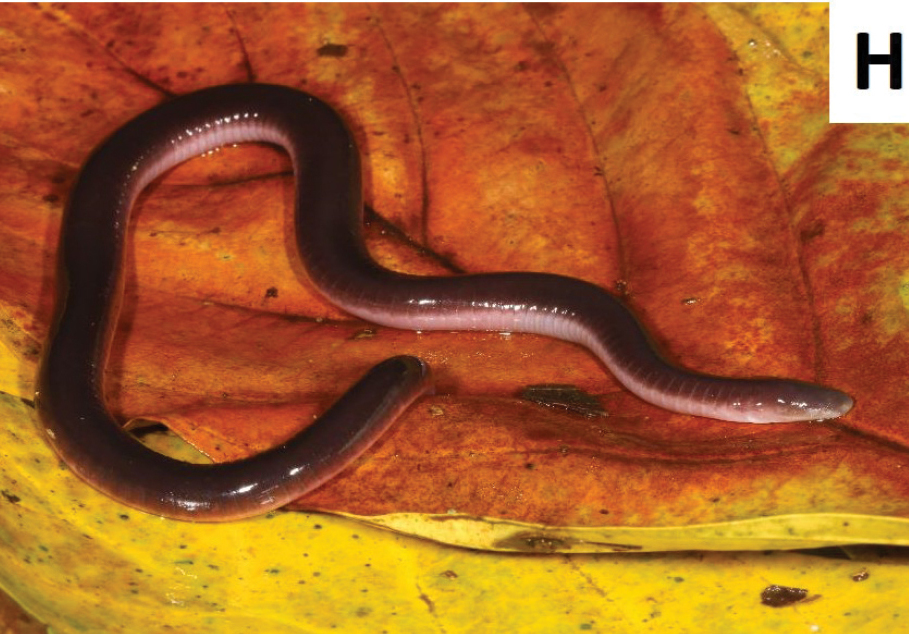
Kirk's Caecilian
Scolecomorphus kirkii
Conradie W, Bittencourt-Silva GB, Engelbrecht HM, Loader SP, Menegon M, Nanvonamuquitxo C, Scott M, Tolley KA (2016) Exploration into the hidden world of Mozambique’s sky island forests: new discove, CC BY 4.0, via Wikimedia Commons

Uluguru Black Caecilian
Scolecomorphus uluguruensis
Side by side
| Kirk's Caecilian | Uluguru Black Caecilian | |
|---|---|---|
| Scientific name | Scolecomorphus kirkii Boulenger, 1883 | Scolecomorphus uluguruensis Barbour & Loveridge, 1928 |
| English name | Kirk's Caecilian | Uluguru Black Caecilian |
| Group | Amphibians | Amphibians |
| Class | Amphibia Amphibians | Amphibia Amphibians |
| Order | Gymnophiona Caecilian | Gymnophiona Caecilian |
| Family | Scolecomorphidae African Caecilians | Scolecomorphidae African Caecilians |
| Genus | Scolecomorphus Tropical Caecilians | Scolecomorphus Tropical Caecilians |
| Named in | 1883 | 1928 |
| Red List category | Least Concern | Endangered |
| Countries on record | 3 countries | 1 country |
| GBIF occurrence records | 128 records | 131 records |
Rows where the two agree are shown in grey.
Where each is found
Both recorded in 1 country
Only Kirk's Caecilian (2)
From Catalogue of Life checklists and GBIF occurrence records. A country missing from a list means no record is held, which is not proof of absence.
Checked facts
| Kirk's Caecilian | Uluguru Black Caecilian | |
|---|---|---|
| Appearance |
| No checked fact yet |
| Size |
| No checked fact yet |
| Habitat |
|
|
| Behaviour |
| No checked fact yet |
| Reproduction |
|
|
| Distribution |
|
|
| Conservation |
|
|
| Uses |
| No checked fact yet |
| Other | No checked fact yet |
|
In brief
Kirk's Caecilian
Scolecomorphus kirkii occurs in southern Malawi east of the Shire River, northern Mozambique and Tanzania. Adults measure 215–463 mm in snout–vent length, making it the largest member of the genus Scolecomorphus. Full profile
Uluguru Black Caecilian
The Uluguru Black Caecilian is an amphibian belonging to the family Scolecomorphidae. It is endemic to the Uluguru Mountains of Tanzania, where it lives in soil in montane forests at elevations of 1,800–2,050 metres above sea level. It does not require water bodies for reproduction. Full profile
Compare something else
Page built on 29 November 2026 from the data on the two species pages, where every source is listed.
Cite this page
ScientificNames.org. (2026). Kirk's Caecilian vs Uluguru Black Caecilian. Retrieved November 29, 2026, from https://scientificnames.org/compare/kirks-caecilian-vs-uluguru-black-caecilian
“Kirk's Caecilian vs Uluguru Black Caecilian.” ScientificNames.org, 2026, scientificnames.org/compare/kirks-caecilian-vs-uluguru-black-caecilian. Accessed 29 Nov. 2026.
ScientificNames.org. “Kirk's Caecilian vs Uluguru Black Caecilian.” Accessed November 29, 2026. https://scientificnames.org/compare/kirks-caecilian-vs-uluguru-black-caecilian.
@misc{scientificnames_kirks_caecilian_vs_uluguru_black_caecilian,
  author = {{ScientificNames.org}},
  title = {Kirk's Caecilian vs Uluguru Black Caecilian},
  year = {2026},
  url = {https://scientificnames.org/compare/kirks-caecilian-vs-uluguru-black-caecilian},
  note = {Accessed 2026-11-29}
}