Species · Amphibians
Kirk's Caecilian Scolecomorphus kirkii
The scientific name of the Kirk's Caecilian is Scolecomorphus kirkii. It is a species of amphibian in the family Scolecomorphidae (african caecilians), order Gymnophiona. The name dates from 1883.
- Scientific name
- Scolecomorphus kirkii Boulenger, 1883
- Common name
- Kirk's Caecilian
- Genus
- Scolecomorphus
- Family
- Scolecomorphidae (African Caecilians)
- Order
- Gymnophiona
- Class
- Amphibia
- Red List category
- LC Least Concern
- Recorded in
- 3 countries
- Name status
- accepted in the Catalogue of Life
Overview
Scolecomorphus kirkii occurs in southern Malawi east of the Shire River, northern Mozambique and Tanzania. Adults measure 215–463 mm in snout–vent length, making it the largest member of the genus Scolecomorphus.
Written 27 November 2026 from the sources listed below. Each statement was checked against the passage it cites; statements that could not be supported were removed.
Appearance
The species has between 130 and 152 primary annuli, which are ring-shaped folds.[1]
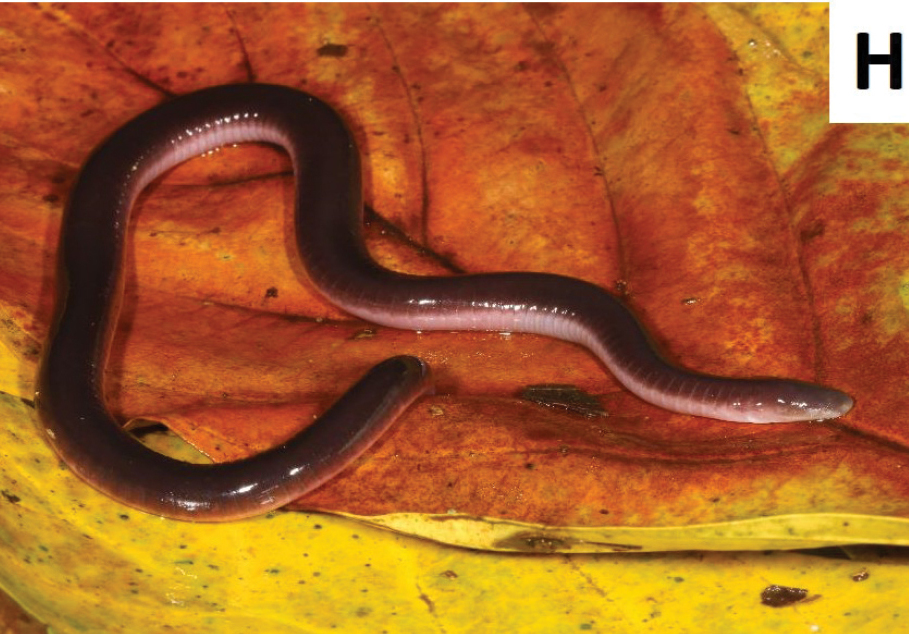
Its dorsal surface is lavender-grey, with the colour extending onto the sides. The mid-ventral surfaces are flesh-coloured or cream-coloured.[2][3]
Its colouration may serve an aposematic function.[4]
Habitat
Kirk's Caecilian is soil-dwelling and inhabits montane and submontane forests. It generally occurs at elevations above 1,000 m above sea level, but can occur as low as 500 m above sea level.[5][6][7][8]
The species can also inhabit secondary environments, including fruit gardens and small-holder agricultural areas.[9]
Behaviour
The species is an efficient burrower.[10]
The fossorial snake Atractaspis aterrima is recorded as a predator of Kirk's Caecilian. An individual was found in the gut of this snake.[11][12]
Reproduction and life cycle
The species is assumed to be viviparous. Its reproduction is also assumed not to depend on bodies of water.[13][14]
Conservation
Kirk's Caecilian is locally abundant and has been assessed as Least Concern by the IUCN.[15][16]
The species may be affected by habitat disturbance and conversion resulting from deforestation and agricultural intensification. However, the significance of these activities as threats has not been established.[17][18]
Annual and perennial non-timber crops are reported as threats to the species. Logging and wood harvesting, as well as agricultural and forestry effluents, are also identified as threats.[19][20][21]
Uses
Kirk's Caecilian has been recorded in the pet trade, although only rarely.[22]
Classification of the Kirk's Caecilian
| Kingdom | Animalia |
|---|---|
| Phylum | Chordata |
| Subphylum | Vertebrata |
| Infraphylum | Gnathostomata |
| Parvphylum | Osteichthyes |
| Megaclass | Tetrapoda |
| Class | Amphibia (Amphibians) |
| Order | Gymnophiona (Caecilian) |
| Family | Scolecomorphidae (African Caecilians) |
| Genus | Scolecomorphus (Tropical Caecilians) |
| Species | Scolecomorphus kirkii Boulenger, 1883 |
Where the Kirk's Caecilian is found
Checklists and occurrence records place Scolecomorphus kirkii in 3 countries. GBIF holds 128 georeferenced records of it.
Countries
Regions and cities with the most records
- Morogoro, Tanzania 9
- Morogoro, Tanzania 7
- Iringa, Tanzania 4
- Zambezia Province, Mozambique 3
- Zomba, Malawi 3
A number beside a place is its count of GBIF occurrence records. A place without a number comes from a checklist alone. Records show where a species has been observed or collected, which can include escapes and vagrants.
Common names
English
- Kirk's Caecilian
- Lake Tanganyika Caecilian
Names in 3 other languages
- Arabic
- ضفدع ثعباني كيركي
- Czech
- afročervor krátkohlavý
- Russian
- Танзанийская червяга
Synonyms
2 other scientific names have been used for this species and are now treated as synonyms of Scolecomorphus kirkii.
- Scolecomorphus convexus Taylor, 1968
- Scolecomorphus kirkii kirkii Boulenger, 1883
Questions and answers
What is the scientific name of the Kirk's Caecilian?
The scientific name of the Kirk's Caecilian is Scolecomorphus kirkii. Written with its author, the full name is Scolecomorphus kirkii Boulenger, 1883.
Which family does the Kirk's Caecilian belong to?
Scolecomorphus kirkii belongs to the family Scolecomorphidae, in the order Gymnophiona and the class Amphibia.
Where is the Kirk's Caecilian found?
Checklists and occurrence records place Scolecomorphus kirkii in 3 countries: Malawi, Tanzania and Mozambique.
What is the conservation status of the Kirk's Caecilian?
The IUCN Red List category recorded for Scolecomorphus kirkii is Least Concern (LC).
What other names does the Kirk's Caecilian have?
Scolecomorphus kirkii is also known in English as Lake Tanganyika Caecilian.
Sources
Passages the profile rests on
- The species has between 130 and 152 primary annuli, which are ring-shaped folds. Source passage: “There are 130–152 primary annuli (ring-shaped folds).” — English Wikipedia
- Its dorsal surface is lavender-grey, with the colour extending onto the sides. Source passage: “The dorsal colouration is lavender-grey and extends to the sides” — English Wikipedia
- Its mid-ventral surfaces are flesh-coloured or cream-coloured. Source passage: “flesh or cream coloured mid-ventral surfaces.” — English Wikipedia
- Its colouration may serve an aposematic function. Source passage: “It is possible that the colouration is aposematic.” — English Wikipedia
- The species is soil-dwelling. Source passage: “Scolecomorphus kirkii is a soil-dwelling species” — English Wikipedia
- It inhabits montane and submontane forests. Source passage: “occurs in montane and submontane forests” — English Wikipedia
- It generally occurs at elevations above 1,000 m above sea level. Source passage: “generally at elevations above 1,000 m (3,300 ft) above sea level” — English Wikipedia
- The species can occur at elevations as low as 500 m above sea level. Source passage: “but sometimes down to 500 m (1,600 ft) asl.” — English Wikipedia
- It can inhabit secondary environments, including fruit gardens and small-holder agricultural areas. Source passage: “It can also live in secondary habitats like fruit gardens and small-holder agricultural areas.” — English Wikipedia
- The species is an efficient burrower. Source passage: “It is an efficient burrower” — English Wikipedia
- The fossorial snake Atractaspis aterrima is recorded as a predator of this species. Source passage: “Among its predators is the fossorial snake Atractaspis aterrima” — English Wikipedia
- An individual of this species was found in the gut of Atractaspis aterrima. Source passage: “based on a S. kirkii individual found in the gut of this snake.” — English Wikipedia
- The species is assumed to be viviparous. Source passage: “Scolecomorphus kirkii is assumed to be viviparous” — English Wikipedia
- Its reproduction is assumed not to depend on bodies of water. Source passage: “not to depend on bodies of water in its reproduction.” — English Wikipedia
- The species is locally abundant. Source passage: “It is locally abundant.” — English Wikipedia
- The IUCN has assessed the species as Least Concern. Source passage: “The International Union for Conservation of Nature (IUCN) has assessed it as of "Least Concern".” — English Wikipedia
- The species may be affected by habitat disturbance and conversion resulting from deforestation and agricultural intensification. Source passage: “It can probably suffer from habitat disturbance and conversion caused by deforestation and agricultural intensification” — English Wikipedia
- The significance of deforestation and agricultural intensification as threats to the species has not been established. Source passage: “although it is not known whether these constitute significant threats.” — English Wikipedia
- The species is reported as threatened by annual and perennial non-timber crops. Source passage: “threatened by annual and perennial non-timber crops” — amphibiaweb.org
- Logging and wood harvesting are identified as threats to the species. Source passage: “logging and wood harvesting” — amphibiaweb.org
- Agricultural and forestry effluents are identified as threats to the species. Source passage: “agricultural and forestry effluents” — amphibiaweb.org
- The species has been recorded in the pet trade, although only rarely. Source passage: “It has been recorded in pet trade but only rarely.” — English Wikipedia
Data
- Catalogue of Life, 2026-10-16 XR cc by
- Global Biodiversity Information Facility CC BY 4.0
- Wikidata CC0
- GeoNames CC BY 4.0
- Wikimedia Commons per image; credit shown with each image
- Within the Catalogue of Life, this name comes from The Integrated Taxonomic Information System cc0
References
- Descriptions of New Species of Lizards and Frogs collected by Hr. A. Forrer in Mexico. (1883). Annals of Natural History, xi, 342–344. https://doi.org/10.1080/00222938309459162 Link where the name was published
This species in other databases
Page built on 27 November 2026. See how the catalog is made and all sources and licences.
Cite this page
ScientificNames.org. (2026). Scolecomorphus kirkii (Kirk's Caecilian). Retrieved November 27, 2026, from https://scientificnames.org/species/scolecomorphus-kirkii
“Scolecomorphus kirkii (Kirk's Caecilian).” ScientificNames.org, 2026, scientificnames.org/species/scolecomorphus-kirkii. Accessed 27 Nov. 2026.
ScientificNames.org. “Scolecomorphus kirkii (Kirk's Caecilian).” Accessed November 27, 2026. https://scientificnames.org/species/scolecomorphus-kirkii.
@misc{scientificnames_scolecomorphus_kirkii_kirks_caecilian,
  author = {{ScientificNames.org}},
  title = {Scolecomorphus kirkii (Kirk's Caecilian)},
  year = {2026},
  url = {https://scientificnames.org/species/scolecomorphus-kirkii},
  note = {Accessed 2026-11-27}
}