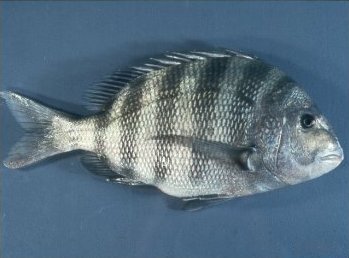
| Appearance | - Scup have a very deep, oval and laterally compressed body. biogeodb.stri.si.edu
- The scup head is deep and has a steep upper profile with a small concavity above the eye. biogeodb.stri.si.edu
- The scup mouth is small and opens at the front. biogeodb.stri.si.edu
- Scup have strongly flattened front-jaw incisor teeth with narrow tips and narrowing bases. biogeodb.stri.si.edu
- Scup have two rows of molar teeth on the sides of their jaws. biogeodb.stri.si.edu
- The scup pectoral fin is very long and extends beyond the third anal-fin spine. biogeodb.stri.si.edu
- Scup have between 49 and 54 lateral-line scales. biogeodb.stri.si.edu
- Scup have scales on their cheeks and opercles but lack scales on the snout and between the eye and mouth. biogeodb.stri.si.edu
- Scup are silvery and olive-colored on the back, usually with five to six faint dark bars on the upper body and 12 to 15 indistinct stripes. biogeodb.stri.si.edu
- Scup have faint blue spots on the head, body and fins, together with a blue patch above and behind each eye. biogeodb.stri.si.edu
| - The front teeth are broad and flattened, while the side teeth include molar-like teeth arranged in three upper rows and two lower rows. English Wikipedia
- The dorsal fin has 12 spines and 11 soft rays. English Wikipedia
- The anal fin has three spines and nine or ten soft rays, with the second spine being particularly robust. English Wikipedia
- The pectoral fins are longer than the pelvic fins and extend to the middle spine of the anal fin. English Wikipedia
- The caudal fin is forked. English Wikipedia
- Adults have silvery to greenish-yellow coloration with olive coloring on the upper body. English Wikipedia
- Adults have five or six dark vertical bars along their flanks, which become less distinct with age. English Wikipedia
- The caudal and pectoral fins are greenish, while the dorsal, anal and pelvic fins are dark. English Wikipedia
- The fish has well-defined incisors, molars and grinding teeth. floridamuseum.ufl.edu
- The sheepshead lacks tooth patches on the roof of its mouth. floridamuseum.ufl.edu
|
|---|
| Size | No checked fact yet | |
|---|
| Habitat | - Scup occur in rocky, coral and oyster reef habitats. biogeodb.stri.si.edu
- Scup are associated with soft-bottom habitats including mud, sand, gravel, beaches, estuaries, mangroves and seagrass. biogeodb.stri.si.edu
| |
|---|
| Diet | | - The sheepshead is an omnivore. English Wikipedia
- Large juveniles and adults consume blue crabs, other crustaceans, shellfish and small fish. English Wikipedia
- Juvenile sheepshead feed on zooplankton, polychaetes and chironomid larvae. English Wikipedia
- The species occasionally consumes vegetable matter. English Wikipedia
- Sheepshead use their flattened teeth to crush shelled or armored prey and remove barnacles from hard surfaces. English Wikipedia
- Oysters and clams are among the foods consumed by large juvenile and adult sheepshead. floridamuseum.ufl.edu
|
|---|
| Behaviour | | - Sheepshead seek warmer water around springs and river discharges. English Wikipedia
- Juveniles leave seagrass beds and join adult aggregations when they reach approximately 50 mm in length. English Wikipedia
|
|---|
| Reproduction | - Female scup can begin reproducing at two years of age. English Wikipedia
- Female scup lay approximately 7,000 eggs annually in areas with abundant sand and weeds. English Wikipedia
- Scup spawn along the inner continental shelf in the Middle Atlantic Bight. English Wikipedia
- Scup larvae occur in inshore waters, along coastlines and in estuarine areas. English Wikipedia
- Scup reach maturity at two to three years of age. English Wikipedia
| - Populations in the Atlantic waters off the southern United States spawn mainly during early spring. English Wikipedia
- Adults migrate offshore to spawn before returning to coastal waters and estuaries. English Wikipedia
- Pelagic sheepshead larvae have been recorded in the Gulf of Mexico from January through May. floridamuseum.ufl.edu
- Spawning frequency ranges from once daily to once every 20 days. floridamuseum.ufl.edu
- Depending on their condition, females may produce between 1,100 and 250,000 eggs per spawning event. floridamuseum.ufl.edu
- Sheepshead eggs are buoyant and approximately 0.8 mm in diameter. floridamuseum.ufl.edu
- Eggs hatch approximately 28 hours after fertilization at 23°C. floridamuseum.ufl.edu
|
|---|
| Distribution | - Scup occurs primarily in the Atlantic Ocean from Massachusetts to South Carolina. English Wikipedia
| - The species occurs in the Western Atlantic Ocean from Nova Scotia to Rio Grande do Sul in Brazil. English Wikipedia
- The species' distribution includes the Gulf of Mexico and Caribbean Sea. English Wikipedia
|
|---|
| Conservation | - Scup were classified as overfished in 1996, after which evidence of population recovery was reported. English Wikipedia
| - The sheepshead is not listed as endangered or vulnerable by the IUCN. floridamuseum.ufl.edu
- Sheepshead populations have experienced periods of overharvesting. floridamuseum.ufl.edu
- Fishery management measures in Florida have been associated with reduced fishing mortality and increased spawning stock. floridamuseum.ufl.edu
|
|---|
| Uses | - Scup are harvested by both commercial and recreational fishermen. English Wikipedia
- Scup are still caught primarily using otter trawls. English Wikipedia
- Scup flesh is described as firm and flaky, with a sweet flavor resembling shrimp. English Wikipedia
- Scup are commonly prepared by frying, broiling or baking. English Wikipedia
- Scup is considered suitable for sushi because of its similarity to Pagrus major and its mild, fatty characteristics. English Wikipedia
- Scup fisheries are managed using size limits, bag limits, fishing seasons and equipment requirements. English Wikipedia
- Scup fisheries are also regulated through quotas that differ between seasons. English Wikipedia
| |
|---|
| Similar species | | No checked fact yet |
|---|
| Name origin | No checked fact yet | - The specific name probatocephalus combines words meaning sheep and head. English Wikipedia
- The common name sheepshead probably refers to the fish's sheep-like features and prominent teeth. English Wikipedia
|
|---|
| Other | - The scientific name of scup is Stenotomus chrysops. mass.gov
| No checked fact yet |
|---|