Species · Fishes
Sheepshead Archosargus probatocephalus
The scientific name of the Sheepshead is Archosargus probatocephalus. It is a species of fish in the family Sparidae (porgies), order Perciformes. The name dates from 1792.
- Scientific name
- Archosargus probatocephalus (Walbaum, 1792)
- Common name
- Sheepshead
- Genus
- Archosargus
- Family
- Sparidae (Porgies)
- Order
- Perciformes
- Class
- Teleostei
- Red List category
- LC Least Concern
- Environment
- brackish, marine
- Recorded in
- 6 countries
- Name status
- accepted in the Catalogue of Life
Overview
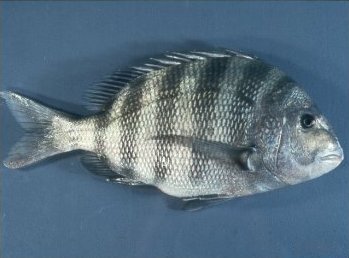
Archosargus probatocephalus occurs in the Western Atlantic Ocean from Nova Scotia to Rio Grande do Sul in Brazil, including the Gulf of Mexico and Caribbean Sea. It is distinguished by broad, flattened front teeth, molar-like side teeth and five or six dark vertical bars along its flanks.
Written 26 November 2026 from the sources listed below. Each statement was checked against the passage it cites; statements that could not be supported were removed.
Appearance
The dorsal fin has 12 spines and 11 soft rays. The anal fin has three spines and nine or ten soft rays, with the second spine particularly robust.[1][2]
The pectoral fins are longer than the pelvic fins and extend to the middle spine of the anal fin. The caudal fin is forked.[3][4]
Adults have silvery to greenish-yellow coloration with olive coloring on the upper body. Five or six dark vertical bars extend along their flanks and become less distinct with age.[5][6]
The caudal and pectoral fins are greenish, while the dorsal, anal and pelvic fins are dark. The fish has well-defined incisors, molars and grinding teeth but lacks tooth patches on the roof of its mouth.[7][8][9]
Habitat
The Sheepshead commonly inhabits coastal waters near rock pilings, jetties, mangrove roots and piers. Tidal creeks are also part of its habitat.[10][11]
The species is euryhaline and prefers brackish water. During winter, it occasionally enters freshwater.[12][13]
Juveniles commonly occupy seagrass beds and muddy substrates. Sheepshead are not particularly tolerant of low dissolved oxygen concentrations.[14][15]
Diet
The Sheepshead is an omnivore. Juveniles feed on zooplankton, polychaetes and chironomid larvae, while large juveniles and adults consume blue crabs, other crustaceans, shellfish and small fish.[16][17][18]
Oysters and clams are among the foods consumed by large juveniles and adults. The species occasionally consumes vegetable matter.[19][20]
The Sheepshead uses its flattened teeth to crush shelled or armored prey and remove barnacles from hard surfaces.[21]
Behaviour
Sheepshead seek warmer water around springs and river discharges. Juveniles leave seagrass beds and join adult aggregations when they reach approximately 50 mm in length.[22][23]
Reproduction and life cycle
Populations in the Atlantic waters off the southern United States spawn mainly during early spring. Adults migrate offshore to spawn before returning to coastal waters and estuaries.[24][25]
Pelagic Sheepshead larvae have been recorded in the Gulf of Mexico from January through May. Spawning frequency ranges from once daily to once every 20 days.[26][27]
Depending on their condition, females may produce between 1,100 and 250,000 eggs per spawning event. The eggs are buoyant and approximately 0.8 mm in diameter.[28][29]
Eggs hatch approximately 28 hours after fertilization at 23°C.[30]
Conservation
The Sheepshead is not listed as endangered or vulnerable by the IUCN. Its populations have experienced periods of overharvesting.[31][32]
Fishery management measures in Florida have been associated with reduced fishing mortality and increased spawning stock.[33]
Uses
The Sheepshead is an important species for recreational and commercial fisheries. It is valued as a food fish because of its fine white flesh and mild flavor and is marketed both fresh and frozen.[34][35][36]
Sheepshead are collected for display in public aquariums.[37]
Classification of the Sheepshead
| Kingdom | Animalia |
|---|---|
| Phylum | Chordata |
| Subphylum | Vertebrata |
| Infraphylum | Gnathostomata |
| Parvphylum | Osteichthyes |
| Gigaclass | Actinopterygii |
| Superclass | Actinopteri |
| Class | Teleostei (Teleost) |
| Order | Perciformes |
| Suborder | Percoidei |
| Family | Sparidae (Porgies) |
| Genus | Archosargus (Sheepshead Porgies) |
| Species | Archosargus probatocephalus (Walbaum, 1792) |
Where the Sheepshead is found
Checklists and occurrence records place Archosargus probatocephalus in 6 countries. GBIF holds 17,635 georeferenced records of it.
Countries
Regions and cities with the most records
- Texas, United States 3,754
- Florida, United States 2,589
- Sebastian, United States 1,417
- Merritt Island, United States 1,211
- Palm Bay, United States 1,109
- Cocoa, United States 1,093
- Melbourne, United States 1,027
- West Melbourne, United States 943
- Rockledge, United States 909
- Portland, United States 894
- Groves, United States 693
- Port Arthur, United States 689
- Vero Beach, United States 677
- Louisiana, United States 616
- Vero Beach South, United States 609
- Corpus Christi, United States 585
- Florida Ridge, United States 488
- Nederland, United States 371
- Seminole, United States 306
- Pinellas Park, United States 298
- West and East Lealman, United States 282
- Lealman, United States 269
- St. Petersburg, United States 259
- Largo, United States 185
- Jupiter, United States 178
- Palm Beach Gardens, United States 178
- Orange, United States 173
- Riviera Beach, United States 172
- West Palm Beach, United States 161
- Clearwater, United States 156
- Palm Springs, United States 156
- Lake Worth Beach, United States 154
- Greenacres City, United States 153
- Lake Worth Corridor, United States 153
- Iona, United States 129
- Dunedin, United States 125
3 more countries have a few records outside this range
These countries hold a few records of Archosargus probatocephalus but lie outside the range the checklists give for it. Such records are often zoo or garden specimens, museum material or vagrants, so the species is not counted as occurring there.
A number beside a place is its count of GBIF occurrence records. A place without a number comes from a checklist alone. Records show where a species has been observed or collected, which can include escapes and vagrants.
Common names
English
- Sheepshead
- Convict Fish
- Sheephead
- Sheepshead Porgy
- Sheepshead Seabream
- Southern Sheeps Head
Names in 10 other languages
- Chinese
- 南方羊鯛, 羊鯛
- Czech
- mořan pruhovaný
- Danish
- Fårehovedhavrude
- Dutch
- Schaapskopbrasem
- French
- Rondeau mouton, spare tête-de-mouton
- German
- Schafskopf-Meerbrasse, Sträflings-Meerbrasse
- Polish
- sargus owczak
- Portuguese
- Sargo-ladrão
- Russian
- Архосарг
- Spanish
- Sargo, sargo chopa
Synonyms
4 other scientific names have been used for this species and are now treated as synonyms of Archosargus probatocephalus.
- Archosargus aries (Valenciennes, 1830)
- Archosargus oviceps Ginsburg, 1952
- Sargus aries Valenciennes, 1830
- Sparus probatocephalus Walbaum, 1792
Related species
-
 Western Atlantic SeabreamArchosargus rhomboidalis
-
 Blackspot PorgyArchosargus pourtalesii
-
 Gilt-head BreamSparus aurata
-
 BogueBoops boops
-
 Red Sea BreamPagrus major
-
 Salema PorgySarpa salpa
-
 White Sea BreamDiplodus sargus
-
 Red PorgyPagrus pagrus
Compare
Questions and answers
What is the scientific name of the Sheepshead?
The scientific name of the Sheepshead is Archosargus probatocephalus. Written with its author, the full name is Archosargus probatocephalus (Walbaum, 1792).
Which family does the Sheepshead belong to?
Archosargus probatocephalus belongs to the family Sparidae, in the order Perciformes and the class Teleostei.
Where is the Sheepshead found?
Checklists and occurrence records place Archosargus probatocephalus in 6 countries: United States, Mexico, Belize, Canada, Panama and Nicaragua.
What is the conservation status of the Sheepshead?
The IUCN Red List category recorded for Archosargus probatocephalus is Least Concern (LC).
What other names does the Sheepshead have?
Archosargus probatocephalus is also known in English as Convict Fish, Sheephead, Sheepshead Porgy, Sheepshead Seabream and Southern Sheeps Head.
What is the biggest sheepshead ever caught?
The maximum published total length is 91 cm. The maximum size reported by the Florida Museum is approximately 76 cm and 9.6 kg.[38][39]
Why do they call it a sheephead?
The common name probably refers to the fish's sheep-like features and prominent teeth. The specific name probatocephalus combines words meaning sheep and head.[40][41]
Sources
Passages the profile rests on
- The dorsal fin has 12 spines and 11 soft rays. Source passage: “The dorsal fin is long and not high and is supported by 12 spines, the front spine points towards the front and may be embedded, and 11 soft rays.” — English Wikipedia
- The anal fin has three spines and nine or ten soft rays, with the second spine being particularly robust. Source passage: “The anal fin contains three spines, the second spine being very robust, and 9 or 10 soft rays.” — English Wikipedia
- The pectoral fins are longer than the pelvic fins and extend to the middle spine of the anal fin. Source passage: “The pectoral fin is long, clearly greater in length than the pelvic fins, extending to the level of the middle spine of the anal fin.” — English Wikipedia
- The caudal fin is forked. Source passage: “The caudal fin is forked.” — English Wikipedia
- Adults have silvery to greenish-yellow coloration with olive coloring on the upper body. Source passage: “The adults are silvery to greenish-yellow with olive on the upper body.” — English Wikipedia
- Adults have five or six dark vertical bars along their flanks, which become less distinct with age. Source passage: “Along the flanks there are five or six dark vertical bars, which fade with age.” — English Wikipedia
- The caudal and pectoral fins are greenish, while the dorsal, anal and pelvic fins are dark. Source passage: “The caudal and pectoral fins are greenish in colour while the dorsal, anal, and pelvic fins are dark.” — English Wikipedia
- The fish has well-defined incisors, molars and grinding teeth. Source passage: “Teeth of the sheepshead include well-defined incisors, molars, and grinders.” — floridamuseum.ufl.edu
- The sheepshead lacks tooth patches on the roof of its mouth. Source passage: “Sheepshead lack tooth patches on the roof of the mouth.” — floridamuseum.ufl.edu
- The species commonly inhabits coastal waters near rock pilings, jetties, mangrove roots and piers. Source passage: “It mainly occurs in coastal waters in the vicinity of rock pilings, jetties, mangrove roots, and piers” — English Wikipedia
- Tidal creeks are also part of the species' habitat. Source passage: “also in tidal creeks.” — English Wikipedia
- The sheepshead is euryhaline and prefers brackish water. Source passage: “It is euryhaline and shows a preference for brackish waters.” — English Wikipedia
- During winter, the species occasionally enters freshwater. Source passage: “will occasionally enter freshwater in the winter.” — English Wikipedia
- Juvenile sheepshead commonly occupy seagrass beds and muddy substrates. Source passage: “The juveniles are most numerous in seagrass beds and over mud substrates” — English Wikipedia
- Sheepshead are not particularly tolerant of low dissolved oxygen concentrations. Source passage: “the sheepshead is not particularly tolerant of low levels of dissolved oxygen.” — floridamuseum.ufl.edu
- The sheepshead is an omnivore. Source passage: “Archosargus probatocephalus is an omnivore:” — English Wikipedia
- Large juveniles and adults consume blue crabs, other crustaceans, shellfish and small fish. Source passage: “the larger juveniles and adults are predators of blue crabs (Callinectes sapidus), other crustaceans, shellfish and small fish” — English Wikipedia
- Juvenile sheepshead feed on zooplankton, polychaetes and chironomid larvae. Source passage: “Juveniles feed on zooplankton, polychaetes, and chironomid larvae.” — English Wikipedia
- The species occasionally consumes vegetable matter. Source passage: “with vegetable matter occasionally taken.” — English Wikipedia
- Oysters and clams are among the foods consumed by large juvenile and adult sheepshead. Source passage: “Large juveniles and adults prey on blue crab, oysters, clams, crustaceans, and small fish” — floridamuseum.ufl.edu
- Sheepshead use their flattened teeth to crush shelled or armored prey and remove barnacles from hard surfaces. Source passage: “The large flattened teeth are used to crush prey protected by shells or armor as well as to pry barnacles off rocks, pilings, jetties and hard reefs.” — English Wikipedia
- Sheepshead seek warmer water around springs and river discharges. Source passage: “It looks for warmer spots around springs and discharges of rivers” — English Wikipedia
- Juveniles leave seagrass beds and join adult aggregations when they reach approximately 50 mm in length. Source passage: “once they grow to a length of around 50 mm (2.0 in), they leave the seagrass beds and aggregate with the adults.” — English Wikipedia
- Populations in the Atlantic waters off the southern United States spawn mainly during early spring. Source passage: “Populations of this fish in the Atlantic waters off the southern United States spawn mainly in the early spring.” — English Wikipedia
- Adults migrate offshore to spawn before returning to coastal waters and estuaries. Source passage: “Adults move further offshore to spawn, going back to coastal waters and estuaries.” — English Wikipedia
- Pelagic sheepshead larvae have been recorded in the Gulf of Mexico from January through May. Source passage: “pelagic larvae have been recorded from January through May in the Gulf of Mexico.” — floridamuseum.ufl.edu
- Spawning frequency ranges from once daily to once every 20 days. Source passage: “Spawning frequency ranges from once a day to once every 20 days.” — floridamuseum.ufl.edu
- Depending on their condition, females may produce between 1,100 and 250,000 eggs per spawning event. Source passage: “Depending upon their condition, females may produce from 1,100 to 250,000 eggs per spawning event.” — floridamuseum.ufl.edu
- Sheepshead eggs are buoyant and approximately 0.8 mm in diameter. Source passage: “The buoyant eggs are approximately 0.8mm in diameter” — floridamuseum.ufl.edu
- Eggs hatch approximately 28 hours after fertilization at 23°C. Source passage: “hatching 28 hours following fertilization at 23°C.” — floridamuseum.ufl.edu
- The sheepshead is not listed as endangered or vulnerable by the IUCN. Source passage: “This fish is not listed as endangered or vulnerable with the World Conservation Union (IUCN).” — floridamuseum.ufl.edu
- Sheepshead populations have experienced periods of overharvesting. Source passage: “Assessments of sheepshead populations based upon the number of recruits and catch yields have indicated that they have been at times over-harvested.” — floridamuseum.ufl.edu
- Fishery management measures in Florida have been associated with reduced fishing mortality and increased spawning stock. Source passage: “Fishery management actions, including catch method restrictions, size limits, and bag limits, are credited with bringing about a decline in fishing mortality and a shift in age-specific vulnerability allowing for the increase in spawning stock in Florida.” — floridamuseum.ufl.edu
- The sheepshead is an important species for recreational and commercial fisheries. Source passage: “The sheepshead is an important species to recreational and commercial fisheries.” — English Wikipedia
- Sheepshead are valued as food fish because of their fine white flesh and mild flavor. Source passage: “This fish is highly valued for human consumption due to its fine white flesh and mild flavor.” — floridamuseum.ufl.edu
- The species is marketed both fresh and frozen. Source passage: “It is marketed fresh and frozen” — floridamuseum.ufl.edu
- Sheepshead are collected for display in public aquariums. Source passage: “Sheepshead are also collected for public show aquariums.” — floridamuseum.ufl.edu
- The maximum published total length of the sheepshead is 91 cm. Source passage: “The sheepshead reaches a maximum published total length of 91 cm (36 in)” — English Wikipedia
- The maximum size reported by the Florida Museum is approximately 76 cm and 9.6 kg. Source passage: “Although it reaches a maximum size of about 29.5 inches (76 cm) and 22 pounds (9.6 kg)” — floridamuseum.ufl.edu
- The specific name probatocephalus combines words meaning sheep and head. Source passage: “Archosargus probatocephalus has a specific name which compounds probaton, meaning "sheep", with cephalus. This means "head"” — English Wikipedia
- The common name sheepshead probably refers to the fish's sheep-like features and prominent teeth. Source passage: “reflecting its common name, sheepshead, which it was probably given because of some sheep-like features, such as having large teeth protruding from an open mouth.” — English Wikipedia
Data
- Catalogue of Life, 2026-10-16 XR cc by
- Global Biodiversity Information Facility CC BY 4.0
- Wikidata CC0
- GeoNames CC BY 4.0
- Wikimedia Commons per image; credit shown with each image
- Within the Catalogue of Life, this name comes from World Register of Marine Species cc by
This species in other databases
- Catalogue of Life 5VQ8G
- Wikidata Q744187
- iNaturalist 49750
- WoRMS urn:lsid:marinespecies.org:taxname:159238
- ITIS 169189
Page built on 27 November 2026. See how the catalog is made and all sources and licences.
Cite this page
ScientificNames.org. (2026). Archosargus probatocephalus (Sheepshead). Retrieved November 27, 2026, from https://scientificnames.org/species/archosargus-probatocephalus
“Archosargus probatocephalus (Sheepshead).” ScientificNames.org, 2026, scientificnames.org/species/archosargus-probatocephalus. Accessed 27 Nov. 2026.
ScientificNames.org. “Archosargus probatocephalus (Sheepshead).” Accessed November 27, 2026. https://scientificnames.org/species/archosargus-probatocephalus.
@misc{scientificnames_archosargus_probatocephalus_sheepshead,
  author = {{ScientificNames.org}},
  title = {Archosargus probatocephalus (Sheepshead)},
  year = {2026},
  url = {https://scientificnames.org/species/archosargus-probatocephalus},
  note = {Accessed 2026-11-27}
}