Comparison

Sheepshead vs Bogue

Sheepshead (Archosargus probatocephalus) and Bogue (Boops boops) both belong to the family Sparidae (porgies) and part ways below it.
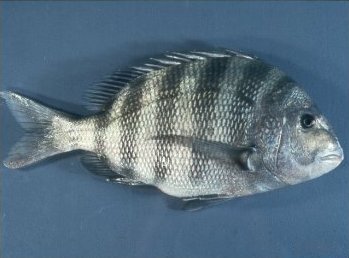
Sheepshead

Sheepshead

Archosargus probatocephalus

Unknown author, Public domain, via Wikimedia Commons

Bogue

Bogue

Boops boops

Diego Delso, CC BY-SA 4.0, via Wikimedia Commons

Side by side

SheepsheadBogue
Scientific nameArchosargus probatocephalus (Walbaum, 1792)Boops boops (Linnaeus, 1758)
English nameSheepsheadBogue
GroupFishesFishes
ClassTeleostei TeleostTeleostei Teleost
OrderPerciformesPerciformes
FamilySparidae PorgiesSparidae Porgies
GenusArchosargus Sheepshead PorgiesBoops
Named in17921758
Red List categoryLeast ConcernLeast Concern
Environmentbrackish, marinemarine
Countries on record6 countries19 countries
GBIF occurrence records17,635 records20,765 records

Rows where the two agree are shown in grey.

Where each is found

Only Sheepshead (6)

Only Bogue (19)

From Catalogue of Life checklists and GBIF occurrence records. A country missing from a list means no record is held, which is not proof of absence.

Checked facts

SheepsheadBogue
Appearance
  • The front teeth are broad and flattened, while the side teeth include molar-like teeth arranged in three upper rows and two lower rows. English Wikipedia
  • The dorsal fin has 12 spines and 11 soft rays. English Wikipedia
  • The anal fin has three spines and nine or ten soft rays, with the second spine being particularly robust. English Wikipedia
  • The pectoral fins are longer than the pelvic fins and extend to the middle spine of the anal fin. English Wikipedia
  • The caudal fin is forked. English Wikipedia
  • Adults have silvery to greenish-yellow coloration with olive coloring on the upper body. English Wikipedia
  • Adults have five or six dark vertical bars along their flanks, which become less distinct with age. English Wikipedia
  • The caudal and pectoral fins are greenish, while the dorsal, anal and pelvic fins are dark. English Wikipedia
  • The fish has well-defined incisors, molars and grinding teeth. floridamuseum.ufl.edu
  • The sheepshead lacks tooth patches on the roof of its mouth. floridamuseum.ufl.edu
Size
Habitat
Diet
  • The sheepshead is an omnivore. English Wikipedia
  • Large juveniles and adults consume blue crabs, other crustaceans, shellfish and small fish. English Wikipedia
  • Juvenile sheepshead feed on zooplankton, polychaetes and chironomid larvae. English Wikipedia
  • The species occasionally consumes vegetable matter. English Wikipedia
  • Sheepshead use their flattened teeth to crush shelled or armored prey and remove barnacles from hard surfaces. English Wikipedia
  • Oysters and clams are among the foods consumed by large juvenile and adult sheepshead. floridamuseum.ufl.edu
Behaviour
  • Sheepshead seek warmer water around springs and river discharges. English Wikipedia
  • Juveniles leave seagrass beds and join adult aggregations when they reach approximately 50 mm in length. English Wikipedia
Reproduction
  • Populations in the Atlantic waters off the southern United States spawn mainly during early spring. English Wikipedia
  • Adults migrate offshore to spawn before returning to coastal waters and estuaries. English Wikipedia
  • Pelagic sheepshead larvae have been recorded in the Gulf of Mexico from January through May. floridamuseum.ufl.edu
  • Spawning frequency ranges from once daily to once every 20 days. floridamuseum.ufl.edu
  • Depending on their condition, females may produce between 1,100 and 250,000 eggs per spawning event. floridamuseum.ufl.edu
  • Sheepshead eggs are buoyant and approximately 0.8 mm in diameter. floridamuseum.ufl.edu
  • Eggs hatch approximately 28 hours after fertilization at 23°C. floridamuseum.ufl.edu
  • Sex determination in Boops boops is described as unclear. English Wikipedia
  • Some descriptions characterize Boops boops as a rudimentary intersex organism. English Wikipedia
  • Some descriptions characterize Boops boops as a protogynous intersex species. English Wikipedia
  • Under the protogynous intersex description, individuals begin life as females and some subsequently become males. English Wikipedia
Distribution
  • The species occurs in the Western Atlantic Ocean from Nova Scotia to Rio Grande do Sul in Brazil. English Wikipedia
  • The species' distribution includes the Gulf of Mexico and Caribbean Sea. English Wikipedia
Conservation
  • The sheepshead is not listed as endangered or vulnerable by the IUCN. floridamuseum.ufl.edu
  • Sheepshead populations have experienced periods of overharvesting. floridamuseum.ufl.edu
  • Fishery management measures in Florida have been associated with reduced fishing mortality and increased spawning stock. floridamuseum.ufl.edu
No checked fact yet
Uses
  • Boops boops is commercially harvested. English Wikipedia
  • A reported commercial catch of Boops boops in 2008 amounted to 37,830 tonnes. English Wikipedia
  • Boops boops is used to produce fishmeal. English Wikipedia
  • Boops boops is used as bait for tuna fishing. English Wikipedia
  • Boops boops has been used as an indicator of microplastic pollution in the Mediterranean Sea. English Wikipedia
  • Freshly prepared Boops boops has been described as good tasting when pan-fried, broiled, or baked. English Wikipedia
  • Storing Boops boops at 0 °C for a week results in unacceptable cooked taste quality. English Wikipedia
  • Storing Boops boops slightly above freezing for two to four days results in unacceptable cooked taste quality. English Wikipedia
Name origin
  • The specific name probatocephalus combines words meaning sheep and head. English Wikipedia
  • The common name sheepshead probably refers to the fish's sheep-like features and prominent teeth. English Wikipedia
  • The scientific name Boops derives from the Ancient Greek word βόωψ, meaning ox-eyed. English Wikipedia

In brief

Sheepshead

Archosargus probatocephalus occurs in the Western Atlantic Ocean from Nova Scotia to Rio Grande do Sul in Brazil, including the Gulf of Mexico and Caribbean Sea. It is distinguished by broad, flattened front teeth, molar-like side teeth and five or six dark vertical bars along its flanks. Full profile

Bogue

Boops boops occurs along the coasts of Europe and Africa, in the Mediterranean Sea and Black Sea, and in the Atlantic from Norway to Angola, including the Azores and Canary Islands. It has large eyes. Full profile

Compare something else

Page built on 27 November 2026 from the data on the two species pages, where every source is listed.

Cite this page

ScientificNames.org. (2026). Sheepshead vs Bogue. Retrieved November 27, 2026, from https://scientificnames.org/compare/sheepshead-vs-bogue