Comparison

Flame-shouldered Blister Beetle vs Spanish Fly

Flame-shouldered Blister Beetle (Sitaris muralis) and Spanish Fly (Lytta vesicatoria) both belong to the family Meloidae (blister beetle) and part ways below it. Both are recorded in 16 countries.

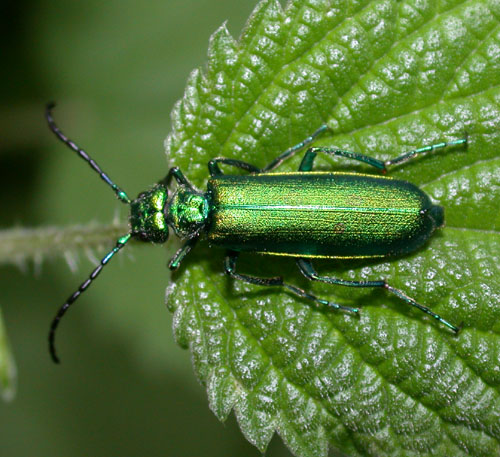
Flame-shouldered Blister Beetle

Flame-shouldered Blister Beetle

Sitaris muralis

Tobias 67, CC BY-SA 4.0, via Wikimedia Commons

Spanish Fly

Spanish Fly

Lytta vesicatoria

Franco christophe, CC BY-SA 3.0, via Wikimedia Commons

Side by side

Flame-shouldered Blister BeetleSpanish Fly
Scientific nameSitaris muralis (Förster, 1771)Lytta vesicatoria (Linnaeus, 1758)
English nameFlame-shouldered Blister BeetleSpanish Fly
GroupInsectsInsects
ClassInsecta InsectInsecta Insect
OrderColeoptera BeetleColeoptera Beetle
FamilyMeloidae Blister BeetleMeloidae Blister Beetle
GenusSitarisLytta
Named in17711758
Countries on record19 countries31 countries
GBIF occurrence records2,148 records4,280 records

Rows where the two agree are shown in grey.

Where each is found

Both recorded in 16 countries

Only Flame-shouldered Blister Beetle (3)

Only Spanish Fly (15)

From Catalogue of Life checklists and GBIF occurrence records. A country missing from a list means no record is held, which is not proof of absence.

Checked facts

Flame-shouldered Blister BeetleSpanish Fly
Appearance
  • Sitaris muralis has a black body with buff-orange patches on the front of its wing cases. English Wikipedia
  • The adult beetle has a slender, soft-bodied appearance with metallic, iridescent golden-green coloration. English Wikipedia
  • The species has emerald-green coloration. inaturalist.org
SizeNo checked fact yet
  • Adult beetles measure approximately 20 mm in length and 5 mm in width. English Wikipedia
Habitat
  • Adult Sitaris muralis occurs near the nests of the digger bees that it parasitises. English Wikipedia
  • Adults are typically found on steep loess slopes, in old sun-warmed house walls, and in gravel infill beneath balconies. English Wikipedia
  • Females deposit their eggs on the ground near the nests of solitary bees that nest underground. English Wikipedia
  • Adult beetles inhabit woody plants on which they feed. English Wikipedia
Diet
  • Sitaris muralis larvae feed on the eggs and honey provisioned by their host bees. English Wikipedia
  • A beetle larva initially consumes the host bee's egg before feeding on the honey. English Wikipedia
  • Adult beetles primarily consume the leaves of ash, lilac, Amur privet, honeysuckle, and white willow. English Wikipedia
  • Plum, rose, and elm are occasional food plants for adult beetles. English Wikipedia
  • The larval stages consume bee larvae and food stored in solitary bee nests. English Wikipedia
Behaviour
  • Sitaris muralis is a kleptoparasite of bees belonging to the genus Anthophora. English Wikipedia
  • The larvae enter diapause shortly after hatching and remain dormant until the following May. English Wikipedia
  • After diapause, the larvae seek male digger bees and attach themselves to the bees' hairs. English Wikipedia
  • A female host bee provisions individual chambers with nectar and lays an egg in each chamber. English Wikipedia
  • A beetle larva cannot metabolise the host bee's honey until it has eaten the egg and shed its skin. English Wikipedia
  • Newly hatched larvae actively climb flowering plants while waiting for solitary bees. English Wikipedia
  • First-instar larvae attach themselves to solitary bees using three claws on their legs. English Wikipedia
  • Solitary bees transport the attached larvae into their nests. English Wikipedia
  • Adult beetles aggregate conspicuously in exposed locations, a pattern associated with aposematic coloration. English Wikipedia
Reproduction
  • Female Sitaris muralis lays batches of at least two thousand eggs near the galleries and chambers constructed by host bees in September. English Wikipedia
  • Newly hatched larvae gather into small heaps mixed with the remains of their egg cases. English Wikipedia
  • Beetle larvae transfer from the male host bee to a female bee when the male mates with her. English Wikipedia
  • Females lay fertilized eggs on the ground close to ground-nesting solitary bee nests. English Wikipedia
  • Males synthesize cantharidin, while females acquire the compound from males during mating through the spermatophore. English Wikipedia
  • The transfer of cantharidin during mating may function as a nuptial gift that increases the reproductive fitness of males. English Wikipedia
  • Larval development involves hypermetamorphosis, with active early larvae transforming into a different larval form during subsequent instars. English Wikipedia
Distribution
  • Sitaris muralis occurs in Western Europe, including the British Isles, Spain, France, Luxembourg, Germany, Austria, the Czech Republic, and Italy. English Wikipedia
  • Sitaris muralis is described as an eastern Palaearctic species. English Wikipedia
  • Sitaris muralis is very rare in southern England, which lies at the northwestern edge of its range. English Wikipedia
  • The species occurs across Eurasia. English Wikipedia
  • Its distribution is concentrated mainly in southern Europe, with additional records from southern Great Britain and Poland. English Wikipedia
UsesNo checked fact yet
  • The species has historically been processed into traditional apothecary preparations known as cantharides. English Wikipedia
  • Cantharidin obtained from the beetle was historically used as an exfoliating agent, an anti-rheumatic drug, and an aphrodisiac. English Wikipedia
  • The beetle has traditionally been administered as a sexual stimulant to male livestock to facilitate breeding. britannica.com
  • Beetle-derived cantharidin has been incorporated into certain North African ras el hanout spice blends. English Wikipedia
  • In Morocco and other parts of North Africa, green metallic beetles believed to be this species were occasionally included as minor ingredients in ras el hanout. English Wikipedia
  • The sale of beetles believed to be this species in Moroccan spice markets was prohibited during the 1990s. English Wikipedia
  • Cantharidin is currently used primarily as a topical treatment for warts and molluscum contagiosum. English Wikipedia

In brief

Flame-shouldered Blister Beetle

Sitaris muralis occurs near the nests of the digger bees that it parasitises and is found on steep loess slopes, in old sun-warmed house walls, and in gravel infill beneath balconies. It has a black body with buff-orange patches on the front of its wing cases. Full profile

Spanish Fly

The species occurs across Eurasia, with its distribution concentrated mainly in southern Europe and additional records from southern Great Britain and Poland. Adult beetles have a slender, soft-bodied appearance and metallic, iridescent golden-green coloration. Full profile

Compare something else

Page built on 29 November 2026 from the data on the two species pages, where every source is listed.

Cite this page

ScientificNames.org. (2026). Flame-shouldered Blister Beetle vs Spanish Fly. Retrieved November 29, 2026, from https://scientificnames.org/compare/flame-shouldered-blister-beetle-vs-spanish-fly