Comparison

Velvet-fronted Nuthatch vs Brown-headed Nuthatch

Velvet-fronted Nuthatch (Sitta frontalis) and Brown-headed Nuthatch (Sitta pusilla) both belong to the genus Sitta (nuthatch) and part ways below it.

Velvet-fronted Nuthatch

Velvet-fronted Nuthatch

Sitta frontalis

Mildeep, CC BY-SA 4.0, via Wikimedia Commons

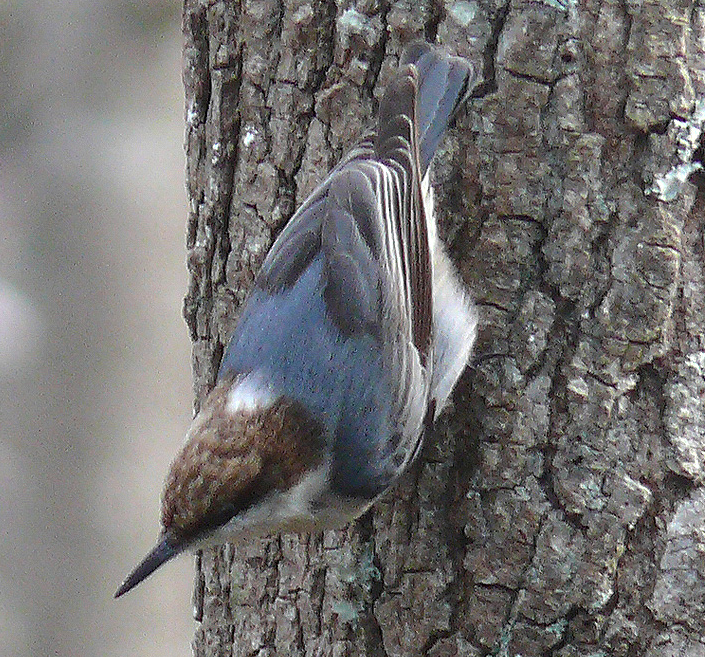
Brown-headed Nuthatch

Brown-headed Nuthatch

Sitta pusilla

derivative work: Snowmanradio (talk) Brown-headed_Nuthatch-27527.jpg: Ken Thomas, Public domain, via Wikimedia Commons

Side by side

Velvet-fronted NuthatchBrown-headed Nuthatch
Scientific nameSitta frontalis Swainson, 1820Sitta pusilla Latham, 1790
English nameVelvet-fronted NuthatchBrown-headed Nuthatch
GroupBirdsBirds
ClassAves BirdAves Bird
OrderPasseriformes PasserinePasseriformes Passerine
FamilySittidae NuthatchSittidae Nuthatch
GenusSitta NuthatchSitta Nuthatch
Named in18201790
Red List categoryLeast ConcernLeast Concern
Countries on record17 countries1 country
GBIF occurrence records76,310 records1,065,259 records

Rows where the two agree are shown in grey.

Where each is found

Only Velvet-fronted Nuthatch (17)

Only Brown-headed Nuthatch (1)

From Catalogue of Life checklists and GBIF occurrence records. A country missing from a list means no record is held, which is not proof of absence.

Checked facts

Velvet-fronted NuthatchBrown-headed Nuthatch
Appearance
  • The species has violet-blue upperparts, lavender cheeks, buffy grey underparts, yellow eyes and a whitish throat. English Wikipedia
  • Its bill ranges from orange-red to bright red. English Wikipedia
  • The species has a black patch on its forehead and lores, which is more developed in adults than in young birds. English Wikipedia
  • Adult males have a black superciliary stripe extending above the eye and over the head towards the nape. English Wikipedia
  • Females lack the superciliary stripe and have warmer-coloured underparts than males. English Wikipedia
  • Juveniles are duller in colour than adults and lack the black frontal band. English Wikipedia
  • Young birds have dark bills and dark tips to their undertail coverts. English Wikipedia
  • The species has a short tail and a powerful bill and feet. English Wikipedia
  • The species has a brown cap, a narrow black eyeline, buff-white cheeks, a chin and belly, and bluish-gray wings. English Wikipedia
  • Males and females have similar body sizes and coloration. animaldiversity.org
  • Juveniles resemble adults in both coloration and size. animaldiversity.org
Size
Habitat
  • The species typically inhabits open, mature pine stands with sparse understory vegetation. animaldiversity.org
  • Areas subject to frequent prescribed burns provide suitable habitat by maintaining open understories and creating nesting snags. animaldiversity.org
  • The species is generally found at elevations below 700 metres. animaldiversity.org
  • The species is associated with forests, woodlands, shrublands, savannas, and thickets. audubon.org
  • Pine forests provide the species with both food and shelter. nps.gov
Diet
  • The species eats both seeds and insects. nps.gov
  • Pine seeds become a more important food source during winter when insect activity decreases. nps.gov
  • The species consumes more insects during warmer months when insects are abundant. nps.gov
  • The species is particularly attracted to sunflower seeds and suet cakes at feeding stations. English Wikipedia
Behaviour
  • The species forages along tree trunks and branches. English Wikipedia
  • Its strongly clawed toes enable it to climb down tree trunks and move beneath horizontal branches. English Wikipedia
  • The species moves jerkily up and down or around tree branches and trunks. English Wikipedia
  • The species frequently joins mixed-species feeding flocks with other passerines. English Wikipedia
  • The species produces a rapid chipping call note. English Wikipedia
  • The species is often located by its repeated sit-sit-sit call. English Wikipedia
  • In Sri Lanka, racket-tailed drongos sometimes capture insects disturbed by the nuthatch. English Wikipedia
  • Adults undergo a complete postbreeding moult beginning at the end of June in northern India. English Wikipedia
  • The species uses pieces of bark, small twigs, and pine needles as tools when searching for insects. English Wikipedia
  • Individuals use loose bark as wedges to remove additional pieces of bark and expose insects. animaldiversity.org
  • Individuals wedge seeds into bark depressions and crack them by hammering with their beaks. animaldiversity.org
  • The species travels in single-species flocks of four to five birds during the breeding season. animaldiversity.org
  • During the non-breeding season, individuals travel in mixed-species flocks containing eight to twenty birds. animaldiversity.org
  • The species is bold, inquisitive, and readily approachable by humans. English Wikipedia
  • The species is the only member of the family Sittidae documented using tools. animaldiversity.org
Reproduction
  • Brown-headed Nuthatches are cooperative breeders, with groups of two to five adults participating in raising young. animaldiversity.org
  • Cooperative breeding groups include one to three helper birds in addition to the breeding pair. animaldiversity.org
  • Nest construction generally begins in February. animaldiversity.org
  • Nests are commonly located in snags, birdhouses, or abandoned woodpecker cavities. animaldiversity.org
  • Nest entrances are usually less than 2.5 cm in diameter. animaldiversity.org
  • The nest cavity is at least 30 cm deep and less than three metres above the ground. animaldiversity.org
  • Females generally lay four to eight eggs per brood between March and July. animaldiversity.org
  • Nestlings remain in the nest for approximately 17 to 19 days after hatching. animaldiversity.org
  • Young birds fledge approximately 18 to 19 days after hatching. animaldiversity.org
  • Most adults produce only one clutch of eggs annually. nps.gov
  • Females lay an average of four to six eggs per nest. nps.gov
Distribution
  • The species occurs across southern Asia, from Nepal, India, Sri Lanka and Bangladesh eastwards to southwestern China and Indonesia. English Wikipedia
  • The Brown-headed Nuthatch is endemic to pine forests throughout the southeastern United States. English Wikipedia
  • The species occurs as far north as Virginia, as far west as Texas, and as far south as southern Florida. animaldiversity.org
  • A small, declining population occurs on the Grand Bahama Islands. animaldiversity.org
  • The species occurs along the coastal states of the southeastern United States from North Carolina to Texas. nps.gov
Conservation
  • The species is classified as a Species of Conservation Concern by the Missouri Department of Conservation. mdc.mo.gov
Similar speciesNo checked fact yet
  • The Brown-headed Nuthatch is approximately the same size as the Pygmy Nuthatch, and both are identified as the world's smallest nuthatches. English Wikipedia
  • The Brown-headed Nuthatch overlaps geographically with Red-breasted and White-breasted Nuthatches, which are larger and differently marked. English Wikipedia
OtherNo checked fact yet
  • The Bahama Nuthatch was formerly classified as a subspecies of the Brown-headed Nuthatch but is now recognized as a separate species. English Wikipedia

In brief

Velvet-fronted Nuthatch

Sitta frontalis occurs across southern Asia, from Nepal, India, Sri Lanka and Bangladesh eastwards to southwestern China and Indonesia. Full profile

Brown-headed Nuthatch

Sitta pusilla is endemic to pine forests throughout the southeastern United States, with a small, declining population on the Grand Bahama Islands. It is distinguished by its brown cap, narrow black eyeline, buff-white cheeks, and bluish-gray wings. Full profile

Compare something else

Page built on 28 November 2026 from the data on the two species pages, where every source is listed.

Cite this page

ScientificNames.org. (2026). Velvet-fronted Nuthatch vs Brown-headed Nuthatch. Retrieved November 28, 2026, from https://scientificnames.org/compare/velvet-fronted-nuthatch-vs-brown-headed-nuthatch