Comparison

Snake River Physa Snail vs Acute Bladder Snail

Snake River Physa Snail (Physella natricina) and Acute Bladder Snail (Physella acuta) both belong to the genus Physella and part ways below it. Both are recorded in 1 country.

Snake River Physa Snail

Physella natricina
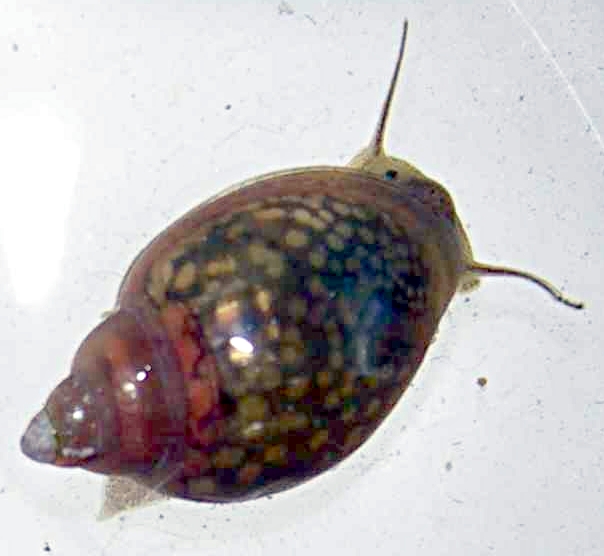
Acute Bladder Snail

Acute Bladder Snail

Physella acuta

N yotarou, CC BY 2.5, via Wikimedia Commons

Side by side

Snake River Physa SnailAcute Bladder Snail
Scientific namePhysella natricina (D. W. Taylor, 1988)Physella acuta (Draparnaud, 1805)
English nameSnake River Physa SnailAcute Bladder Snail
GroupMolluscsMolluscs
ClassGastropoda GastropodGastropoda Gastropod
FamilyPhysidae Bladder SnailsPhysidae Bladder Snails
GenusPhysellaPhysella
Named in19881805
Red List categoryData DeficientLeast Concern
Environmentfreshwaterfreshwater
Countries on record1 country39 countries
GBIF occurrence records15 records47,154 records

Rows where the two agree are shown in grey.

Where each is found

Both recorded in 1 country

Only Acute Bladder Snail (38)

From Catalogue of Life checklists and GBIF occurrence records. A country missing from a list means no record is held, which is not proof of absence.

Checked facts

Snake River Physa SnailAcute Bladder Snail
Appearance
  • The species has an ovoid shell ranging in color from amber to brown. English Wikipedia
  • The shell has an ear-shaped aperture that extends approximately three-quarters of its total height. English Wikipedia
  • The shell is thin, with thickness increasing in response to predator presence. English Wikipedia
  • The animal's body colour varies from blue to dark grey. English Wikipedia
  • The upper mantle has golden spots that are often visible through the shell. English Wikipedia
  • The mantle has seven to eleven finger-like lobes on the right side and four to six on the left. English Wikipedia
  • Its tentacles are slender, cylindrical, grey and almost transparent, with small black eyes at their bases. English Wikipedia
  • The foot is narrow and terminates in a pointed tail. English Wikipedia
Size
  • The species can reach a maximum shell length of approximately 6.5 millimetres. English Wikipedia
  • The shell reaches a maximum length of 16 mm and width of 9 mm. English Wikipedia
  • Shell thickness ranges from 0.15 to 0.35 mm depending on environmental predator cues and self-fertilisation rates. English Wikipedia
Habitat
  • The species inhabits swift-current areas of the Snake River, living on the undersides of large cobbles and boulder-sized rocks. English Wikipedia
  • The species inhabits lakes, ponds, streams and ditches. English Wikipedia
  • The species also occupies artificial freshwater environments, including reservoirs, sewage drains and irrigation systems. English Wikipedia
  • The species tolerates polluted and oxygen-deprived waters. English Wikipedia
  • The species can occupy freshwater habitats with widely varying water availability. English Wikipedia
DietNo checked fact yet
  • The species feeds by scraping green algae, diatoms and aquatic plants from surfaces. English Wikipedia
BehaviourNo checked fact yet
  • The species can rapidly twist its shell clockwise through rotations of up to 120 degrees. English Wikipedia
  • Shell twisting helps the snail defend itself against slow-moving predators such as leeches and fly larvae. English Wikipedia
  • The shell-twisting defence is ineffective against fast-moving predators that actively pursue the snail. English Wikipedia
  • The mantle lobes can extract additional oxygen from the environment and help detect predators through touch-sensitive tissue. English Wikipedia
  • The eyes distinguish only between light and dark. English Wikipedia
ReproductionNo checked fact yet
  • The species is a simultaneous hermaphrodite with functioning male and female reproductive organs. English Wikipedia
  • Individuals can reproduce through either mating with another individual or self-fertilisation. English Wikipedia
  • Outcrossing accounts for most reproduction in natural populations. English Wikipedia
  • Self-fertilisation rates in natural populations range from 10 to 30 percent. English Wikipedia
  • Self-fertilisation can become more frequent when potential mates are scarce. English Wikipedia
  • Individuals reach maturity for outcrossing after approximately five to seven weeks. English Wikipedia
  • Individuals reach maturity for self-fertilisation at approximately 14 weeks. English Wikipedia
  • Sexually mature individuals reproduce throughout the year and lay 50–100 eggs weekly. English Wikipedia
  • Eggs are deposited in elongated gelatinous sacs attached to rocks, compacted mud or other individuals' shells. English Wikipedia
  • Eggs hatch approximately 15–20 days after deposition. English Wikipedia
Distribution
  • The species occurs in the middle Snake River of southern Idaho. English Wikipedia
  • The known modern range extended from Grandview, Idaho, at approximately river mile 487, to the Hagerman Reach of the Snake River, at approximately river mile 573, according to a 1995 report. English Wikipedia
  • The species' recovery area extends from Snake River mile 553 to mile 675. English Wikipedia
  • The species has a North American origin, with evidence supporting an origin in the United States. English Wikipedia
  • The species occurs on every continent except Antarctica. English Wikipedia
  • The species' spread beyond North America has been largely facilitated by the aquarium trade. English Wikipedia
Conservation
  • The species is classified as rare, with fewer than 50 individuals collected in total. English Wikipedia
  • The species has been listed as endangered since 14 December 1992. English Wikipedia
No checked fact yet
UsesNo checked fact yet
  • The species is used as a model organism in biological research. English Wikipedia
  • The species is used in studies assessing pesticide toxicity across different life stages. English Wikipedia
  • Controlled populations in aquariums can help remove organic leftovers and control algal growth. English Wikipedia
Other
  • The species is a freshwater snail and an aquatic gastropod mollusc belonging to the family Physidae. English Wikipedia
  • The species is classified in the class Gastropoda, order Basommatophora, and family Physidae. idfg.idaho.gov
  • A 2023 five-year review of the species was published under the Endangered and Threatened Wildlife and Plants program. fws.gov
No checked fact yet

In brief

Snake River Physa Snail

The Snake River Physa Snail is a freshwater gastropod mollusc belonging to the family Physidae. It inhabits swift-current areas of the Snake River in southern Idaho. It has an ovoid shell ranging in color from amber to brown, with a maximum shell length of approximately 6.5 millimetres. Full profile

Acute Bladder Snail

Physella acuta inhabits lakes, ponds, streams, ditches and artificial freshwater environments. It is a simultaneous hermaphrodite that can reproduce through mating or self-fertilisation. Full profile

Compare something else

Page built on 28 November 2026 from the data on the two species pages, where every source is listed.

Cite this page

ScientificNames.org. (2026). Snake River Physa Snail vs Acute Bladder Snail. Retrieved November 28, 2026, from https://scientificnames.org/compare/snake-river-physa-snail-vs-acute-bladder-snail