Comparison

Snow Leopard vs Bobcat

Snow Leopard (Panthera uncia) and Bobcat (Lynx rufus) both belong to the family Felidae (cats) and part ways below it.
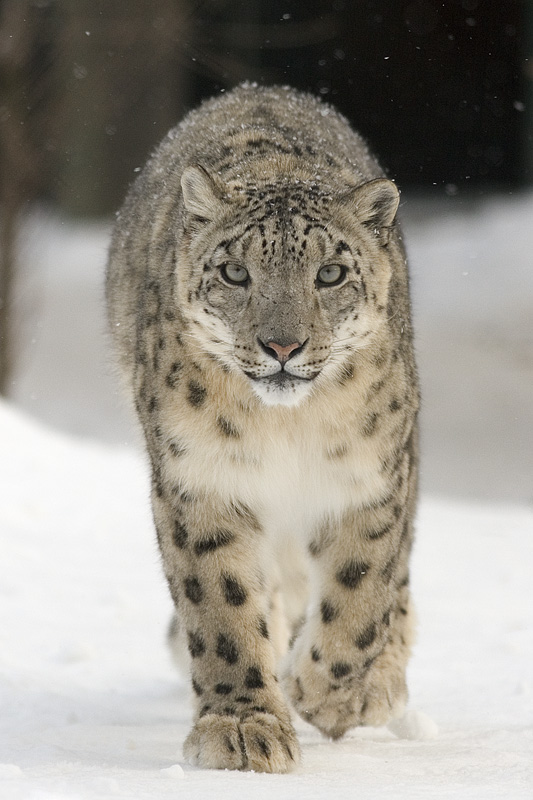
Snow Leopard

Snow Leopard

Panthera uncia

Bernard Landgraf, CC BY-SA 3.0, via Wikimedia Commons

Bobcat

Bobcat

Lynx rufus

Becker1999 (Paul and Cathy), CC BY 2.0, via Wikimedia Commons

How they differ

The snow leopard has thick whitish-to-grey fur with black spots and rosettes, while the bobcat has a tan-to-grayish-brown coat with black streaks and dark bars. The snow leopard has small, rounded ears, while the bobcat has pointed ears with black tips and short black tufts. The snow leopard is solitary and mostly active around dawn and twilight, while the bobcat is predominantly solitary and primarily active during twilight. The snow leopard is classified as Vulnerable on the IUCN Red List, while the bobcat has been classified as Least Concern since 2002.

Snow LeopardBobcat
AppearanceThe snow leopard has whitish-to-grey fur with black spots on its head and neck and larger rosettes on its back, flanks and bushy tail.The bobcat has a coat ranging from tan to grayish-brown with black streaks and dark bars.
EarsThe snow leopard has small, rounded ears.The bobcat has pointed ears with black tips and short black tufts.
UnderpartsThe snow leopard has a whitish underbelly.The bobcat generally has off-white lips, chin, and underparts.
Social behaviourThe snow leopard is solitary.The bobcat is predominantly solitary and territorial, although its home ranges can overlap.
ActivityThe snow leopard is mostly active around dawn and twilight.The bobcat is primarily active during twilight and is classified as crepuscular.
Conservation statusThe snow leopard is classified as Vulnerable on the IUCN Red List.The bobcat has been classified as Least Concern on the IUCN Red List since 2002.
DietThe snow leopard is a carnivore that actively hunts prey, predominantly larger-bodied wild hoofed mammals.The bobcat prefers rabbits and hares but also consumes insects, birds, rodents, and deer.
Prey weightThe snow leopard's preferred prey generally weighs between 36 and 76 kg.The bobcat primarily preys on mammals weighing approximately 0.7–6 kg.

Written from the checked facts listed further down. Statements that the sources did not support were removed.

Side by side

Snow LeopardBobcat
Scientific namePanthera uncia (Schreber, 1775)Lynx rufus (Schreber, 1777)
English nameSnow LeopardBobcat
GroupMammalsMammals
ClassMammalia MammalMammalia Mammal
OrderCarnivora CarnivoresCarnivora Carnivores
FamilyFelidae CatsFelidae Cats
GenusPanthera Roaring CatsLynx Lynxes
Named in17751777
Red List categoryVulnerableLeast Concern
EnvironmentNot recordedterrestrial
Countries on record10 countries4 countries
GBIF occurrence records399 records104,301 records

Rows where the two agree are shown in grey.

Where each is found

Only Snow Leopard (10)

Only Bobcat (4)

From Catalogue of Life checklists and GBIF occurrence records. A country missing from a list means no record is held, which is not proof of absence.

Checked facts

Snow LeopardBobcat
Appearance
  • The snow leopard has thick whitish-to-grey fur with black spots on its head and neck and larger rosettes on its back, flanks and bushy tail. English Wikipedia
  • The snow leopard has a short muzzle, domed forehead and large nasal cavities. English Wikipedia
  • The snow leopard has small, rounded ears, broad paws and a thick tail. English Wikipedia
  • The snow leopard has thick fur with individual hairs measuring 5–12 cm long. English Wikipedia
  • The snow leopard has a whitish underbelly. English Wikipedia
  • The snow leopard has long canine teeth measuring 28.6 mm. English Wikipedia
  • The snow leopard has short legs and a stocky body. English Wikipedia
  • The bobcat has distinctive black bars on its forelegs and a short, black-tipped tail. English Wikipedia
  • The bobcat's coat generally ranges from tan to grayish-brown and has black streaks and dark bars. English Wikipedia
  • The bobcat's spotted coat pattern provides camouflage. English Wikipedia
  • The bobcat has pointed ears with black tips and short black tufts. English Wikipedia
  • The bobcat generally has off-white lips, chin, and underparts. English Wikipedia
  • Bobcats from southwestern desert regions have lighter coats than those from northern forested regions. English Wikipedia
  • Bobcat kittens are born with fur and visible spots. English Wikipedia
Size
Habitat
  • The snow leopard inhabits alpine and subalpine zones, particularly at elevations of 3,000–4,500 m. English Wikipedia
  • The snow leopard prefers rocky, broken terrain. English Wikipedia
  • During summer, the snow leopard commonly occupies alpine meadows and rocky regions above the tree line at elevations of 2,700–6,000 m. English Wikipedia
  • During winter, the snow leopard descends to elevations of approximately 1,200–2,000 m. English Wikipedia
  • The snow leopard can move through snow up to 85 cm deep. English Wikipedia
  • Snow leopards occupy alpine habitats at elevations ranging from 900 to 4,500 m. pmc.ncbi.nlm.nih.gov
  • Bobcats inhabit deciduous, coniferous, and mixed woodlands but do not require deep forest environments. English Wikipedia
  • Bobcats occupy habitats ranging from Florida's humid swamps to Texas's deserts and rugged mountain environments. English Wikipedia
  • Bobcats can inhabit agricultural landscapes when rocky ledges, swamps, or forested areas are present. English Wikipedia
  • Bobcats occur in urban-edge environments where human development meets natural habitats. English Wikipedia
  • Bobcats occur in coniferous forests, deciduous forests, mixed forests, prairie, grasslands, chaparral, sagebrush scrubland, creosotebush scrubland, and mesquite scrub. research.fs.usda.gov
  • Bobcats commonly occupy landscapes containing a mosaic of different plant communities and vegetation succession stages. research.fs.usda.gov
  • In Minnesota, bobcats preferred areas containing black spruce, northern white-cedar, balsam fir, quaking aspen, and lowland shrubs. research.fs.usda.gov
  • Winter habitat for bobcats in Minnesota primarily consisted of thick northern white-cedar or black spruce swamps. research.fs.usda.gov
Diet
  • The snow leopard is a carnivore that actively hunts its prey. English Wikipedia
  • The snow leopard's preferred wild prey includes Himalayan blue sheep, Himalayan tahr, argali, markhor and wild goats. English Wikipedia
  • The snow leopard also hunts smaller mammals, including Himalayan marmots, pikas and voles. English Wikipedia
  • The snow leopard also preys on domestic livestock. English Wikipedia
  • The snow leopard consumes grass and twigs in addition to animal prey. English Wikipedia
  • The snow leopard's preferred prey generally weighs between 36 and 76 kg. English Wikipedia
  • In the Himalayas, the snow leopard commonly hunts Himalayan blue sheep, Siberian ibex, white-bellied musk deer and wild boar. English Wikipedia
  • The snow leopard's preferred prey species have an average weight of approximately 55 ± 5 kg. pmc.ncbi.nlm.nih.gov
  • The snow leopard's diet can include pikas, hares and game birds such as chukar partridges and snowcocks. pmc.ncbi.nlm.nih.gov
  • An individual snow leopard requires approximately 1.5 kg of meat per day. pmc.ncbi.nlm.nih.gov
  • Across its range, the snow leopard predominantly consumes larger-bodied wild hoofed mammals, with prey selection varying according to availability. dsc.duq.edu
  • Livestock accounts for between 0% and 33% of the snow leopard's dietary repertoire in the studied populations. dsc.duq.edu
  • Bobcats prefer rabbits and hares but also consume insects, birds, rodents, and deer. English Wikipedia
  • Bobcats primarily prey on mammals weighing approximately 0.7–6 kg. English Wikipedia
  • Eastern cottontails and New England cottontails are major prey species for bobcats in the eastern United States. English Wikipedia
  • Snowshoe hares are a major prey species for bobcats in northern regions. English Wikipedia
  • In a northwestern Montana winter-diet study, red squirrels and cricetid rodents accounted for more than 78% of bobcat dietary biomass. pmc.ncbi.nlm.nih.gov
  • Bobcats in northwestern Montana consumed snowshoe hares, deer, and grouse less frequently than red squirrels and cricetid rodents. pmc.ncbi.nlm.nih.gov
  • Bobcats across their northern range routinely consume multiple prey species. pmc.ncbi.nlm.nih.gov
  • Eastern bobcats appear to consume more lagomorphs than western bobcats. pmc.ncbi.nlm.nih.gov
  • Mammals are generally the most common prey category in the bobcat's diet. research.fs.usda.gov
  • Cottontail rabbits are considered the principal prey of bobcats across most of their range. research.fs.usda.gov
  • Eastern cottontails and cotton rats are important year-round food sources for bobcats in the southeastern United States. research.fs.usda.gov
Behaviour
  • The snow leopard is solitary and is mostly active around dawn and twilight. English Wikipedia
  • The snow leopard commonly rests near cliffs and ridges that provide vantage points and shade. English Wikipedia
  • The snow leopard uses its long, flexible tail to maintain balance in rocky terrain. English Wikipedia
  • The snow leopard can wrap its thick, fur-covered tail around its face for protection while sleeping. English Wikipedia
  • Bobcats are primarily active during twilight and are classified as crepuscular. English Wikipedia
  • Bobcats generally travel 3–11 km along habitual routes each night. English Wikipedia
  • Bobcats are predominantly solitary and territorial, although their home ranges can overlap. English Wikipedia
  • Bobcats mark territorial boundaries using claw marks and deposits of urine or feces. English Wikipedia
  • Bobcats are capable climbers and swim when necessary but normally avoid water. English Wikipedia
  • Bobcats generally exhibit crepuscular activity patterns. research.fs.usda.gov
ReproductionNo checked fact yet
Distribution
  • The snow leopard is native to the mountain ranges of Asia, extending from the eastern Hindu Kush and Himalayas to southern Siberia, Mongolia and western China. English Wikipedia
  • The bobcat is native to North America and ranges from southern Canada through most of the contiguous United States to Oaxaca, Mexico. English Wikipedia
  • The bobcat nearly disappeared from Iowa because of habitat loss and unregulated harvesting. iowadnr.gov
Conservation
  • The snow leopard is classified as Vulnerable on the IUCN Red List in document 1. English Wikipedia
  • The global population of mature snow leopards is estimated at fewer than 10,000 individuals. English Wikipedia
  • Poaching and habitat destruction are major threats to the snow leopard. English Wikipedia
  • The snow leopard is listed in Appendix I of CITES. English Wikipedia
  • Snow leopards are threatened by habitat loss, reduced prey availability, retaliatory killings and climate change. dsc.duq.edu
  • Reduced availability of wild prey can increase livestock predation and retaliatory killings of snow leopards. pmc.ncbi.nlm.nih.gov
  • Conservation of the snow leopard depends partly on maintaining populations of its preferred wild prey. pmc.ncbi.nlm.nih.gov
  • The bobcat has been classified as Least Concern on the IUCN Red List since 2002. English Wikipedia
Uses
  • The snow leopard is widely used in heraldry and as an emblem in Central Asia and parts of North India. English Wikipedia
No checked fact yet
OtherNo checked fact yet

In brief

Snow Leopard

The Snow Leopard inhabits alpine and subalpine zones in the mountain ranges of Asia. It has thick whitish-to-grey fur with black spots and rosettes, broad paws, short legs and a thick, bushy tail. Full profile

Bobcat

The Bobcat is native to North America and ranges from southern Canada through most of the contiguous United States to Oaxaca, Mexico. The Bobcat has distinctive black bars on its forelegs and a short, black-tipped tail. Full profile

Compare something else

Page built on 24 November 2026 from the data on the two species pages, where every source is listed.

Cite this page

ScientificNames.org. (2026). Snow Leopard vs Bobcat. Retrieved November 24, 2026, from https://scientificnames.org/compare/snow-leopard-vs-bobcat