Comparison

Sonora Chub vs Thicktail Chub

Sonora Chub (Gila ditaenia) and Thicktail Chub (Gila crassicauda) both belong to the genus Gila (western chubs) and part ways below it. Both are recorded in 1 country.

Sonora Chub

Sonora Chub

Gila ditaenia

(c) Rob Foster, some rights reserved (CC BY), CC BY 4.0, via Wikimedia Commons

Thicktail Chub

Thicktail Chub

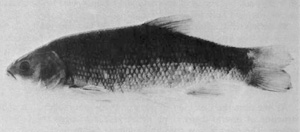
Gila crassicauda

California Department of Fish and Game, Public domain, via Wikimedia Commons

Side by side

Sonora ChubThicktail Chub
Scientific nameGila ditaenia Miller, 1945Gila crassicauda (Baird & Girard, 1854)
English nameSonora ChubThicktail Chub
GroupFishesFishes
ClassTeleostei TeleostTeleostei Teleost
OrderCypriniformesCypriniformes
FamilyCyprinidae CarpsCyprinidae Carps
GenusGila Western ChubsGila Western Chubs
Named in19451854
Red List categoryVulnerableExtinct
Environmentfreshwaterfreshwater
Countries on record2 countries1 country
GBIF occurrence records236 records55 records

Rows where the two agree are shown in grey.

Where each is found

Both recorded in 1 country

Only Sonora Chub (1)

From Catalogue of Life checklists and GBIF occurrence records. A country missing from a list means no record is held, which is not proof of absence.

Checked facts

Sonora ChubThicktail Chub
Appearance
  • The Sonora chub has a typically stout body, although some individuals have fusiform or cylindrical body shapes. English Wikipedia
  • The Sonora chub has 63 to 75 scales along its lateral line. English Wikipedia
  • Its dorsal, anal, and pelvic fins typically have eight fin rays, with variation between seven and nine. English Wikipedia
  • The Sonora chub is usually very dark, with two black stripes running parallel above and below its lateral line. English Wikipedia
  • Its underside is very light in color, forming a counter-shading pattern. English Wikipedia
  • During mating seasons, the paired and anal fins develop red markings and the belly develops orange areas. English Wikipedia
  • A round spot at the base of the tail is a distinguishing feature during mating seasons. English Wikipedia
  • The Sonora chub has strongly developed scale radii on all scale fields and a horizontal to oblique mouth. fieldguide.mt.gov
  • The thicktail chub had a heavy body, a thick tail, and a small, cone-shaped head. English Wikipedia
  • The thicktail chub's back ranged in color from greenish brown to purplish black. English Wikipedia
  • The thicktail chub had yellow sides and a yellow belly. English Wikipedia
Size
  • The Sonora chub rarely exceeds 200 millimeters in length. English Wikipedia
  • Most Sonora chubs recorded in the United States are no longer than 125 millimeters. English Wikipedia
Habitat
  • The Sonora chub is a stream-dwelling minnow. ecos.fws.gov
  • The Sonora chub concentrates in the deepest and largest pools because they provide more permanent and stable environments for juveniles. English Wikipedia
  • The species uses sandy pool bottoms to bury its eggs and protect them from predators. English Wikipedia
  • Drought can force Sonora chubs from deeper streams into shallower pools. English Wikipedia
  • California Gulch is a small intermittent or ephemeral tributary of Sycamore Canyon that joins it in Mexico. English Wikipedia
  • The thicktail chub inhabited lowlands and weedy backwaters of the Sacramento and San Joaquin Rivers in California's Central Valley. English Wikipedia
  • The thicktail chub inhabited lowland lakes, marshes, ponds, and slow-moving river stretches. English Wikipedia
  • During years of heavy runoff, the thicktail chub also inhabited surface waters of San Francisco Bay. English Wikipedia
Diet
  • The thicktail chub was probably carnivorous and fed on small fish and invertebrates. English Wikipedia
BehaviourNo checked fact yet
Reproduction
  • Sonora chub spawning usually occurs during the early spring. English Wikipedia
  • Sonora chub larvae and juveniles have been recorded in Sycamore Creek and the Rio Altar during November. English Wikipedia
  • The species' spawning is not restricted to spring. English Wikipedia
  • Male Sonora chubs commonly display strongly exaggerated coloration patterns. English Wikipedia
  • Breeding males develop bright red and orange fin patterns associated with mating success. English Wikipedia
  • The species' coloration patterns have been suggested to develop after spring and summer rains. English Wikipedia
No checked fact yet
Distribution
  • The Sonora chub occurs only in the Rio de la Concepcion drainage in the United States and Mexico. ecos.fws.gov
  • The Sonora chub is endemic to the Rio de la Concepcion basin. repository.arizona.edu
  • The Sonora chub was identified in California Gulch in 1995. English Wikipedia
  • The thicktail chub was native to the Central Valley of California, including the Sacramento and San Joaquin River systems. English Wikipedia
Conservation
  • The Sonora chub was placed on the endangered species list in 1988. English Wikipedia
  • Sycamore Creek and Penasco Creek habitats have been designated as critical areas where interference and fishing are prohibited. English Wikipedia
  • A 12-meter riparian boundary zone further restricts access to the species' streams. English Wikipedia
  • Mining, grazing, recreation, and introduced foreign taxa have contributed to habitat modification in Sycamore Creek. English Wikipedia
  • Non-native green sunfish are identified as a potential predator of the Sonora chub. English Wikipedia
  • Decreasing watershed conditions and increasing drought conditions are identified as additional threats to the species. English Wikipedia
  • A one-time search for Sonora chubs in California Gulch in 2022 did not locate any individuals. English Wikipedia
  • A section of border wall was built over the California Gulch bed between 2023 and 2024 and may obstruct upstream migration. English Wikipedia
  • The thicktail chub became extinct, with its last known specimen caught on April 16, 1957. English Wikipedia
  • Agricultural conversion of the Central Valley was identified as the primary cause of the thicktail chub's extinction. English Wikipedia
  • Drainage of sloughs and marshes, dam construction, and irrigation-related water diversion destroyed much of the thicktail chub's habitat. English Wikipedia
  • Competition from exotic species contributed to the extinction of the thicktail chub. English Wikipedia
UsesNo checked fact yet
  • The thicktail chub was a favored food of Indigenous peoples living around Clear Lake and in the Central Valley. English Wikipedia
  • The thicktail chub was commercially exploited by fishermen supplying the San Francisco market. English Wikipedia
  • The thicktail chub represented 40% of fish remains in Native American middens. English Wikipedia
Similar species
  • Gila ditaenia closely resembles Gila pandora but can be distinguished by its smaller lateral scales. fishbase.org
No checked fact yet

In brief

Sonora Chub

Gila ditaenia occurs in the Rio de la Concepcion drainage in the United States and Mexico. It is usually very dark, with two black stripes parallel to its lateral line and a very light underside. Full profile

Thicktail Chub

Gila crassicauda was native to the Central Valley of California, including the Sacramento and San Joaquin River systems. It had a heavy body, a thick tail, a small cone-shaped head, and yellow sides and belly. Full profile

Compare something else

Page built on 27 November 2026 from the data on the two species pages, where every source is listed.

Cite this page

ScientificNames.org. (2026). Sonora Chub vs Thicktail Chub. Retrieved November 27, 2026, from https://scientificnames.org/compare/sonora-chub-vs-thicktail-chub